Sourcing Exclusive Litigation Ready Inquiries: The 2026 Law Firm Growth Guide
Stop buying shared leads. Learn how to source exclusive litigation ready inquiries with AI-driven data to build a predictable pipeline of high-value MVA cases.
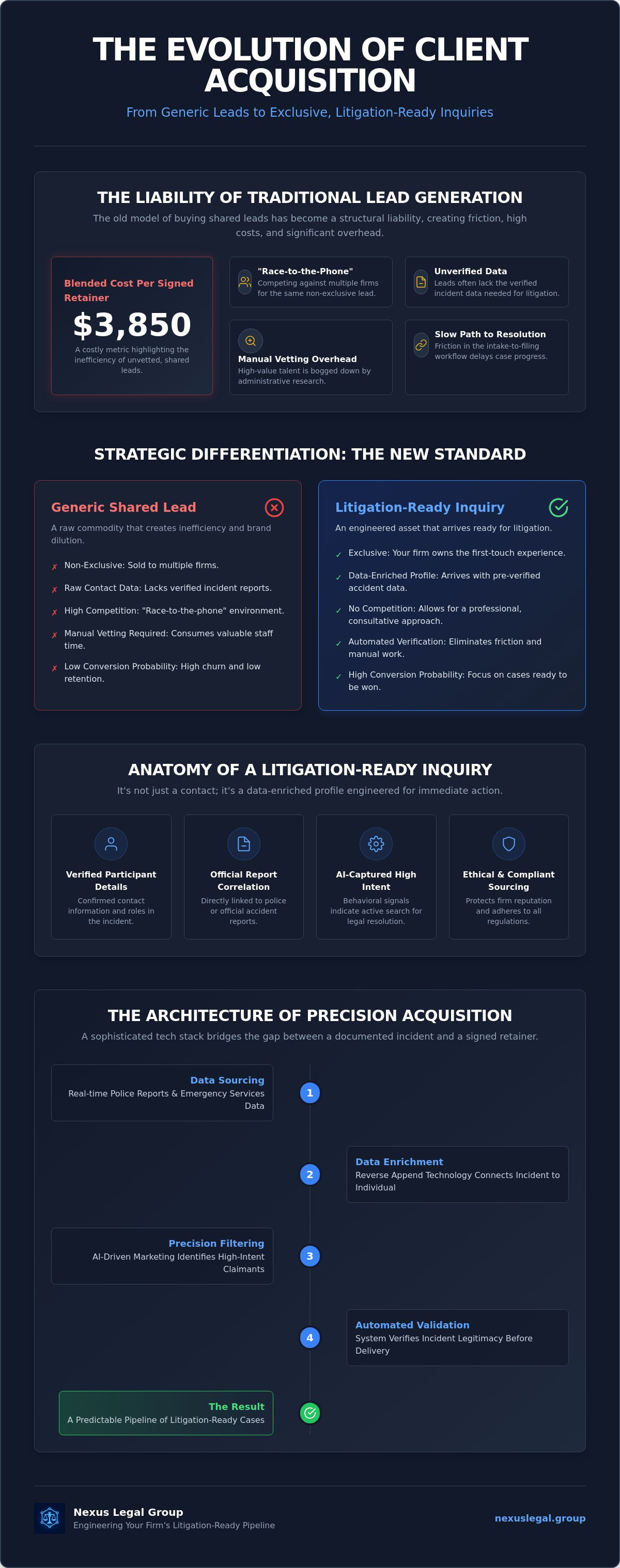
With the blended cost per signed retainer for mass torts reaching $3,850 in early 2026, the traditional model of buying shared leads has become a structural liability for growing firms. You've likely experienced the frustration of the "race-to-the-phone" against multiple competitors, only to find that the lead lacks the verified accident data necessary to move toward litigation. This manual vetting process creates significant overhead and slows your path to resolution. It's time to shift from reactive intake to a system of precision acquisition.
This guide explores how elite plaintiff firms leverage AI-driven data and automated verification to secure exclusive litigation ready inquiries that eliminate friction from the start. You'll discover how to integrate reverse-append technology and police-report-generated leads into your workflow to build a predictable pipeline of high-intent MVA and mass tort cases. We'll outline the exact mechanics of using automated verification to ensure every inquiry is backed by verified reports, allowing your team to focus on winning cases rather than chasing data.
Key Takeaways
- Learn how to distinguish between a standard lead and a litigation-ready inquiry to optimize your firm's intake resources and reduce manual vetting.
- Discover how to leverage police reports and reverse append technology to acquire exclusive litigation ready inquiries that arrive with pre-verified accident data.
- Analyze why measuring cost-per-signed-case is a more accurate growth metric than initial purchase price for evaluating long-term acquisition channels.
- Build a scalable growth infrastructure that utilizes automated verification to reduce friction between initial contact and a signed retainer.
- Implement AI-driven precision to maintain a predictable pipeline of high-intent MVA and mass tort cases that are ready for immediate litigation.
Defining Exclusive Litigation-Ready Inquiries in 2026
The legal market in 2026 has reached a saturation point where traditional lead generation is no longer a viable growth strategy for elite firms. The distinction between a generic lead and an inquiry prepared for litigation is a matter of structural efficiency. While most providers sell raw contact data, exclusive litigation ready inquiries are engineered assets that arrive with pre-verified accident reports and documented intent. This shift from volume to quality is driven by rising acquisition costs and the necessity of eliminating friction in the intake-to-filing workflow.
Firms that continue to rely on bulk data often find their high-value legal talent bogged down by administrative research. High-intent data reduces the timeline from initial contact to filing by providing the necessary evidence at the point of entry. In a landscape where 70% of searches result in zero clicks, the ability to bypass the noise and secure a claimant with a documented incident is a significant competitive advantage.
The Anatomy of a Litigation-Ready Inquiry
A litigation-ready inquiry isn't just a phone number; it's a data-enriched profile. To meet this standard, an inquiry must include verified participant details that correlate directly with official accident reports. AI-driven marketing systems now capture high-intent behavioral signals, ensuring the claimant isn't just browsing but is actively seeking legal resolution. This precision ensures that your intake team spends their time on cases that have a high probability of conversion.
Ethical sourcing serves as the foundation for these systems. Modern acquisition must remain sensitive to the common law concept of barratry, ensuring all outreach is compliant and non-intrusive. By utilizing police report data and emergency services signals, firms can identify claimants who have a legitimate, documented need for representation without crossing ethical boundaries. This creates a more professional atmosphere for the claimant and protects the firm's standing.
Why Exclusivity Dictates Conversion Rates
Exclusivity is the primary variable in the conversion equation. Non-exclusive leads force your intake team into a "race-to-the-phone" scenario that devalues your firm's brand and frustrates potential clients. When multiple firms call the same person within minutes, the interaction becomes a commodity transaction rather than a professional consultation. This high-pressure environment leads to lower retention rates and higher churn.
Securing exclusive litigation ready inquiries allows your firm to own the first-touch experience. This control is essential for protecting your reputation and ensuring a seamless transition into the litigation pipeline. A dedicated, non-shared pipeline provides the stability needed for predictable scaling. You can't build a high-performance growth infrastructure on shared resources that might be diverted to a competitor at any moment. Elite firms treat acquisition as a foundational layer of their organization, prioritizing systemic integrity over cheap, high-volume data sets.
The Architecture of High-Intent Acquisition: Data and AI
The acquisition of exclusive litigation ready inquiries requires a sophisticated technological stack that bridges the gap between a roadside incident and a signed retainer. Elite firms no longer rely on broad-match keywords or generic lead forms. Instead, they utilize a system built on real-time police reports and emergency services data. This architectural approach identifies potential claimants at the moment of peak intent, ensuring that the firm's outreach is both timely and relevant. AI-driven marketing doesn't just cast a wide net; it deploys resources with surgical precision to identify those who've already experienced a documented incident.
Precision in 2026 is governed by the ability to filter noise. As state-level regulation of legal marketing becomes more stringent, firms must prioritize transparency and compliance. Automated verification systems serve as the first line of defense, validating the legitimacy of an incident before it ever reaches your intake team. This removes the frantic pressure of traditional lead chasing and allows for a methodical, professional approach to case acquisition. It's a shift from chasing prospects to managing a verified pipeline.
Reverse Append and Accident Report Enrichment
Reverse append technology is the bridge between incident data and actionable legal inquiries. It functions by taking a single data point, such as a phone number or a license plate, and cross-referencing it against expansive databases to build a comprehensive profile. This process transforms basic contact info into a detailed accident profile that includes insurance information and participant details. By securing this data early, firms eliminate hours of manual research and can immediately assess the viability of a Motor Vehicle Accident (MVA) case. This enrichment ensures that when your intake team makes the first call, they're already equipped with the facts of the case.
In cases where liability depends on complex road conditions, this data is often supplemented by technical analysis from experts like ML Traffic Engineers Australia, who provide the transport planning and traffic engineering insights necessary to build a robust litigation strategy.
Automated Intake and Verification Systems
The integration of AI-driven verification systems is what distinguishes high-performance growth infrastructure from standard marketing. These systems analyze behavioral signals to filter for high-intent claimants, significantly reducing administrative overhead. When an inquiry is automatically vetted for specific criteria, such as injury severity or liability clarity, it accelerates the conversion process. If you're looking to engineer a more efficient pipeline, focus on systems that push verified inquiries directly into your case management software without manual intervention. This automation provides several key advantages:
- Reduction in Friction: Eliminates the need for repetitive questioning during the initial intake call.
- Data Integrity: Ensures that every case in the pipeline is backed by documented accident reports.
- Scalability: Allows the firm to handle a higher volume of inquiries without increasing headcount.
By shifting the burden of verification to the acquisition stage, firms can focus their resources on litigation and client advocacy. This systemic approach doesn't just generate leads; it builds a foundation for sustainable growth by ensuring every entry point is qualified for the courtroom.
Strategic Differentiation: Generic Leads vs. Litigation-Ready Inquiries
Purchasing raw data at a lower price point often masks the true cost of acquisition. For many firms, the allure of a $100 lead is quickly extinguished by the reality of a low conversion rate. When you calculate the labor hours required to vet incomplete data, the "cheap" lead becomes an expensive liability. Exclusive litigation ready inquiries represent a shift in focus from front-end cost to back-end efficiency. By securing inquiries that are already qualified for the courtroom, you're not just buying contact information; you're investing in a streamlined path to a signed retainer—a strategy that aligns with the pipeline acceleration methods used by B2B specialists like Virtual Sales Limited.
Elite legal talent is a firm's most valuable asset. When high-level attorneys or senior intake specialists spend their time chasing unverified leads, it creates a hidden drain on operational capacity. This friction slows down the entire litigation pipeline. Moving to a model based on verified, high-intent inquiries allows your team to focus on case strategy rather than data entry. It's about protecting your margins by ensuring that every minute spent on intake has a high probability of resulting in a viable case.
ROI Metrics for Modern Plaintiff Firms
The transition from measuring Cost Per Lead (CPL) to Cost Per Signed Case is essential for sustainable growth. In the competitive 2026 market, shared leads can cost a firm between $3,000 and $6,000 per signed case due to the low conversion rates inherent in "race-to-the-phone" scenarios. Conversely, exclusive inquiries typically result in a cost-per-signed-case between $1,500 and $2,500. This $3,500 difference in acquisition cost demonstrates why exclusivity is a non-negotiable standard for high-margin operations.
- Data Enrichment: Inquiries backed by police reports and emergency services data have a higher trial success rate because the foundational evidence is secured at the point of entry.
- Conversion Velocity: High-intent behavioral signals captured via AI-driven marketing reduce the time from first contact to a signed retainer.
- Margin Protection: Reducing the administrative overhead of manual vetting directly increases the net value of every case in your pipeline.
Identifying Red Flags in Legal Lead Generation
Distinguishing between a strategic partner and a data broker requires a clinical eye for quality. One of the most significant red flags is a lack of verifiable incident data. If an inquiry doesn't correlate with a specific accident report or emergency services signal, it's likely a low-intent lead that will require extensive follow-up research. Shared leads are another major risk; they erode claimant trust and often result in a poor first-touch experience that damages your firm's reputation.
Compliance is the final pillar of quality. Sourcing methods that don't prioritize ethical standards create future liability for your firm. You should always verify that your exclusive litigation ready inquiries are obtained through transparent, compliant channels. Avoid providers who can't explain their data enrichment process or those who rely on deceptive marketing tactics. A reliable acquisition framework should function as a foundational layer for your organization, providing a predictable flow of cases without compromising your professional integrity.
Integrating Litigation-Ready Flow into Your Firm’s Growth Infrastructure
Establishing a scalable acquisition framework requires a shift in perspective. You shouldn't view case acquisition as a peripheral marketing activity, but as a foundational layer of your organization. When exclusive litigation ready inquiries are treated as growth infrastructure, they provide the structural stability needed to scale without increasing operational friction. This systemic approach ensures that every inquiry is not just a data point, but a verified asset that fits into a pre-defined litigation strategy. By aligning your acquisition flow with your firm's specific capacity and trial goals, you create a predictable engine for expansion.
The Growth Infrastructure Model
A robust law firm growth infrastructure eliminates the silos between marketing, intake, and litigation. Systemic integrity is maintained when the data enrichment process begins before the inquiry ever reaches your team. This means that the insurance details, participant identities, and accident report correlations are already mapped. This level of preparation allows your firm to function as a high-performance machine, moving cases through the pipeline with clinical precision. It's about building a system where the growth is a logical result of the infrastructure's design rather than a byproduct of aggressive, uncoordinated outreach.
Training Intake Teams for Data-Enriched Inquiries
The arrival of data-enriched inquiries changes the fundamental nature of the initial claimant call. Your intake team must shift from a "discovery" mindset to a "confirmation" mindset. Instead of asking open-ended questions to find out what happened, they should use the enriched accident reports to confirm the facts you already have. This high-authority communication builds immediate credibility with the claimant. When your team can say, "We have the report from the incident on Main Street involving the commercial vehicle," it signals a level of competence that generic intake processes can't match.
Utilizing automated intake for plaintiff firms allows you to maintain this precision at scale. By reducing the time spent on manual data entry, your specialists can focus on the human element of the transition, which significantly reduces the time-to-sign. This informed approach ensures that the claimant feels secure and the firm secures the retainer faster. If you are ready to modernize your acquisition workflow, you can partner with a strategic architect to engineer a pipeline that delivers exclusive litigation ready inquiries directly into your existing case management software. This integration ensures that your marketing spend is always aligned with your firm's operational reality.
Nexus Legal Group: Engineering Your Firm's Litigation-Ready Pipeline
Nexus Legal Group operates as the strategic architect for firms seeking to transcend the limitations of traditional lead generation. By focusing on the mechanics of systemic integrity, we provide a foundational layer that allows elite plaintiff practices to scale with confidence. Our process is designed to deliver exclusive litigation ready inquiries that arrive with the data enrichment necessary for immediate case assessment. This eliminates the uncertainty inherent in raw data and replaces it with a predictable, high-performance pipeline. We position ourselves as a powerful engine that drives your expansion from behind the scenes, ensuring your team remains focused on high-level litigation.
End-to-End Growth Solutions
Achieving 2026 scalability requires more than just high volume; it requires a commitment to data-driven standards. Nexus provides the verified MVA leads for law firms that serve as the building blocks for successful litigation. By utilizing police report generated MVA leads, we ensure that every inquiry is anchored in official documentation and real-world incident data. This enrichment process provides exclusive access to signed cases and high-intent inquiries that are ready for the courtroom from the first touchpoint. Our end-to-end solutions move beyond simple contact info, providing insurance details and participant correlations that reduce the administrative burden on your senior staff.
The Strategic Architect of Legal Expansion
Elite firms partner with Nexus to eliminate the operational friction that typically accompanies aggressive expansion. Our customizable frameworks for MVA and mass tort case acquisition are engineered to align with your specific litigation goals and resource capacity. We combine AI-driven marketing precision with rigorous automated verification to ensure that every inquiry meets your firm's ethical and clinical standards. This approach positions your firm as an elite practitioner, focused on high-margin outcomes rather than manual data entry. We don't just provide leads; we engineer the systems that allow your firm to dominate its market through technical superiority and reliable case flow.
The transition to a data-backed acquisition model is the defining characteristic of successful firms in 2026. Engineered for Growth: Secure Your Exclusive Inquiry Pipeline with Nexus Legal Group. By integrating these exclusive litigation ready inquiries into your growth infrastructure, you create a sustainable advantage that competitors using shared, unverified leads cannot match. Our commitment to systemic integrity and technical mastery ensures your firm remains focused on its primary objective: achieving superior results for your clients through efficient, high-intent case acquisition.
Engineering Your Firm's Future with Data-Driven Precision
The transition from reactive lead chasing to a proactive acquisition strategy is the hallmark of elite plaintiff practices in 2026. By moving beyond generic data and securing exclusive litigation ready inquiries, your firm can significantly reduce the intake-to-litigation timeline. This shift allows your high-level talent to focus on trial strategy rather than administrative research, turning your intake department into a streamlined gateway for high-intent cases.
Sustainable growth is achieved through the integration of AI-driven precision and reverse append data enrichment. These technologies ensure that every case in your pipeline is backed by verified accident reports and documented behavioral signals. When you combine these tools with rigorous ethical and compliant standards, you create a foundational layer for your organization that's both scalable and reliable. It's about building a system that functions with clinical precision from the first touchpoint to the final resolution.
It's time to stop competing for shared leads and start owning your market. Secure Your Exclusive Litigation-Ready Inquiry Pipeline and transform your acquisition mechanics into a high-performance engine. You're now equipped to lead your firm toward a more efficient and profitable future.
Frequently Asked Questions
What exactly defines an inquiry as 'litigation-ready'?
A litigation-ready inquiry is defined by the presence of verified incident data, including police reports and confirmed participant details. Unlike a generic lead, exclusive litigation ready inquiries arrive with the evidentiary foundation required to move directly into the litigation pipeline. You can reduce the time your intake team spends on discovery, ensuring that every contact has a high probability of conversion into a signed case.
How does Nexus Legal Group ensure the exclusivity of its inquiries?
Nexus Legal Group maintains exclusivity by utilizing a proprietary acquisition framework that delivers inquiries to a single firm in real-time. You don't have to participate in the shared lead generation model that forces a race to the phone. Every inquiry is routed through a dedicated pipeline, ensuring your firm owns the first-touch experience. This systemic integrity prevents the erosion of conversion rates caused by multiple firms.
Are these inquiries compliant with current ethical legal marketing standards?
Yes, all acquisition methods follow rigorous ethical and compliant standards to protect your firm's professional standing. In addition to ethical sourcing, maintaining a clean digital footprint is essential, which is why many firms utilize Content Removal to manage their online presence and address harmful content. You'll find that we utilize transparent sourcing channels, such as emergency services and police report data, to identify claimants with documented needs. This approach avoids deceptive marketing tactics and ensures all outreach is legally sound. Our systems are built to adapt to evolving state-level regulations, providing a secure foundation for growth.
How does reverse append technology improve MVA case acquisition?
Reverse append technology functions as the bridge between raw contact data and actionable case profiles. By taking a single identifier, like a phone number, the system cross-references databases to obtain accident reports and participant details. You should use this enrichment to verify insurance coverage and liability before the first call is made. It's a critical tool for eliminating manual research and accelerating your firm's intake-to-litigation workflow.
Can these litigation-ready inquiries be integrated into my firm's existing CRM?
Yes, our systems are designed to integrate seamlessly with standard law firm case management software and CRMs. You can maintain clinical precision by pushing exclusive litigation ready inquiries directly into your existing workflow via API or secure data transfer. This automation ensures your intake team receives verified, data-enriched profiles in real-time. This connectivity allows for immediate follow-up and maintains the systemic integrity of your firm's pipeline.
What is the typical conversion rate for high-intent, data-enriched inquiries?
High-intent, data-enriched inquiries typically convert at a significantly higher rate than generic leads because the foundational vetting is completed prior to delivery. You should measure your success by the lower overall cost per signed case compared to shared models. By removing low-intent noise and focusing on claimants with documented incidents, your team can achieve a more predictable and efficient intake-to-retainer ratio for the firm.
Does Nexus Legal Group provide signed cases as well as inquiries?
Yes, Nexus Legal Group provides both high-intent inquiries and ethical, compliant signed cases to meet your firm's specific capacity. You can use our signed case acquisition model to bypass the intake stage entirely for a portion of your caseload. These cases utilize the same rigorous automated verification and data enrichment processes used for our inquiry pipeline. We act as the strategic architect of your expansion.
How does AI-driven marketing differ from traditional PPC for law firms?
AI-driven marketing differs from traditional PPC by focusing on behavioral signals and real-time incident data rather than broad-match keywords. You'll notice traditional PPC often results in high-volume, low-intent traffic that requires extensive manual vetting. In contrast, AI-driven precision identifies potential claimants at the moment of peak intent based on documented events. This results in a higher quality of inquiry and reduces wasted spend from generic terms.