Scalable Legal Lead Acquisition: Engineering Growth Infrastructure for Elite Plaintiff Firms
Ready for scalable MVA case acquisition? Ditch lead mills and engineer a growth infrastructure that delivers verified, litigation-ready cases automatically.
Most plaintiff firms treat growth as a marketing challenge, yet for elite organizations, it's actually a mechanical infrastructure problem. You've likely hit a plateau where buying more leads simply creates more noise, forcing your intake team to sift through unverified data while overhead costs climb. If you're ready to move beyond the volatility of traditional lead mills, you need a system for scalable MVA case acquisition that prioritizes precision over volume. With 6.14 million police-reported crashes occurring annually according to the NHTSA, the opportunity is vast, but capturing it requires a shift from manual guesswork to automated, data-driven systems.
It's clear that the current model of processing unverified leads is unsustainable for firms aiming for national expansion. You need a way to scale without adding a dozen intake specialists for every new market. This guide provides the blueprint for engineering a growth infrastructure that delivers a predictable flow of litigation-ready cases. We'll walk through the technical framework of using reverse-append technology and automated verification to ensure every inquiry is verified, compliant, and ready for your attorneys. By the end of this article, you'll understand how to transform your acquisition process into a high-performance engine that scales without increasing operational friction.
Key Takeaways
- Shift from traditional lead generation to a growth infrastructure model to ensure operational efficiency remains intact as your case volume increases.
- Prioritize incident-driven data over broad behavioral targeting to capture high-intent inquiries from sources like police and emergency services reports.
- Understand the mechanics of scalable MVA case acquisition by analyzing the total cost of acquisition, including the hidden labor costs of manual intake.
- Implement AI-driven verification and automated intake systems to eliminate unqualified inquiries without exhausting your firm's internal resources.
Beyond Lead Volume: Defining Scalable Legal Case Acquisition
For elite plaintiff firms, the objective isn't merely to increase the number of inquiries hitting the intake desk. True scalable MVA case acquisition represents the capacity to expand case volume while maintaining a stable return on investment and high operational efficiency. Most firms confuse growth with scalability. Growth is simply the act of getting bigger, which often leads to increased friction and administrative bloat. Scalability, however, is the ability to handle that increased volume without a linear increase in overhead. It's the difference between a firm that struggles under the weight of its own success and one that operates as a high-performance engine.
While many firms rely on basic lead generation to fill their pipelines, institutional-grade organizations require a comprehensive growth infrastructure. Traditional lead buying is often volatile, delivering unverified data that forces intake teams into a cycle of manual filtering. To reach institutional scale, firms must transition away from founder-led acquisition strategies where a partner's personal network or individual oversight dictates volume. Instead, they must focus on litigation-ready inquiries. These are data points that have been verified, enriched, and are ready for immediate conversion into signed cases.
The Bottleneck Problem in Plaintiff Practices
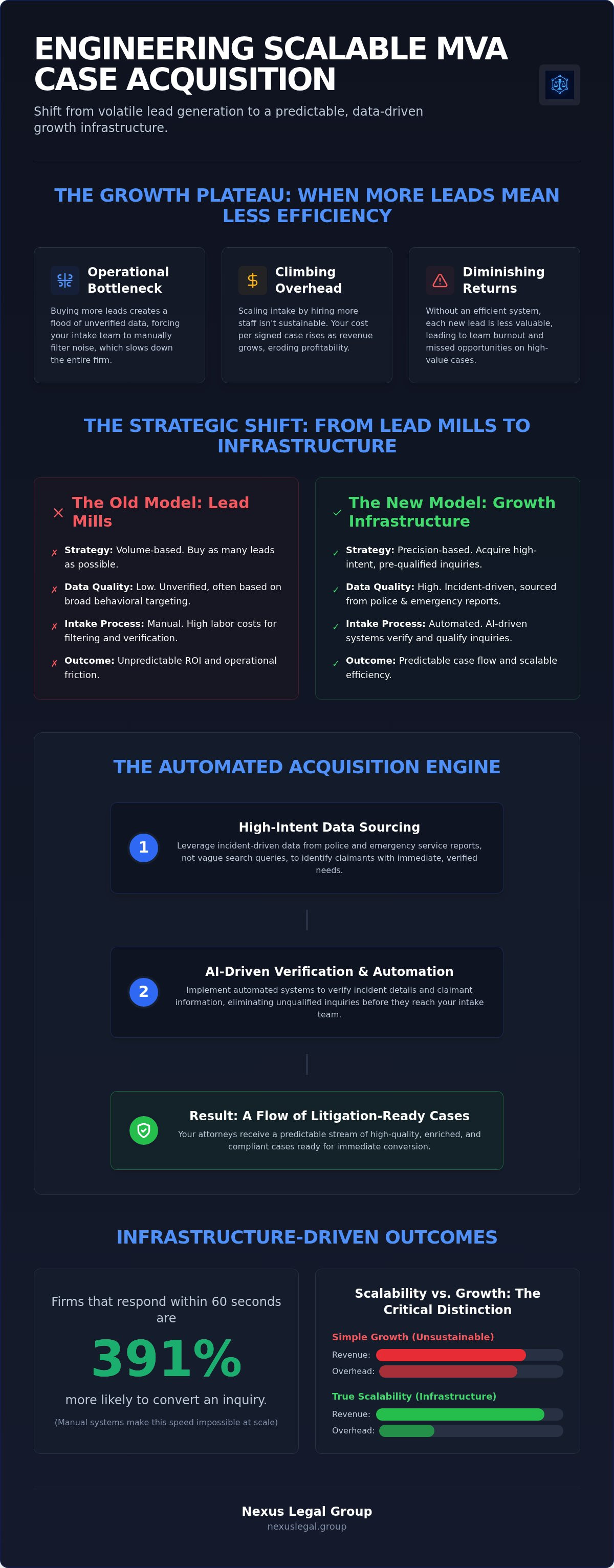
The primary constraint to firm expansion is rarely a lack of leads; it's the friction of manual intake. When a firm attempts to scale by simply purchasing more volume from traditional lead mills, they often encounter diminishing returns. Without automated systems, an increase in lead volume leads to a backlog of unverified data. This creates a bottleneck that slows response times and increases the cost per signed case. Law firms that respond to inquiries within 60 seconds are 391% more likely to convert the lead, yet manual systems make this speed nearly impossible to maintain at scale.
Scalability vs. Growth: The Infrastructure Distinction
Growth without scalability is a recipe for operational collapse. If your firm’s overhead increases at the same rate as your revenue, you aren't building a more valuable business; you're simply managing a larger, more complex one. This is where law firm growth infrastructure becomes essential. It provides the foundational layer that stabilizes revenue by automating the qualification process. In high-stakes sectors like MVA and Mass Torts, precision data is the only way to maintain compliance and profitability. By shifting the focus from raw volume to a mechanical, data-driven acquisition model, firms can achieve predictable expansion without the typical friction of manual operations, allowing partners to explore leadership roles within an organization like Network In Action.
The Mechanics of High-Intent Data: Sourcing Litigation-Ready Inquiries
Elite firms recognize that scalable MVA case acquisition isn't about casting a wider net; it's about building a more precise filter. Traditional methods often rely on broad behavioral targeting, capturing individuals who might be browsing for general information rather than those with an immediate, verified need. By shifting to incident-driven data acquisition, firms can bypass the noise of the general market. AI-driven marketing systems now identify high-intent claimants by analyzing real-time data signals that occur immediately following a collision. This approach operates within the established legal framework for lawyer advertising, ensuring that acquisition efforts remain compliant while targeting the highest possible case quality.
The transition from "lead buyer" to "system architect" requires a focus on the primary unit of growth: the litigation-ready inquiry. While many firms first establish their online authority using Tools N Tactics | Local SEO & Digital Marketing Solutions to capture general search interest, scaling to an institutional level requires enriched data sets that provide a clear picture of an incident before the first phone call is even placed. When you source data based on actual events rather than vague search queries, you eliminate the guesswork that often plagues high-volume practices.
Leveraging Police Reports and Emergency Services Data
The most reliable validation of a high-value claim comes from official documentation. Integrating police report generated MVA leads into your workflow transforms the acquisition process from speculative to clinical. Sourcing real-time incident data from emergency services allows firms to reduce time-to-contact, which is a critical factor in securing retainers. Unlike generic search intent, which can be ambiguous or outdated, incident-based data confirms the legitimacy of the event. This precision ensures your intake team focuses exclusively on verified accidents, maximizing their efficiency and your firm's overhead utilization.
This methodology of leveraging real-time intelligence is also transforming how agencies identify high-intent opportunities in other service sectors; for those interested in restoration or HVAC markets, you can learn more about LeadOpsIQ's specialized lead intelligence.
Reverse Append Technology and Data Enrichment
Once an incident is identified, the next step is technical enrichment. Reverse append technology allows firms to take a single data point, such as a contact name or incident location, and match it against official accident records. This process creates a comprehensive file that includes vehicle impact points, insurance carrier information, and accident details. This level of data driven case acquisition significantly reduces internal vetting time. Your attorneys spend less time verifying basic facts and more time building the case. If you're looking to upgrade your firm's foundational systems, exploring a sophisticated acquisition infrastructure is the logical next step to ensure you're only pursuing high-intent, exclusive inquiries.
Lead Mills vs. Growth Infrastructure: A Strategic Comparison
Choosing between a traditional lead mill and a comprehensive growth infrastructure is a choice between purchasing a commodity and investing in a system. Lead mills operate on a volume-first model, often selling the same inquiry to multiple firms. This creates a "race to the bottom" where the first firm to call wins, regardless of case quality. In contrast, scalable MVA case acquisition relies on a mechanical, proprietary infrastructure that delivers exclusive, verified inquiries. This distinction is critical for elite firms that value predictable margins over raw volume. When you treat acquisition as a foundational layer of your firm, you move from a reactive posture to a strategic one.
Analyzing the total cost of acquisition (TCOA) reveals the true inefficiency of the lead mill model. While the upfront price of a shared lead may appear lower, the secondary costs are significant. You must account for the intake labor required to filter through unverified data and the wasted partner hours spent reviewing low-intent inquiries. A mechanical acquisition strategy mitigates these risks by delivering litigation-ready files that require minimal internal vetting. This approach positions acquisition as a risk management tool, protecting the firm from the volatility of unverified sources.
The Hidden Costs of Unverified Lead Generation
Processing unverified inquiries imposes a "friction tax" on your entire organization. When your intake team spends the majority of their day chasing ghost leads or non-responsive claimants, their morale and efficiency erode. High-performing staff members want to work on high-value cases, not administrative filtering. There's also a massive opportunity cost involved. While your team is busy processing low-intent data, high-value claimants in a competitive national market are likely signing with firms that utilize more responsive, data-driven systems.
Precision Acquisition for Elite Plaintiff Firms
In the 2026 legal market, the standard for a "litigation-ready" inquiry has shifted toward complete data enrichment. This includes verified incident reports and insurance details provided before the intake call. Brand protection is also a major factor. Utilizing compliant legal lead generation is no longer optional. With evolving national regulatory frameworks imposing fines from $5,000 to $100,000 for non-compliant ads and TCPA penalties ranging from $500 to $1,500 per incident, the cost of non-compliance is catastrophic for firms like Nexus Legal Group. Exclusive inquiries ensure you aren't competing on speed alone, allowing your firm to maintain its professional standards while scaling case volume.
Engineering an Automated Intake and Verification System
Building a foundation for scalable MVA case acquisition requires more than just a marketing budget; it demands a technical architecture that removes human error from the initial vetting phase. Traditional firms often rely on live intake representatives to screen callers, a model that is inherently difficult to scale and prone to inconsistency. By integrating specialized digital agents from Global AI Reps, firms can replace these manual touchpoints with an automated intake system designed for institutional-grade scale. This system acts as a mechanical filter, employing AI-driven verification to process inquiries in real-time. By the time a claimant is presented to your legal team, the engine has already validated the incident legitimacy, cross-referenced the data against police reports, and confirmed insurance coverage.
The integration of this data into your firm's existing CMS or CRM is the final step in creating a frictionless growth engine. Instead of manual data entry, acquisition data flows directly into your workflow, pre-populated with the enriched details sourced during the discovery phase. This seamless handoff is critical in high-stakes MVA cases where the speed of engagement often dictates the likelihood of a signed retainer.
Eliminating Manual Friction in Lead Vetting
Manual vetting is a primary cause of operational friction. By implementing logic-based qualifying questions, firms can ensure that only high-intent inquiries reach their staff. These verified MVA leads for law firms arrive with a complete profile, including vehicle impact details and injury status. This level of automation enables 24/7 scalability, allowing your firm to capture and qualify claimants even during off-hours or weekends without increasing headcount. It transforms the intake desk from a filtering station into a closing station.
Ethical Compliance and Data Integrity Standards
Scaling an acquisition infrastructure requires a rigorous commitment to data integrity and regulatory compliance. Automated systems provide a level of oversight that manual processes cannot match. Every claimant interaction is logged, creating a comprehensive audit trail that documents TCPA consent and ethical bar compliance. This systemized approach is essential for firms operating at a national scale, where the regulatory environment varies by jurisdiction. The reverse append process must adhere to strict data security standards, ensuring that sensitive incident information is handled with clinical precision and encrypted at every stage of the enrichment cycle.
Nexus Legal Group: Institutional-Grade Case Acquisition Infrastructure
Nexus Legal Group doesn't just provide leads; it engineers the foundational layer for firm expansion. For elite practices, the transition to scalable MVA case acquisition requires moving away from the volatility of individual vendors and toward an institutional-grade infrastructure. Our model is built on the principle that acquisition should be a predictable, mechanical process rather than a speculative marketing exercise. By serving as the strategic architect for national plaintiff firms, Nexus provides the technical framework necessary to secure high-intent, litigation-ready inquiries at scale. We position ourselves as a foundational layer for your organization, ensuring your growth is limited only by your desire to expand.
The Nexus system is designed to handle the complexities of both MVA and Mass Tort litigation with clinical precision. This isn't a surface-level service. It's an end-to-end infrastructure that manages everything from the initial data discovery to the delivery of signed cases. Because our data is sourced directly from incident-level events like police and emergency services reports, the inquiries we provide are exclusive to your firm. This exclusivity eliminates the "race to the bottom" and allows your attorneys to focus on high-stakes litigation with the confidence that their pipeline is secure, compliant, and verified.
End-to-End Growth Architecture for Elite Firms
The core of our offering is AI driven legal case acquisition. This platform integrates multiple technical layers to ensure clinical precision. It combines real-time police report data with reverse append technology to enrich every inquiry with the specific accident details required for a litigation-ready file. For firms targeting large-scale Mass Tort litigation, this framework offers unparalleled scalability. It allows you to enter new markets or litigation types with a pre-built engine that automates the verification and qualification process, ensuring your ROI remains stable as your volume grows. Our national scope ensures that your firm can scale across jurisdictions without the typical operational friction associated with geographic expansion. To complement this infrastructure with AI-powered search and performance marketing, visit RANE Digital.
Transitioning from Lead Buying to Case Acquisition
If your firm is looking to upgrade its growth infrastructure in 2026, the first step is auditing your current acquisition friction. Most firms find that their growth is capped by the labor-intensive process of vetting unverified data. Transitioning to the Nexus model allows you to replace these bottlenecks with a permanent growth engine. We provide the technical mastery and operational excellence required to stabilize your revenue and protect your brand. This isn't just about getting more cases; it's about installing a sophisticated system that drives expansion from behind the scenes. You aren't just buying a lead; you're installing a high-performance engine designed for long-term dominance.
Architecting the Next Phase of Firm Expansion
Transitioning from a reactive lead-buying model to a mechanical growth infrastructure is the only sustainable path to scalable MVA case acquisition. By integrating police report data and reverse append technology, you eliminate the friction of unverified inquiries and secure exclusive, litigation-ready files. This shift allows your team to focus on high-value litigation rather than administrative filtering. You're no longer just buying a commodity; you're installing a permanent engine designed for national scale.
Success in the 2026 legal market requires a clinical approach to data and a rigorous commitment to ethical compliance. AI-verified systems provide the audit trails and precision necessary to protect your brand while maximizing your firm's operational efficiency. It's time to move beyond the volatility of traditional lead mills and establish a foundational layer that delivers predictable, high-intent cases. You've mastered the law; now it's time to master the mechanics of institutional growth—a philosophy of professional excellence embraced by firms like Massingill Attorneys & Counselors at Law in the business and estate planning fields.
Your firm is ready for its next major evolution. Building a sophisticated, data-driven system today ensures your dominance in the competitive landscape of tomorrow.
Frequently Asked Questions
What is the difference between scalable acquisition and traditional lead generation?
Scalable acquisition is a mechanical infrastructure designed to increase case volume while maintaining operational efficiency, whereas traditional lead generation is often a volatile process of buying unverified data. It's the difference between purchasing a commodity and installing a permanent growth engine. This systemized approach ensures that your firm can expand its reach without a linear increase in manual intake labor or overhead costs.
How does reverse append technology improve MVA case quality?
Reverse append technology matches initial inquiry data against official accident records to verify incident legitimacy and insurance details before the first call. This process creates a litigation-ready file that includes vehicle impact points and insurance carrier information. By enriching inquiries with verified data, your attorneys spend less time on basic discovery and more time building high-value cases with established merit.
Is automated intake ethical and compliant for plaintiff law firms?
Yes, automated intake systems are engineered to strictly adhere to TCPA regulations and state bar advertising rules by creating documented audit trails of claimant consent. These systems eliminate the human error often associated with manual intake, ensuring every interaction meets legal and ethical standards at scale. This mechanical oversight is essential for firms operating in highly regulated jurisdictions like California under SB 37.
Can scalable acquisition models handle the complexity of mass tort litigation?
Scalable models are specifically engineered to manage the high volume and rigorous qualification requirements of mass tort litigation across national markets. By using automated verification and data enrichment, firms can manage thousands of inquiries without exhausting internal resources. This infrastructure provides the clinical precision needed to filter claimants based on specific medical or incident criteria, ensuring a high-quality docket for large-scale litigation.
What data sources are used to generate litigation-ready inquiries?
Litigation-ready inquiries are sourced from incident-driven data, including police reports and emergency services records, rather than broad behavioral search intent. This ensures that the acquisition process begins with a verified event that has already been documented by official sources. Starting with incident-based data allows for a more precise qualification process, leading to higher conversion rates and more predictable case outcomes for elite practices.
How does growth infrastructure reduce firm overhead?
Growth infrastructure reduces overhead by automating the initial vetting and qualification phases, which significantly decreases the need for a large manual intake staff. It's a foundational layer that allows for scalable MVA case acquisition by lowering the total cost per signed case through mechanical efficiency. By eliminating the "friction tax" of processing unverified leads, firms can redirect their resources toward high-level legal work.
Why is exclusivity critical for scaling personal injury practices?
Exclusivity prevents the competitive "race to the bottom" associated with shared leads, where multiple firms contact the same claimant simultaneously. Exclusive inquiries allow your firm to maintain professional standards and higher conversion ratios, which are essential for predictable expansion. When you aren't competing on speed alone, you can focus on providing a sophisticated claimant experience that reflects your firm's authoritative brand and high-level competence.
How long does it take to implement a scalable acquisition system?
Implementation follows a structured roadmap that involves integrating the acquisition infrastructure with your firm's existing CMS or CRM for seamless data flow. While timelines vary based on firm size and specific litigation targets, the goal is to establish a permanent, automated engine within a few weeks. This methodical deployment ensures that your firm can begin receiving verified, litigation-ready inquiries without disrupting your current operational workflows.