MVA Lead Generation Companies: The 2026 Strategic Roundup for Plaintiff Firms
Stop wasting money on bad leads. Our 2026 roundup of MVA lead generation companies helps firms find high-intent, verified cases to boost ROI.
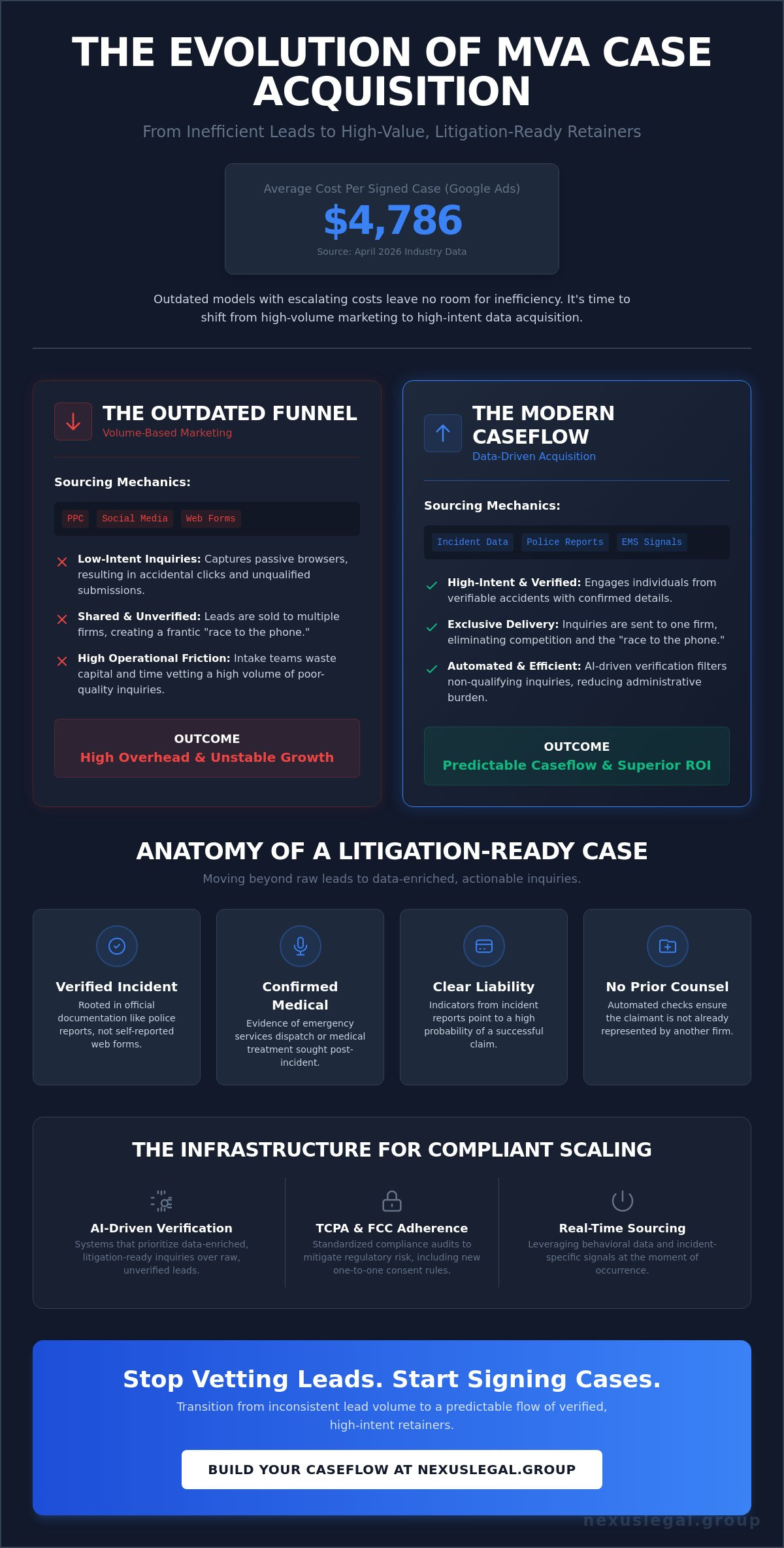
Recent April 2026 data shows that the average cost per signed case via Google Ads has reached $4,786, leaving no room for inefficiencies in your intake funnel. Relying on outdated MVA lead generation companies that provide shared, low-intent inquiries is no longer a sustainable strategy for firms aiming for elite growth. You've likely felt the strain of high overhead costs from vetting poor-quality inquiries or the frustration of losing prospects in a "race to the phone" scenario. These operational frictions don't just waste capital; they destabilize your firm's entire growth trajectory.
This strategic roundup provides a clinical evaluation of modern case acquisition models and the technological infrastructure required to drive superior ROI. We'll examine the shift toward automated verification and the impact of the FCC's one-to-one consent rules. You'll learn how to transition from managing inconsistent lead volume to maintaining a predictable flow of verified, high-intent retainers that reduce the administrative burden on your internal teams.
Key Takeaways
- Analyze the systemic shift from traditional high-volume marketing toward high-intent data acquisition as the primary driver for institutional firm expansion.
- Distinguish between low-intent digital marketing funnels and high-fidelity incident data sourcing to eliminate operational friction in the intake process.
- Navigate the landscape of MVA lead generation companies by evaluating the functional trade-offs between aggregators, boutique agencies, and integrated infrastructure partners.
- Apply a standardized compliance audit to verify TCPA adherence and ethical integrity, mitigating regulatory risk within your case acquisition pipeline.
- Optimize conversion rates by adopting AI-driven verification systems that prioritize data-enriched, litigation-ready inquiries over unverified leads.
The Landscape of MVA Lead Generation Companies in 2026
MVA lead generation companies function as the technical infrastructure bridging the gap between a traumatic incident and a signed retainer. In the current 2026 environment, these entities have transitioned from simple marketing agencies into specialized data architects that facilitate high-intent case acquisition. The Landscape of MVA Lead Generation now prioritizes the mechanics of systematic expansion through precise data modeling rather than broad-spectrum advertising. This evolution allows firms to treat case acquisition as a foundational operational layer rather than a peripheral marketing expense.
Elite plaintiff firms are aggressively pivoting away from traditional lead models toward integrated caseflow systems. A standard lead is often just a passive inquiry with high frictional costs and low conversion rates. Conversely, a caseflow model ensures real-time delivery of exclusive inquiries that have already met a strict threshold of litigation readiness. This exclusivity is paramount; it eliminates the frantic race to the phone that often disrupts internal firm operations and degrades the overall claimant experience. By securing exclusive rights to high-intent inquiries, firms can maintain a steady, predictable rhythm of growth, which may include establishing referral pathways to resources like Special Risk Term for claimants requiring life insurance coverage after being rated for accident-related injuries.
Logistical support can also be a critical component of the claimant experience; for those requiring relocation, firms can provide a referral to explore Residential Moving with Clear Lake Movers, Inc., further distinguishing the firm's commitment to holistic client care.
Beyond immediate logistical and physical rehabilitation, firms can also offer resources for long-term health maintenance; for instance, claimants can learn more about My NuEra Rx to access specialized weight loss medications that aid in their overall metabolic recovery.
For claimants dealing with the specific neurological and structural impacts of a collision, specialized upper cervical chiropractic services from Precision Spinal Care can provide the targeted support needed to address complex neck and spinal injuries, ensuring a more comprehensive recovery process.
Empowering claimants to regain their sense of personal safety and physical confidence after an accident is another critical element of the recovery process; firms can recommend that clients check out Sin City Krav Maga & Fitness for specialized self-defense and resilience training.
The Shift from Volume to Intent
Market saturation has rendered generic PPC campaigns and social media click-to-call funnels increasingly inefficient for long-term scaling. When multiple firms bid on the same high-volume keywords, the cost per signed case escalates while the actual intent level of the prospect often remains low. To navigate these rising costs, firms often seek the expertise of digital marketing specialists like Epic Web Results to develop more efficient growth strategies. Modern MVA lead generation companies solve this by leveraging behavioral data and incident-specific signals. They identify litigation-ready claimants based on specific actions, such as seeking emergency services or police report access, rather than just passive web-form submissions. This strategic shift ensures that law firms spend their resources on inquiries that demonstrate a high probability of conversion and significant case value.
Defining Litigation-Ready MVA Inquiries
Evaluating Sourcing Mechanics: Marketing Funnels vs. Incident Data
The distinction between marketing-driven and data-driven acquisition is fundamental to sustainable firm scaling. Traditional MVA lead generation companies often rely on social media "click-to-call" funnels that prioritize volume over intent. These funnels capture inquiries from users browsing passively, often leading to accidental clicks or low-intent submissions that burden intake teams with high-friction vetting tasks. This model creates a "race to the phone" scenario where the quality of the inquiry is secondary to the speed of the call, often resulting in poor conversion rates and high administrative waste.
In contrast, sophisticated MVA lead generation companies utilize real-time incident data as the primary sourcing engine. This technical process involves monitoring emergency services transmissions and police report databases to identify high-impact accidents as they occur. By applying reverse append technology, raw incident records are enriched with participant details, transforming a public record into a high-intent case acquisition opportunity. This methodology ensures the firm is engaging with individuals involved in verifiable accidents rather than passive internet users. Firms looking to optimize these mechanics should evaluate how integrated acquisition systems can replace fragmented marketing efforts.
The Precision of Police Report Generated Leads
Utilizing police report generated MVA leads provides a verifiable factual foundation for every potential case. Unlike self-reported web forms, these inquiries are rooted in official documentation that confirms liability, vehicle damage, and the presence of injuries. Emergency services data allows firms to identify high-impact incidents in real-time, providing a window of opportunity to offer services when the need is most acute. The accuracy of data sourced directly from official records eliminates the common discrepancies found in consumer-generated leads, ensuring your intake team works with high-fidelity information from the start.
Automated Verification vs. Manual Intake
The "human-only" vetting model, while traditional, introduces inherent latency and potential for subjective bias into the intake process. Every minute an inquiry sits in a manual queue, the likelihood of a signed retainer decreases. AI-driven verification solves this by applying a clinical set of criteria to every inquiry without delay. This automated system, which can be integrated with sales automation tools like Global AI Reps, ensures that only litigation-ready cases that meet specific firm parameters reach your staff. By utilizing pre-verified inquiries, firms significantly reduce internal overhead and allow their high-value intake professionals to focus on closing retainers rather than filtering out non-qualifying noise.
A Strategic Roundup of MVA Lead Acquisition Models
To maintain operational excellence, plaintiff firms must distinguish between the underlying business models of various MVA lead generation companies. The market is currently segmented into three primary categories: Aggregators, Boutique Agencies, and Infrastructure Partners. Each model offers different levels of technical integration and data integrity. Selecting the wrong model often leads to systemic inefficiencies that hinder a firm's ability to scale predictably. High-performance firms prioritize models that offer exclusive access to high-intent data rather than shared, low-fidelity inquiries.
The Aggregator Model: Scaling Volume at the Cost of Precision
Aggregators focus on maximum volume by harvesting inquiries through broad-spectrum digital marketing and third-party affiliates. While they offer a lower cost per lead, they typically operate on a shared lead basis. This creates an inherent "race to the phone" that forces intake teams to work at an unsustainable pace. Data decay is a significant risk here; the time between the incident and the lead delivery can be substantial, resulting in stale contact information and reduced conversion potential. Aggregators often struggle with lead exclusivity because their business model isn't built for precision. Large firms with massive, low-cost intake centers might find value in this model, but most elite practices find the overhead of vetting these inquiries prohibitive.
The Boutique Agency Model
Boutique agencies utilize a human-centric approach, often involving manual vetting and specialized outreach strategies. While this model offers a more personalized touch, it lacks the automation and speed required for rapid institutional growth. For firms that require professional human interaction for specialized campaigns, Virtual Sales Limited offers expert telemarketing and lead generation services that can bridge the gap between raw data and a qualified prospect. The reliance on human intervention creates a ceiling on scalability and potential for inconsistency; for firms looking for a steady but slow influx of cases, this model serves as a functional stopgap, though it doesn't provide the systemic integrity needed for aggressive expansion.
Growth Infrastructure: The High-Intent Standard
The Compliance and Quality Audit for Plaintiff Firms
Compliance serves as the foundational layer of institutional security for elite plaintiff practices. Firms must move beyond anecdotal trust and implement a rigorous framework for vetting case acquisition partners to mitigate systemic risk. Many MVA lead generation companies operate with opaque sourcing methods that can compromise a firm's bar standing or invite regulatory scrutiny. A clinical audit ensures that every inquiry is not only high-intent but also litigation-ready, meaning it possesses the verified factual density required to survive a defense challenge from the moment of intake.
Transparency in the data chain is the primary indicator of a provider's integrity. Red flags include a lack of documentation regarding the initial point of contact or an inability to provide real-time compliance logs. Litigation-readiness metrics should be the baseline for any partnership. If a provider cannot demonstrate a clear path from the incident data to the claimant's consent, the inquiry is a liability. High-performance firms prioritize providers that offer full visibility into their technical sourcing mechanics.
Ethical and Compliant Lead Generation Standards
Documented consent is a non-negotiable structural requirement in 2026. Under the FCC's one-to-one consent rules and the mandates of 18 U.S.C. § 2721 (DPPA), firms must ensure that every prospect has provided explicit, verifiable permission to be contacted by their specific organization. Automated compliance logs provide an immutable audit trail that protects the firm’s reputation during audits or litigation. Ethical sourcing isn't a peripheral concern; it's a core component of a secure MVA case acquisition strategy that ensures long-term operational stability.
Operational Metrics for Evaluating Partners
Evaluating MVA lead generation companies requires a shift from superficial metrics like "cost per lead" to more telling indicators of ROI. Cost per signed case (CPSC) and the lead-to-retainer conversion rate are the only KPIs that reflect the true efficiency of an acquisition partner. High-intent data enriched with behavioral signals significantly reduces intake friction. Utilizing high conversion MVA leads allows your internal teams to focus on closing retainers rather than manual data entry or vetting non-qualifying inquiries. If a provider's inquiries don't convert at a predictable rate, their low initial cost is an illusion that masks high internal overhead.
For a dedicated personal injury practice like The Todd Law Group, PLLC, focusing on these high-fidelity inquiries is essential for maintaining the firm’s commitment to providing high-quality representation for those injured by negligence.
Scaling Case Acquisition with Nexus Legal Group Infrastructure
Nexus Legal Group represents the technical apex for plaintiff firms seeking to move beyond the limitations of traditional MVA lead generation companies. By replacing fragmented marketing efforts with a centralized growth infrastructure, Nexus provides a foundational layer for institutional expansion. This system doesn't just deliver inquiries; it facilitates the acquisition of litigation-ready cases through a rigorous, data-driven framework that eliminates the friction inherent in manual intake. The transition from a marketing-dependent model to a data-integrated model is essential for firms aiming to maintain a competitive advantage in a saturated market. It allows organizations to treat growth as a predictable engineering outcome rather than a variable marketing expense.
This engineering approach to growth often leads to the need for new physical locations; partners can streamline this expansion by using BuyVacantLand.com to find and acquire suitable vacant parcels for future developments.
Nexus utilizes a sophisticated AI-driven verification layer that filters inquiries against a firm's specific litigation criteria. This automated vetting process operates at sub-second speeds, removing the human error and delay associated with traditional intake. By enriching every inquiry with multi-dimensional data points, the system provides a level of transparency that most MVA lead generation companies cannot match. This transparency allows firm partners to audit their acquisition funnel with clinical precision, ensuring that every dollar of capital is deployed toward high-probability outcomes. This architectural approach creates a secure environment where scaling is limited only by the firm's capacity to process signed retainers.
The Nexus CaseFlow Advantage
The core of the Nexus methodology lies in its utilization of police report generated MVA leads and real-time emergency services data. This approach ensures that every inquiry is rooted in a verifiable factual foundation rather than a passive web submission. By employing reverse append technology, Nexus enriches raw accident reports with precise participant details, providing firms with a comprehensive overview of the incident before the first contact is made. This technical precision ensures that all signed cases and inquiries are ethically sourced and fully compliant with TCPA and DPPA standards. The result is a high-fidelity pipeline that prioritizes case value and litigation-readiness over raw volume, providing a steady flow of verified opportunities.
Integrating High-Intent Acquisition into Your Firm
As part of this expansion, firms can discover Law Offices of David Davidi, APLC to see how a dedicated California practice maintains high standards of client care while processing high-intent MVA inquiries.
Institutionalizing Case Acquisition for the 2026 Legal Market
The transition from high-volume marketing to a data-centric caseflow model represents the only viable path for firms seeking elite institutional growth. Successfully navigating the landscape of MVA lead generation companies requires a clinical audit of their technical sourcing mechanics and compliance protocols. By prioritizing exclusive, litigation-ready inquiries over shared, low-intent leads, firms eliminate the operational friction that historically stalls expansion efforts. This strategic shift allows partners to treat case acquisition as a predictable engineering outcome rather than a variable marketing expense. To see how a dedicated personal injury practice manages these high-intent client transitions, you can learn more about Oberg Law Office and their commitment to providing quality legal help.
Implementing a robust growth infrastructure ensures that every inquiry is filtered through a rigorous AI-driven verification layer before reaching your internal intake team. This technical precision, rooted in police report and emergency services data integration, provides the foundational security required for predictable scaling and long-term operational stability. It's time to institutionalize your firm's growth through a system that rewards efficiency and technical precision; for those who value similar precision in their personal safety and want to find_out_more about tactical training, Performance Krav Maga offers specialized instruction.
Secure Your High-Intent MVA Case Infrastructure with Nexus Legal Group
Frequently Asked Questions
What distinguishes MVA lead generation companies from general personal injury marketing agencies?
MVA lead generation companies specialize in technical data acquisition focused on motor vehicle accidents rather than broad brand awareness or general SEO. They utilize specialized infrastructure to identify high-intent claimants in real-time, often leveraging incident-specific data points like police reports. General agencies focus on top-of-funnel visibility, whereas MVA-specific providers deliver litigation-ready inquiries that have already undergone rigorous verification for liability and injury severity.
How does police report data improve the quality of MVA leads?
Police report data provides a verifiable factual foundation that eliminates the discrepancies inherent in self-reported web forms. This data confirms critical case elements such as liability, vehicle damage, and injury presence directly from official records. By sourcing inquiries rooted in documented incidents, firms reduce the administrative burden of vetting non-qualifying prospects and increase the overall velocity of their case acquisition pipeline through high-fidelity data.
What is the difference between exclusive and shared MVA leads in 2026?
Exclusive leads are delivered solely to one law firm, eliminating the "race to the phone" and preventing the prospect from being contacted by multiple competitors. Shared leads are sold to several firms simultaneously, which often leads to high frictional costs and lower conversion rates. In the 2026 market, elite firms prioritize exclusivity to maintain a professional claimant experience and ensure higher retention rates from inquiry to signed retainer.
How can a law firm verify the compliance of an MVA lead provider?
Firms verify compliance by auditing the provider's data chain and requiring immutable logs of one-to-one TCPA consent. A compliant provider must demonstrate a transparent path from the initial incident data to the specific moment the claimant authorized contact. Documentation should align with 18 U.S.C. § 2721 and FCC regulations. If a provider cannot provide a real-time audit trail of consent, the inquiry represents a significant regulatory risk for the firm.
What role does AI play in the verification of MVA inquiries?
AI-driven systems perform clinical, sub-second verification of every inquiry against a firm's specific litigation parameters. This technology replaces the latency and subjective bias of manual intake staff by filtering for medical treatment, insurance coverage, and liability indicators instantly. By utilizing AI, MVA lead generation companies ensure that only high-intent, litigation-ready cases reach the firm's intake team, significantly reducing operational overhead and increasing conversion efficiency across the entire funnel.
Why is cost-per-signed-case a better metric than cost-per-lead?
Cost-per-signed-case accounts for the total efficiency of the acquisition funnel, whereas cost-per-lead ignores the frictional costs of vetting low-quality inquiries. A low lead price is often an illusion that masks high internal administrative waste and poor conversion rates. This metric provides a clinical view of the actual capital required to secure a retainer, allowing firms to make data-driven decisions about the long-term ROI of their acquisition partners.
What is reverse append technology in the context of motor vehicle accidents?
Reverse append technology allows providers to enrich raw accident data with precise participant details by cross-referencing public records and proprietary databases. This process transforms a basic incident report into a comprehensive profile of the potential claimant, including contact information and household data. This enrichment enables firms to identify high-value opportunities with unmatched precision, ensuring that outreach is targeted toward individuals involved in verifiable, high-impact collisions rather than passive internet users.
Can MVA lead generation companies provide signed retainers or just inquiries?
Advanced MVA lead generation companies offer both verified inquiries and fully signed retainers through integrated intake systems. While many providers only deliver raw contact data, infrastructure partners facilitate the entire acquisition process from initial data capture to the executed fee agreement. This end-to-end model reduces the burden on internal firm staff and ensures a seamless transition for the claimant, resulting in a more predictable flow of litigation-ready cases.