Mass Tort Intake Automation: Engineering High-Intent Growth Infrastructure in 2026
Unlock scalable growth with mass tort intake automation. Learn to build a high-performance system that filters for litigation-ready cases and reduces overhead.
Why are some plaintiff firms scaling at three times the industry average while others struggle with bloated overhead and cases rejected during discovery? The answer lies in the 30% to 50% reduction in cost-per-signed-case reported by firms that have fully integrated AI into their workflows as of July 2026. You've likely realized that manual vetting is no longer sustainable, especially when slow response times mean your highest-intent leads sign with competitors before your staff can even initiate contact.
This article provides a technical overview of how elite firms use mass tort intake automation to build a foundational growth infrastructure that functions with clinical precision. You'll learn how to utilize automated verification and AI-driven data enrichment to eliminate intake friction and secure litigation-ready cases. We'll examine the specific mechanics of a "set-and-forget" system that transforms raw inquiries into predictable, scalable revenue growth without the traditional burden of manual oversight.
Key Takeaways
- Learn how to transition from high-volume manual vetting to a systemic filter that prioritizes litigation-ready cases through automated precision.
- Master the deployment of mass tort intake automation to close the "intent gap" by identifying high-value claimants before they reach your competitors.
- Differentiate between basic CRM-centric software and acquisition-first models designed to act as a foundational infrastructure for institutional firm growth.
- Discover the mechanics of integrating high-intent data sources, including police reports and emergency services records, to enrich and verify claimant data automatically.
- Implement strategic infrastructure like Nexus CaseFlow to transition your practice into a high-performance engine fueled by exclusive, litigation-ready inquiries.
The Evolution of Mass Tort Intake: From Manual Volume to Automated Precision
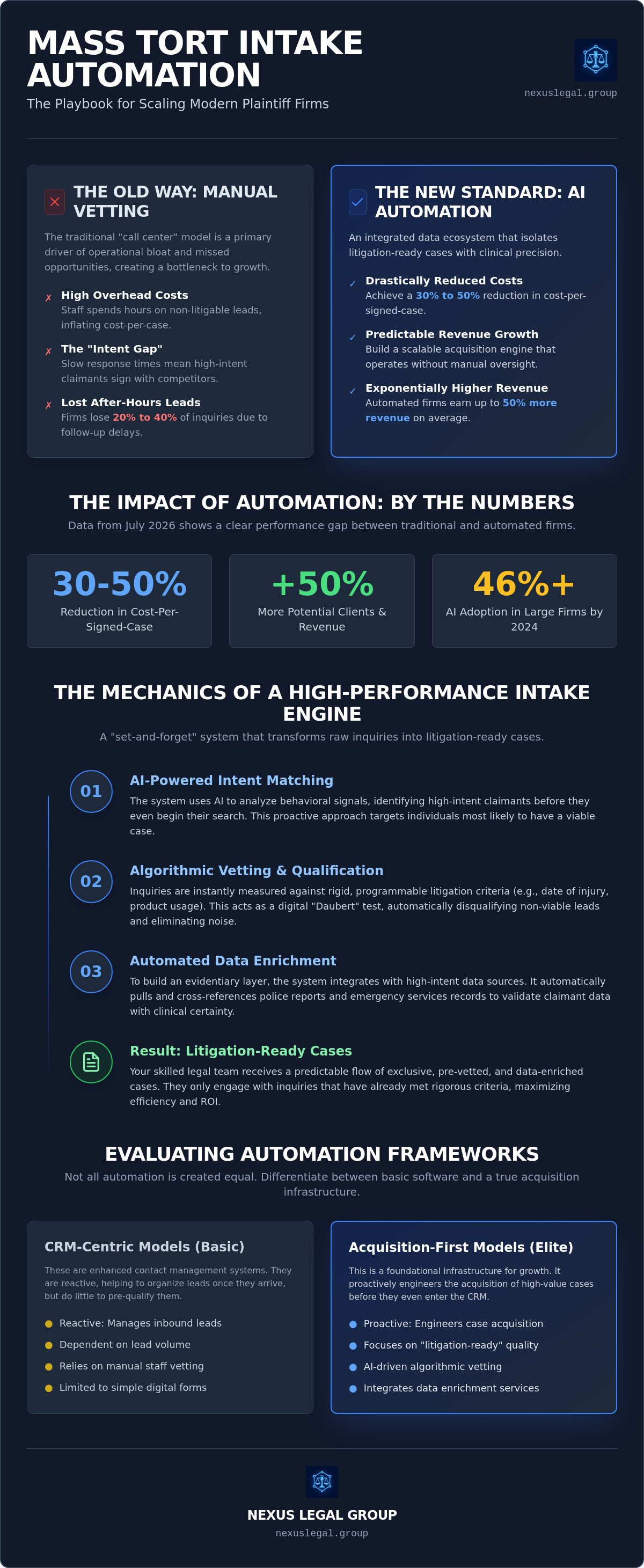
The traditional model of mass tort litigation once relied on brute force. Firms would scale by hiring massive call centers to vet thousands of raw leads, hoping to find a handful of viable cases. This reactive approach creates what we call the "Intent Gap." It's the space where high-intent claimants are lost because the intake process is too slow, too inconsistent, or too burdened by manual friction. In 2026, elite practices have abandoned this "call center" mentality in favor of a proactive acquisition engine. By implementing mass tort intake automation, you aren't just buying software; you're installing a systemic filter designed to isolate litigation readiness with clinical precision.
The High-Volume Bottleneck in Plaintiff Practices
Manual vetting is a primary driver of operational overhead. When your staff spends hours questioning non-litigable leads, your cost-per-signed-case skyrockets. Research from 2026 indicates that traditional firms often lose 20% to 40% of after-hours leads due to delayed follow-up. This friction causes high-intent claimants to abandon the process and seek out competitors who respond instantly. To scale, your firm needs a foundational layer that removes the human bottleneck from the initial qualification stage. This ensures your skilled legal team only engages with inquiries that have already met rigorous criteria. Without this automation, the overhead of managing thousands of non-viable leads eventually caps your firm's ability to grow.
The benefits of reducing manual labor through technology are also being realized in facility management, where businesses can explore Cleaning robots to automate maintenance tasks and optimize commercial operations.
Defining the 2026 Standard for Intake Automation
The 2026 standard for mass tort intake automation goes far beyond simple digital forms. It represents an integrated data ecosystem where AI-driven marketing precision meets algorithmic verification. Elite firms no longer measure success by lead volume; they focus exclusively on "litigation-ready" inquiries. Industry performance data from 2026 indicates that firms deploying integrated intake systems see up to 50% more potential clients and earn 50% more revenue on average. By utilizing automated verification, you eliminate the noise of unqualified leads and create a predictable path for revenue growth. This transition from a reactive service to a high-performance acquisition engine is the only way to maintain a competitive advantage. It's about engineering a system where data integrity is the non-negotiable standard for every inquiry that enters your pipeline.
Just as legal professionals use high-performance systems to optimize their results, automotive enthusiasts can check out N2 Speed to discover how specialized calibration and unlocking services maximize the performance of American vehicles.
The Mechanics of Modern Intake Automation: AI, Data Enrichment, and Verification
Engineering a high-performance acquisition funnel requires moving beyond simple lead capture. Effective mass tort intake automation relies on a sophisticated technological stack that operates well before a lead enters your CRM. In 2026, the industry has shifted toward an "acquisition-first" model. This infrastructure uses AI to analyze behavioral signals, identifying high-intent claimants before they even initiate a search. It's about precision. By 2024, AI adoption among firms with over 100 attorneys had already reached 46%, and that number has surged as firms recognize that automated vetting is the only way to manage the current regulatory environment. This includes adhering to the FCC’s "one-to-one consent" rule, effective January 27, 2026, which mandates explicit, individual consent for every specific seller before contact.
Algorithmic Vetting and Intent Matching
Algorithmic vetting is the heartbeat of this system. It applies rigid, programmable criteria to every inquiry in real time. If a claimant doesn't meet specific litigation requirements, such as a confirmed date of injury or documented usage of a specific product, the system disqualifies them instantly. This prevents the non-litigable noise from ever reaching your intake staff. The goal is to produce exclusive, litigation-ready inquiries that have already passed a rigorous digital "Daubert" test. By automating this qualification, firms ensure that their human closers only spend time on cases with a high probability of success, maximizing the return on an average client acquisition cost that can range from $800 to $3,500 in 2026.
Data Enrichment: The Role of Incident Reports
Data enrichment provides the evidentiary layer necessary for institutional firm growth. By integrating police report data and emergency services records, firms can validate claims with clinical certainty. This process involves several key technological stages:
- Incident Validation: Cross-referencing claimant statements against real-time emergency services data to confirm incident severity.
- Reverse Append Technology: Utilizing minimal claimant data to automatically retrieve comprehensive accident reports and participant details.
- Police Report Integration: Securing official documentation at the point of intake to accelerate the discovery process.
This level of automated verification ensures that every signed case is backed by verifiable incident data. It's not just about getting a name; it's about securing the "Reverse Append" MVA leads that provide the accident reports and participant details needed for litigation readiness. Maintaining this standard for mass tort intake automation in 2026 allows firms to scale without the traditional risk of data inconsistency or rejected cases during discovery.
Evaluating Automation Frameworks: CRM-Centric vs. Acquisition-First Models
Many firms mistake a sophisticated CRM for true mass tort intake automation. While a CRM is vital for organizational health, it's essentially a reactive storage tool. It "manages" whatever data you feed it, regardless of the quality or litigation readiness of that data. In contrast, an acquisition-first model acts as a proactive filter. It ensures that only high-intent, verified cases ever enter your management system. This distinction is critical for firms aiming to reduce the 20% to 40% lead loss typically seen in traditional, slow-response models. You aren't just buying software; you're engineering a gateway that prioritizes clinical precision over raw volume. For those who value this level of rigor in their personal well-being, you can discover Nusbaum Medical Centers to explore clinical medical and surgical weight loss solutions.
The CRM Limitation: Managing vs. Generating
Popular "Intake Wizard" features within CRMs focus on standardizing manual data entry. They help your staff ask the right questions, but they don't solve the problem of high overhead from vetting non-litigable leads. If your intake team is still manually entering data from raw inquiries, you haven't automated the process; you've just digitized a manual bottleneck. The hidden cost here is "management bloat." You're paying skilled staff to organize noise. For a deeper look at this strategic shift, explore Data-Driven Case Acquisition. Elite firms recognize that the ROI of a litigation-ready inquiry far exceeds that of a raw lead, as it bypasses the vetting bottleneck entirely and moves straight to signing.
The Growth Infrastructure Advantage
Nexus Legal Group provides the foundational layer for firm expansion. Our approach to mass tort intake automation integrates automated verification directly with the delivery of signed mass tort cases. We use incident data, such as police reports and emergency services records, to enrich inquiries before they reach your desk. This creates systemic integrity. Instead of a "wizard" that merely guides a human through a form, our infrastructure uses algorithmic precision to deliver cases that are already discovery-ready. This model moves your practice from a labor-intensive "call center" structure to a lean, high-performance engine. You don't just manage cases; you engineer a predictable path for revenue growth through technical mastery of the acquisition funnel.
Implementing an Automated Intake Infrastructure for Scalable Growth
Deploying mass tort intake automation isn't just a software upgrade; it's a structural redesign of your firm’s acquisition pipeline. To transition from a labor-heavy manual system to a high-performance engine, you must follow a logical progression of technical integration. Start by mapping the claimant journey from the initial digital touchpoint to the final retainer signature. Identifying where high-intent individuals drop off allows you to apply algorithmic filters that prioritize speed and accuracy. In the 2026 environment, the first firm to respond to an inquiry often secures the case, so your system must provide an immediate, automated response to prevent claimant abandonment; platforms like Nexdial facilitate this by using AI-powered dialers to automate communication and capture leads instantly.
Transitioning to a Data-Driven Intake Model
Your first step is a comprehensive audit of current manual processes to isolate friction points. Most practices find that intake staff spend a disproportionate amount of time vetting non-litigable leads. By selecting a growth infrastructure that prioritizes case acquisition over simple lead management, you can automate the verification of critical data points. This involves integrating high-intent data sources like Police Report Generated MVA Leads and emergency services records directly into your vetting logic. For a detailed guide on these technical requirements, read about Automated Intake for Plaintiff Firms. This shift ensures your human team only interacts with inquiries that have already been enriched and verified against your specific litigation criteria.
Compliance and Ethics in Automated Acquisition
Compliance is a foundational pillar of any 2026 automation stack. With the FCC’s one-to-one consent rule in effect as of January 27, 2026, firms are now directly liable for the actions of their marketing and intake vendors. This rule mandates explicit, individual consent for each specific seller, ending the era of shared lead lists. Your automated infrastructure must maintain these standards by ensuring every inquiry is ethical and compliant. Adhering to TCPA protocols is vital, as violations carry statutory penalties of $500 to $1,500 per incident. ABA Formal Opinion 512 mandates that lawyers using AI maintain competence and confidentiality throughout this process. By delivering litigation-ready inquiries that meet these rigorous standards, you protect your firm’s reputation while ensuring predictable growth. To begin engineering your firm’s scalable future, explore our high-intent acquisition infrastructure.
- Step 1: Audit the claimant journey to identify and eliminate manual friction.
- Step 2: Integrate incident-level data, including police and emergency services reports.
- Step 3: Deploy algorithmic vetting protocols to ensure litigation readiness.
- Step 4: Enforce strict TCPA and FCC compliance within every automated touchpoint.
Nexus CaseFlow: The Institutional Layer for Elite Mass Tort Practices
Nexus Legal Group doesn't just provide a service; it functions as the strategic architect of your firm's expansion. By implementing a sophisticated layer of mass tort intake automation, you replace the unpredictability of raw lead volume with the clinical precision of litigation-ready inquiries. This institutional approach ensures that every case entering your workflow has already undergone a rigorous vetting process. It's about systemic integrity. You're no longer managing a chaotic funnel; you're operating a high-performance engine designed for scalable revenue growth. This transition allows your firm to move away from the high overhead of manual intake and toward a model where signed cases are delivered with algorithmic certainty.
End-to-End Growth Infrastructure
Our growth infrastructure is built on the seamless integration of high-intent data and automated verification. We leverage exclusive data sources, including Police Report Generated MVA Leads and Emergency Services Generated MVA Leads, to provide a level of validation that manual teams simply can't match. Through reverse append technology, we obtain accident reports and participant details automatically, enriching every inquiry before it reaches your desk. This technical mastery reduces your firm's overhead by eliminating the need for manual vetting of thousands of non-litigable leads. Instead of paying staff to chase incomplete data, your team focuses on revenue-generating activities. Explore our Case Acquisition Systems to see how this foundational layer operates to deliver exclusive, litigation-ready inquiries over the shared, low-intent leads that often plague traditional funnels.
Securing Your Firm’s Future in 2026
In 2026, the competitive landscape is defined by speed, data integrity, and strict compliance. With the FCC's one-to-one consent rule now in full effect as of January 27, 2026, the era of shared, low-intent leads is over. Elite plaintiff firms must adopt mass tort intake automation to remain viable and protect themselves from the statutory penalties of non-compliance. This isn't just about efficiency; it's a strategic necessity for maintaining ethical standards and firm reputation. By transitioning from manual vetting to a systemic acquisition model, you secure a predictable volume of exclusive cases. The result is a higher conversion rate from inquiry to signed case, allowing your firm to scale with confidence. It's time to move beyond the limitations of traditional, labor-heavy intake. Scale your practice with Nexus Legal Group and engineer a future built on technical excellence and predictable growth.
Engineering Your Firm's Scalable Future
Transitioning from a labor-intensive call center to a high-performance acquisition engine is no longer optional for elite practices. By prioritizing acquisition-first models over basic CRM management, you eliminate the friction that causes high-intent claimants to sign with competitors. You've seen how integrating police reports and emergency services data ensures that every case is discovery-ready from the moment of intake. Implementing a robust mass tort intake automation system allows you to scale with clinical precision while maintaining absolute compliance with evolving FCC and TCPA regulations.
Success in the 2026 legal landscape depends on your ability to leverage AI-driven marketing precision and secure litigation-ready inquiries. You don't have to manage the technical complexities of this infrastructure alone. By focusing on ethical and compliant signed cases, your firm can achieve predictable, institutional growth. It's time to move past manual bottlenecks and embrace a foundational layer built for operational excellence.
Achieving this level of excellence often extends to personal health and recovery; for those seeking specialized rehabilitation and medical treatments, Hani Amcha facilitates premier care in the Czech Republic with a focus on high standards.
In addition to streamlining business operations, many elite professionals prioritize health as a pillar of performance; to explore options for medical weight management, visit My NuEra Rx and discover their specialized compounded medications.
Secure Your Growth Infrastructure with Nexus Legal Group and start building the scalable practice your team deserves today.
Frequently Asked Questions
What exactly is mass tort intake automation?
Mass tort intake automation is a foundational technological layer that uses algorithmic logic to filter, verify, and qualify potential claimants in real time. It replaces manual, labor-intensive vetting with a high-performance engine that identifies litigation readiness before a lead enters your case management system. By deploying this infrastructure, firms ensure that every inquiry meets specific evidentiary standards, effectively eliminating the high overhead associated with non-viable leads.
How does automated verification ensure lead quality for mass torts?
Automated verification ensures lead quality by cross-referencing claimant submissions against authoritative incident data, such as police reports and emergency services records. This process utilizes mass tort intake automation to validate the date, location, and severity of an incident with clinical precision. By confirming these details programmatically, the system isolates high-intent inquiries and filters out the noise of unqualified leads that typically clog traditional intake funnels.
Can automated intake systems handle the complexity of specific mass tort criteria?
These systems are designed to handle highly complex, tort-specific criteria through programmable logic gates. You can configure the automation to verify exact medical diagnoses, specific product exposure windows, and geographical requirements. This ensures that every signed case meets the rigorous standards required for discovery. The system acts as a digital gatekeeper, only allowing inquiries that satisfy every necessary legal threshold to proceed to your signing team.
Is automated legal intake compliant with ethical standards and bar associations?
Automated intake is fully compliant when built on a framework that prioritizes FCC and TCPA regulations. In 2026, this means adhering to the one-to-one consent rule and maintaining end-to-end encryption for HIPAA-protected data. Using an automated system actually strengthens your ethical standing by providing a clear, immutable audit trail of claimant consent and data handling, which is often difficult to maintain with manual processes.
How does data enrichment from police reports improve intake conversion?
Data enrichment from police reports improves conversion by providing immediate validation of a claimant's story. When you use reverse append technology to secure accident details, you can confirm the legitimacy of a claim while the individual is still on the initial inquiry. This speed-to-lead advantage, combined with verified incident data, increases sign-up rates because it instills confidence in the claimant and allows your firm to move directly to the retainer stage.
What is the difference between mass tort CRM software and growth infrastructure?
Mass tort CRM software is a reactive tool designed to store and organize data that has already been collected. In contrast, growth infrastructure is a proactive acquisition engine that generates, enriches, and verifies inquiries before they reach the storage phase. While a CRM manages the "aftermath" of a lead, growth infrastructure focuses on the mechanics of business expansion by ensuring only high-intent, litigation-ready cases enter your practice.
How quickly can a firm implement an automated intake system?
Implementation timelines depend on the complexity of your current tech stack and the specific torts you target. Most firms can integrate a foundational acquisition layer within a few weeks. The process involves mapping your existing claimant journey, configuring vetting protocols, and connecting APIs for real-time data enrichment. Once active, the system functions as a scalable infrastructure that increases case volume without requiring additional intake staff.
Does automation reduce the personal touch needed for mass tort claimants?
Automation actually preserves the personal touch by removing the administrative burden from your intake specialists. When your team doesn't have to spend hours on rote data entry or vetting unqualified callers, they can focus their energy on providing empathetic, professional guidance to high-intent claimants. Automation handles the technical verification, while your staff handles the high-level human connection that secures a long-term client relationship.