Mass Tort Case Acquisition Infrastructure: Engineering Growth for Elite Firms
Build a robust mass tort case acquisition infrastructure. Move beyond lead buying to engineer scalable growth, ensure compliance, and lower your cost per case.
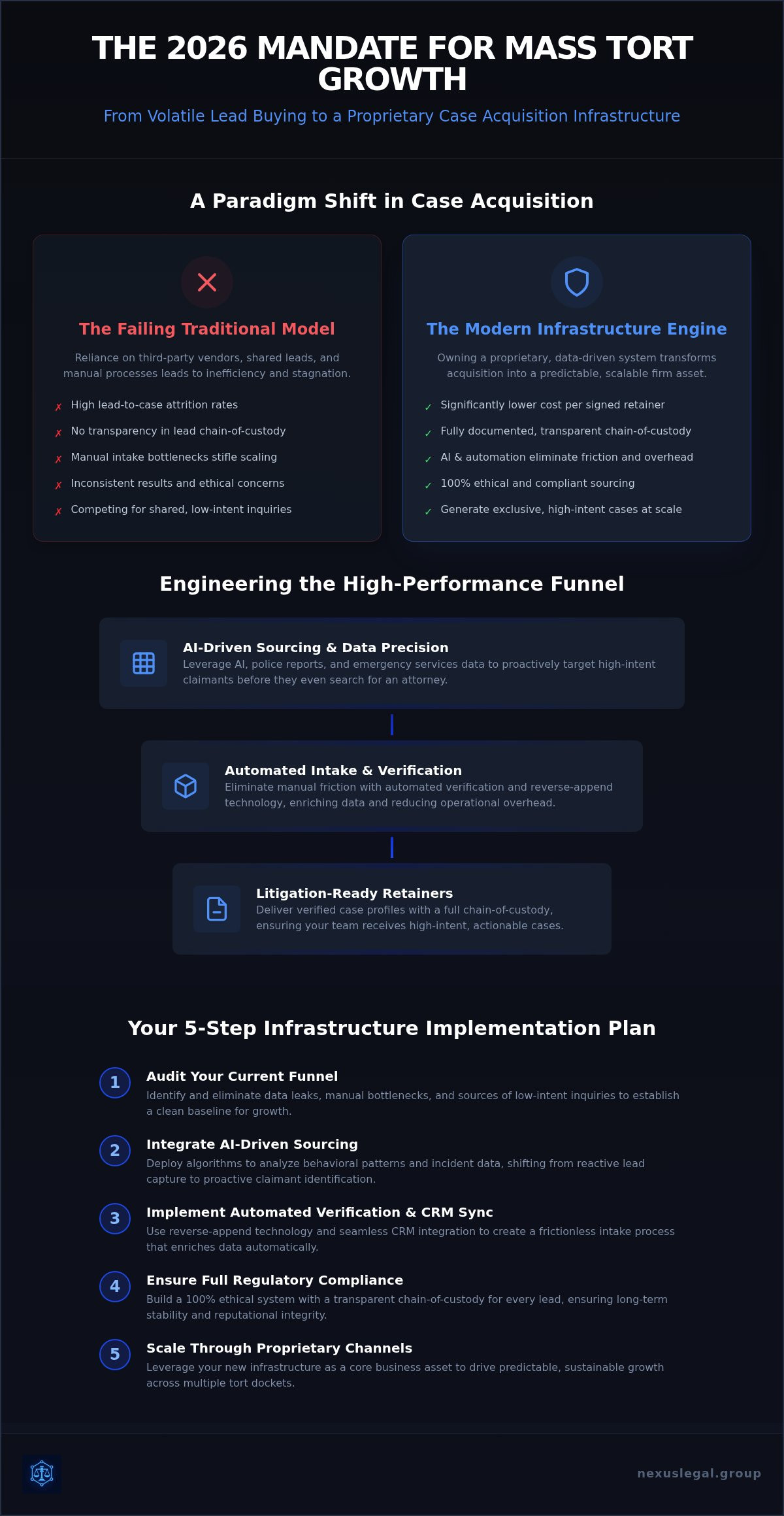
In 2026, elite mass tort growth is no longer a marketing challenge; it's an infrastructure engineering challenge. Many firms find themselves trapped in a cycle of high lead-to-case attrition and a frustrating lack of transparency in the lead chain-of-custody. If you've struggled with manual intake bottlenecks that stifle your ability to scale, you're not alone. The traditional model of purchasing shared, low-intent inquiries is failing the modern firm. To dominate the market, you need a sophisticated mass tort case acquisition infrastructure that functions as a foundational layer of your organization rather than a peripheral tool.
You probably agree that the current reliance on third-party vendors often leads to inconsistent results and ethical concerns. This article shows you how to transition from buying leads to building a proprietary, data-driven acquisition engine. We'll explore the technical mastery required to generate high-intent cases at scale while significantly lowering your cost per signed retainer. By the end of this guide, you'll understand how to implement a 100% ethical and compliant sourcing system that eliminates friction and drives growth with clinical precision.
Key Takeaways
- Learn how to move beyond volatile lead-buying models by establishing a robust mass tort case acquisition infrastructure that integrates AI-driven sourcing and seamless CRM automation.
- Discover how to leverage police and emergency services data alongside advanced marketing algorithms to identify high-intent claimants with clinical precision.
- Master the use of automated verification and reverse-append technology to eliminate manual intake friction and significantly reduce operational overhead.
- Understand the 2026 regulatory landscape to ensure 100% ethical compliance and maintain a transparent chain-of-custody for every signed retainer.
- Follow a systematic implementation plan to audit your current funnel for data leaks and scale your firm through high-performance, proprietary acquisition channels.
What is Mass Tort Case Acquisition Infrastructure?
A Mass tort involves a civil action where many plaintiffs have similar claims against a defendant. To navigate these complex dockets, elite firms no longer rely on sporadic lead purchases. Instead, they implement a mass tort case acquisition infrastructure. This is a systemic framework that fuses AI-driven sourcing, automated verification, and seamless CRM integration into a single, high-performance engine. It's the difference between buying a one-off service and owning a foundational layer of your organization. In 2026, traditional lead buying models fail because they cannot account for the high lead-to-case attrition rates that plague the industry. When firms don't own the data chain, they lose control over the quality and intent of the claimant.
The core objective of this infrastructure is to deliver litigation-ready inquiries with a fully documented chain-of-custody. This means your firm isn't just receiving a name and a phone number. You're receiving a verified case profile backed by incident data and behavioral intent. This transition from transactional lead purchasing to institutional growth infrastructure allows firms to operate with a level of clinical precision that was previously impossible. It eliminates the manual intake bottlenecks that typically slow down scaling, ensuring that every dollar of ad spend is tied to a high-intent, verifiable outcome.
The Evolution of Case Acquisition
The legal marketing landscape has undergone a radical transformation. We've moved from manual cold-calling and broad-spectrum television ads to high-intent digital sourcing. AI now identifies potential claimant patterns before those individuals even realize they have a viable claim. By integrating data from emergency services and police reports, firms can reach plaintiffs with unprecedented speed. In this new environment, "exclusive" must mean more than just "not shared." It refers to an inquiry that is unique to your firm's proprietary data ecosystem, ensuring that the claimant's first and only interaction is with your brand.
Infrastructure vs. Agency Models
Most agencies provide leads, but they don't provide a scalable business asset. A true infrastructure model provides a technological foundation that you control. Owning your technology stack is critical for maintaining long-term stability and operational efficiency. It allows for the elimination of friction at every stage of the funnel. This shift also directly impacts a firm's market position. By implementing a proprietary law firm growth infrastructure, you transform the acquisition process into a permanent, high-performance asset that drives predictable, sustainable growth across multiple tort dockets.
Engineering the Funnel: AI-Driven Marketing and Data Precision
Elite firms don't just wait for claimants to find them; they engineer a mass tort case acquisition infrastructure that anticipates need through data science. Traditional social media advertising often produces a high volume of low-quality inquiries that drain resources. By contrast, a sophisticated funnel utilizes AI-driven marketing to target high-intent individuals with clinical precision. This involves moving beyond basic keywords to analyze complex behavioral patterns across multiple platforms, ensuring you reach potential plaintiffs at the exact moment their legal need arises. It's a shift from reactive catching to proactive, data-informed targeting.
Leveraging Incident Data for Mass Tort Sourcing
Real-time emergency services data provides a significant advantage over reactive search ads. By integrating police report feeds and incident data, your firm can identify potential claimants faster than any traditional agency. Reverse append technology serves as a specialized tool for securing participant details by matching fragmented data points against comprehensive public and private databases. This process enriches basic contact information into a detailed accident report, giving your intake team the context needed to sign cases immediately. Adhering to the rigorous standards found in the Manual for Complex Litigation ensures that your outreach remains ethically sound while maintaining litigation-ready quality. Firms looking to optimize their intake can explore high-intent MVA case acquisition solutions that utilize these advanced data layers.
AI and Behavioral Targeting
Predicting claimant intent requires more than just demographic filters. Cross-platform behavioral data allows for the creation of pre-click qualification algorithms that eliminate 'tire-kickers' before they ever enter your CRM. These systems analyze search history, location data, and even consumer habits to score lead quality in real-time. When you integrate these AI models into your mass tort case acquisition infrastructure, you create a proprietary channel that competitors cannot replicate. This level of technical mastery ensures that your signed retainers come from high-intent inquiries rather than shared, recycled leads. It's a methodical approach that prioritizes data integrity and systemic efficiency above all else.
Automated Intake and Verification: Eliminating Acquisition Friction
Scaling a firm requires more than just high-volume sourcing; it demands an intake process that doesn't buckle under pressure. Traditional firms often view intake as a human-service cost, relying on live agents to verify complex claims. This manual approach introduces human error and significant delays that can sabotage your ROI. By contrast, a modern mass tort case acquisition infrastructure treats intake as a technological asset. It replaces manual bottlenecks with automated verification systems that deliver litigation-ready inquiries to your CRM without the need for constant attorney oversight. This reduces firm overhead while ensuring that the data chain-of-custody remains unbroken and verifiable.
The Mechanics of Automated Vetting
Automation in vetting isn't just about collecting contact info. It uses logic-based questionnaires to filter out non-qualifying claimants before they ever touch your staff's desk. These systems execute complex branching logic to determine eligibility in real-time, effectively performing the first level of legal vetting. This digital framework handles automated document collection and verification during the initial phase, ensuring that only the highest-intent cases move forward. For a deeper look at the technical requirements, you can study the mechanics of automated intake for plaintiff firms. By the time a case reaches your legal team, it's already been scrubbed for inconsistencies and verified against incident data.
Increasing Conversion through Speed-to-Lead
In 2026, claimants expect instantaneous engagement. If your firm takes hours or even days to respond, you've already lost the case to a faster competitor. Integrating automated intake with 24/7 communication channels ensures that you capture every inquiry the moment it's generated. Speed-to-lead is no longer a luxury; it's a survival metric that determines your overall cost per signed retainer. Verification technology protects your firm's most valuable resource, attorney time, by ensuring you only focus on cases with a high probability of settlement. This methodical approach transforms your intake from a chaotic cost center into a refined, high-speed engine of growth. You aren't just answering phones; you're operating a sophisticated data-processing facility designed for elite firm expansion.
Ensuring Ethical Compliance in High-Volume Acquisition
In the 2026 regulatory environment, ethical compliance is no longer a checklist; it's a core component of your firm's operational integrity. Elite plaintiff firms must navigate a landscape defined by heightened scrutiny from state bar associations and evolving federal regulations. For instance, California's Senate Bill 37 introduced significant revisions to attorney advertising on January 1, 2026, while New York implemented simplified but stricter advertising rules on June 1, 2026. A robust mass tort case acquisition infrastructure integrates these legal requirements directly into the data sourcing and intake workflows. This ensures that every high-intent inquiry is captured through TCPA-compliant methods and that all outreach remains within the ethical boundaries of the relevant jurisdiction.
Risk mitigation strategies for firms scaling their volume must prioritize the elimination of non-compliant sourcing. Relying on opaque third-party lead chains creates significant liability that can jeopardize years of litigation effort. By establishing a proprietary acquisition engine, you gain full control over the messaging and consent mechanisms used to engage potential claimants. This methodical approach protects your firm's reputation in high-stakes litigation and ensures that your docket is built on a foundation of verified, ethically sourced retainers.
Transparency and Audit Trails
Modern compliance demands an absolute ability to trace every signed case back to its original digital source. Tech-enabled compliance systems within your infrastructure provide a transparent audit trail that documents the entire claimant journey. This level of documentation is essential for avoiding Bar Association scrutiny and defending the validity of your docket during MDL proceedings. You can find detailed frameworks for these requirements in the latest standards for compliant legal lead generation. Maintaining a clear chain-of-custody for every inquiry isn't just a defensive measure; it's a clinical requirement for institutional growth.
Ethical Sourcing of Signed Cases
Defining a case as "litigation-ready" requires more than just meeting medical criteria; it requires meeting rigorous ethical standards. Automated verification technology supports this due diligence by cross-referencing claimant data against incident reports and emergency services records in real-time. This process filters out fraudulent or inconsistent claims that could undermine the firm's standing in court. By utilizing a sophisticated mass tort case acquisition infrastructure, you ensure that every signed retainer has undergone a rigorous digital vetting process. This systematic verification protects the firm's resources and ensures that attorney time is spent only on cases that meet the highest standards of legal and ethical viability.
Scaling Your Firm: A Step-by-Step Infrastructure Implementation Plan
Transitioning to a proprietary mass tort case acquisition infrastructure is a strategic move that shifts your firm away from the volatility of shared lead brokers. This process isn't just about software installation; it's a fundamental re-engineering of how your firm identifies and secures claimants. By following a logical implementation plan, you can transform your acquisition funnel into a high-performance business asset that delivers predictable results. The goal is to move from a reactive model to a proactive, data-driven engine that functions with clinical precision.
Auditing Your Current Growth Engine
Start by identifying the data leaks and friction points in your manual intake processes. If your team is struggling with high lead-to-case attrition, you likely have a bottleneck in your verification stage. Evaluate the quality of your current third-party sources. If they don't provide a transparent chain-of-custody, they're a liability. In 2026, elite firms should set performance benchmarks that align with industry standards, such as a lead-to-retainer conversion rate of approximately 17% to 20%. This audit establishes the baseline data required to justify the shift toward a more sophisticated, institutional framework.
Once your audit is complete, the next phase involves integrating high-intent sourcing channels. This means utilizing AI-driven marketing and incident data, such as police reports, to reach potential plaintiffs at the moment of need. Deploy an automated intake and verification layer to filter these inquiries in real-time. This system ensures that every inquiry is litigation-ready before it ever reaches your staff. Finally, connect this entire infrastructure to your existing CRM for seamless handoffs. Monitoring operational metrics like ROI and conversion speed will allow you to refine the system for maximum efficiency.
Deploying the Nexus Legal Group Framework
Nexus Legal Group acts as the strategic architect for firms ready to scale. Our framework integrates directly with elite practices to provide a foundational layer of growth that replaces the need for traditional agencies. We focus on lead generation for trial lawyers that prioritizes technical mastery and systemic integrity. This approach ensures your firm isn't just buying inquiries but is instead building a scalable engine that lowers the cost per signed retainer over time. Explore how our growth infrastructure engineers elite results by providing the connectivity and automation necessary for long-term expansion.
Engineering the Future of Your Firm's Acquisition
Building a high-performance practice in 2026 requires a fundamental shift from transactional lead buying to a sophisticated mass tort case acquisition infrastructure. You've learned how AI-driven precision and incident data integration identify high-intent claimants with clinical accuracy. We've also explored the mechanics of automated verification, which eliminates manual intake bottlenecks to ensure your team focuses exclusively on litigation-ready files. By establishing a transparent data chain-of-custody, you protect your firm's reputation while maintaining 100% ethical compliance in an increasingly complex regulatory landscape.
This methodical approach transforms your growth strategy into a permanent, scalable business asset that increases your firm's overall valuation. It's time to stop reacting to the market and start engineering your expansion from a position of technical mastery. You now have the blueprint to reduce operational overhead, lower your cost per signed retainer, and secure exclusive inquiries that drive sustainable results. Your firm's potential is no longer limited by external lead vendors; it's empowered by your own proprietary systems.
Take the first step toward institutional growth today. With the right systems in place, your firm's trajectory is limited only by your ambition to lead the market.
Frequently Asked Questions
What is the difference between a mass tort lead and a mass tort case acquisition infrastructure?
A lead is a transactional data point representing a potential claimant, while a mass tort case acquisition infrastructure is an institutional framework that controls the entire sourcing lifecycle. Leads are often shared and lack transparency. An infrastructure combines AI-driven targeting, automated verification, and seamless CRM integration to deliver litigation-ready inquiries. This systemic approach ensures a documented chain-of-custody and provides your firm with a proprietary asset rather than a one-off purchase from a third-party vendor.
How does AI-driven marketing improve mass tort case quality?
AI-driven marketing improves quality by utilizing behavioral targeting to identify high-intent claimants with clinical precision. Instead of relying on broad keywords, algorithms analyze cross-platform data to predict which individuals are most likely to have a viable claim. This eliminates low-quality inquiries before they enter your funnel. By focusing on specific behavioral patterns rather than general searches, your firm can secure exclusive inquiries that are more likely to convert into signed retainers and successful settlements.
Why is automated intake verification essential for high-volume firms in 2026?
Automated intake verification is critical because it removes manual bottlenecks that cause lead-to-case attrition. In 2026, speed-to-lead is a survival metric; claimants demand an immediate response. Automation uses logic-based questionnaires to qualify inquiries in seconds, ensuring that your legal team only reviews litigation-ready cases. This technology protects your firm's resources and reduces overhead by filtering out non-qualifying individuals automatically. It allows for high-volume scaling without a corresponding increase in manual labor or human error.
How do you ensure mass tort leads are ethical and compliant?
We ensure compliance by maintaining a transparent audit trail for every signed retainer. Our system uses TCPA-compliant consent mechanisms and documents the entire chain-of-custody from the initial digital touchpoint. By controlling the acquisition engine, your firm avoids the risks associated with opaque third-party lead brokers. This methodical approach adheres to the strict 2026 ethical standards required by state bar associations, protecting your firm's reputation and ensuring that your docket stands up to rigorous judicial scrutiny.
Can this infrastructure integrate with my existing law firm CRM?
Yes, our infrastructure is engineered for seamless connectivity with your current practice management software. This integration ensures that high-intent inquiries move directly from the verification layer into your CRM without friction. By eliminating manual data entry, you reduce the risk of data leaks and improve your firm's overall response time. This connectivity is a foundational part of a mass tort case acquisition infrastructure, allowing your staff to focus on case management rather than administrative tasks.
What is reverse append technology, and how does it help attorneys?
Reverse append technology is a sophisticated data-matching tool used to enrich basic claimant information with comprehensive incident details. It allows attorneys to obtain full accident reports and participant data by matching fragmented inputs against verified databases. This process provides your firm with the clinical precision needed to assess a case's viability instantly. By securing these details early, you can verify claims against police and emergency records, ensuring that every signed retainer is backed by documented evidence.
How do you source high-intent claimants using police and emergency data?
High-intent claimants are identified by integrating real-time emergency services data and police reports into our proprietary sourcing engine. This allows your firm to reach potential plaintiffs immediately after an incident occurs. By combining this incident data with AI-driven behavioral targeting, we identify individuals who have a documented legal need. This proactive strategy ensures that your inquiries are exclusive and high-intent, providing a significant advantage over competitors who rely solely on reactive search-based advertising or social media.
What operational metrics should I track for mass tort acquisition?
Firms should track metrics that define systemic efficiency, such as the cost per signed retainer and lead-to-retainer conversion speed. It's also vital to monitor the percentage of litigation-ready inquiries and the overall ROI of your acquisition channels. In 2026, elite firms use these data points to optimize their infrastructure and eliminate friction points. Tracking these metrics ensures that your growth is driven by logic and data rather than guesswork, allowing for predictable and sustainable firm expansion.