High Conversion MVA Leads: Behavioral Trends and Data Enrichment in 2026
Struggling with rising costs? Discover data-driven strategies to generate high conversion MVA leads and eliminate intake bottlenecks with automated verificat...
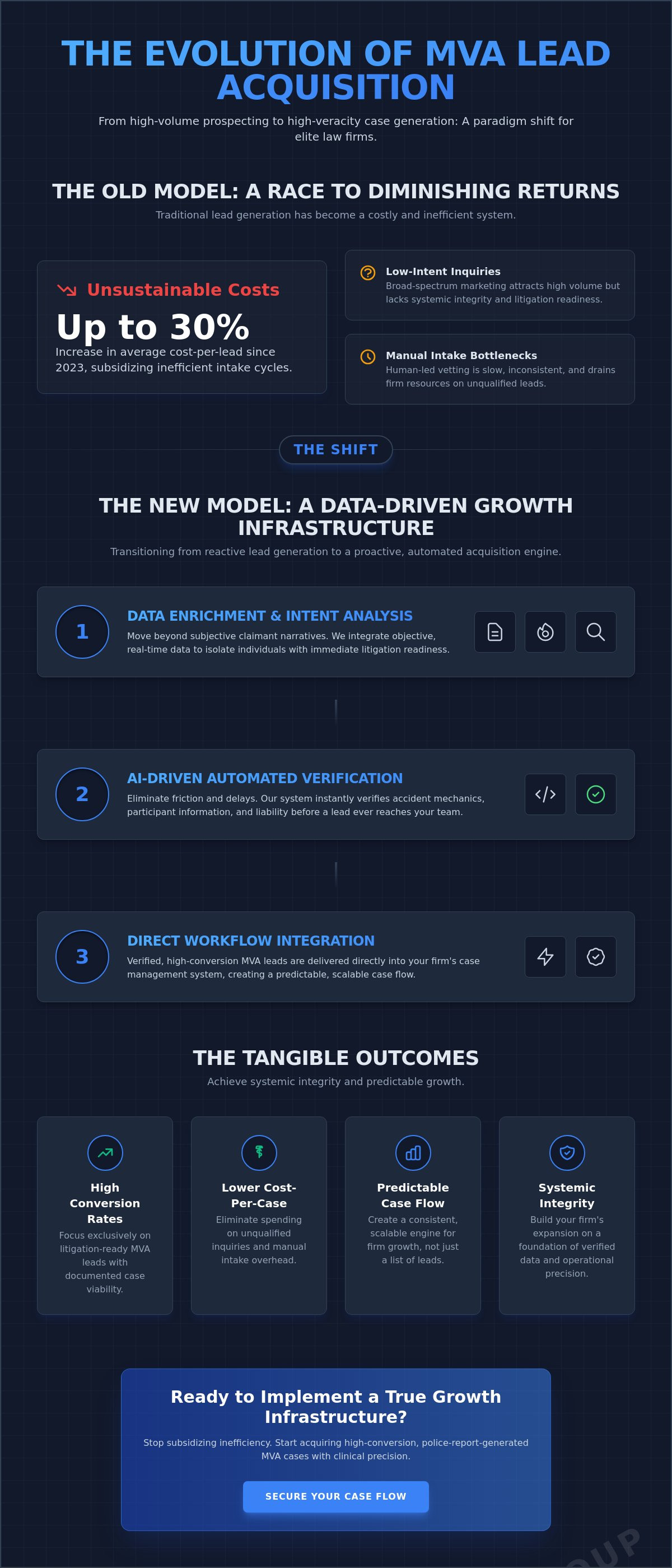
With the average cost per law firm lead increasing by up to 30% since 2023, firms can't afford to subsidize inefficient intake cycles or settle for inquiries that fail to become high conversion MVA leads. You've likely noticed that traditional lead generation has become a race toward diminishing returns, where high volume often masks a systemic lack of intent and leads to unsustainable costs per signed case. This professional shift requires a move away from generic inquiries toward a rigorous, data-driven acquisition model. We'll examine the technological frameworks and data enrichment strategies that drive elite conversion rates for motor vehicle accident litigation. This analysis covers the mechanics of automated verification, the integration of police report data, and the deployment of reverse append processes to ensure a predictable case flow. By the end of this overview, you'll understand how to achieve seamless data integration into your firm's workflow while navigating the strict liability requirements of new regulations like California's SB 37.
Key Takeaways
- Identify the transition from broad-spectrum marketing to behavioral intent analysis to isolate litigation-ready claimants with clinical precision.
- Utilize reverse append technology and police report data to instantly verify accident details and participant information for every inquiry.
- Eliminate manual intake bottlenecks by deploying automated verification systems that ensure systemic integrity throughout the acquisition process.
- Discover the infrastructure requirements for generating high conversion MVA leads through advanced data enrichment and unified acquisition mechanics.
The Paradigm Shift in MVA Lead Acquisition
The 2026 legal market has moved beyond the era of raw inquiry volume. For elite plaintiff firms, the traditional lead generation process has reached a point of saturation where generic traffic yields diminishing returns. High conversion MVA leads are now defined by a sophisticated intersection of real-time behavioral data and verified accident mechanics. This is no longer about simply capturing a name and a phone number. It's about identifying individuals who possess immediate litigation readiness and documented case viability through clinical precision.
Traditional models fail because they prioritize quantity over systemic integrity. When a firm relies on broad-spectrum marketing, they often inherit manual intake bottlenecks and inconsistent lead quality. This creates a high cost-per-signed-case that erodes profitability. Clinical precision in firm expansion requires a shift toward high-intent case acquisition. This means focusing on the mechanics of the accident itself, such as police report data and emergency services records, rather than just the search terms used to find an attorney. In many cases, leveraging technical insights from specialists like mltraffic.com.au can further clarify the environmental and engineering factors involved in a collision. It's a fundamental move from a reactive stance to a proactive, data-enriched strategy.
From Lead Generation to Growth Infrastructure
Peripheral marketing tools often act as temporary patches for deeper operational gaps. To achieve sustainable scaling, firms must implement a robust law firm growth infrastructure that serves as a foundational layer for the practice. This infrastructure integrates data enrichment and automated verification directly into the workflow. It replaces fragmented lead sources with a unified system designed for high-intent MVA case acquisition. By treating lead acquisition as a mechanical process rather than a creative one—much like the specialized performance calibration provided by N2 Speed—firms eliminate the friction that typically stalls growth. This structural approach ensures every inquiry is vetted against rigorous litigation standards before it ever reaches a human intake specialist.
The Mechanics of Controlled Urgency
Response speed is a critical variable in the conversion equation. High-intent MVA claimants exist in a state of acute crisis; they require immediate validation and clear directives. Any delay in the initial touchpoint increases the likelihood of claimant drop-off or engagement with a competitor. Eliminating friction means automating the transition from inquiry to retainer. The psychological profile of a high-intent claimant is defined by a desire for resolution and technical mastery from their legal counsel. When a firm demonstrates this mastery through efficient, data-backed intake, they secure high conversion MVA leads with higher predictability and a lower cost-per-signed-case.
Data Enrichment: The Role of Police Reports and Reverse Append
The evolution of case acquisition hinges on the transition from subjective claimant narratives to objective incident metrics. Relying solely on self-reported data introduces systemic risks, including inaccurate liability assessments and exaggerated injury claims. By integrating police report data, firms can verify accident details with clinical precision before the first intake call occurs. This objective verification layer ensures that only cases with documented viability enter the workflow, effectively filtering out low-quality inquiries that inflate the cost-per-signed-case. When inquiries are grounded in factual incident data, the entire acquisition process becomes a predictable engine for growth.
High conversion MVA leads are the direct result of this data enrichment process. When a lead is generated from police reports or emergency services data, the baseline for litigation readiness is established through official documentation rather than consumer memory. This methodology allows attorneys to assess the mechanics of a collision, the presence of responding units, and the initial assessment of fault with institutional authority. Firms that leverage Police Report Generated MVA Leads can bypass the noise of traditional marketing and focus exclusively on high-intent litigation. This shift toward data-enriched inquiries is what separates elite firms from those struggling with inconsistent lead quality.
Leveraging Emergency Services and Incident Data
Real-time integration of emergency services data provides a critical advantage in identifying high-severity incidents as they occur. By automating the verification of incident facts, firms reduce the operational overhead associated with manual vetting. This data-driven approach allows for the immediate identification of liability and injury severity, ensuring that the firm's resources are allocated to the most promising opportunities. The use of objective reporting eliminates the friction caused by inconsistent claimant statements, providing a clear path to a signed retainer. It's a mechanical solution to the problem of intake uncertainty.
Reverse Append Technology in MVA Context
Reverse append technology serves as a powerful mechanism for securing participant details and accident reports that are otherwise difficult to obtain. This process involves matching limited inquiry data against comprehensive databases to identify high-intent participants and their specific accident history. The impact on conversion-to-retainer metrics is significant; when an intake team possesses the full context of an accident, the conversation shifts from discovery to validation. Enriching inquiries through reverse append ensures that high conversion MVA leads are backed by a complete data profile, maximizing the efficiency of the firm's growth infrastructure. This technical mastery ensures that no viable case is lost to a lack of initial information.
Just as law firms use these tools to verify case details, auto finance companies rely on specialized platforms to manage risk and insurance coverage; learn more about Verifacto and their cloud-based solutions for collateral protection.
AI-Driven Verification vs. Manual Intake Vetting
The debate between manual intake and automated verification often centers on the perceived value of a "human touch," yet this sentiment frequently overlooks the mechanical failures inherent in manual systems. Human vetting is slow, prone to cognitive bias, and difficult to scale during high-volume periods. It creates a bottleneck that increases the cost-per-signed-case and slows the firm's growth trajectory. Conversely, AI-driven verification operates with a level of clinical precision that human teams cannot sustain. It identifies high conversion MVA leads by analyzing complex behavioral signals that indicate litigation readiness, ensuring that the firm's resources are dedicated only to high-value opportunities.
Relying on manual vetting often results in a fragmented intake process where lead quality varies based on the individual performance of staff members. This inconsistency is a primary driver of high cost-per-signed-case. Automated systems eliminate this friction by applying a uniform, data-driven standard to every inquiry. By shifting the focus from human judgment to algorithmic accuracy, firms can process a higher volume of inquiries without a corresponding increase in overhead. This technical mastery ensures that the firm's growth is supported by a stable, high-performance engine rather than a variable manual process.
The Evolution of Automated Case Vetting
Machine learning has transformed the way firms evaluate potential cases by applying predictive models to filter non-litigable inquiries. These systems perform real-time verification of claimant intent and liability, matching inquiry data against objective incident metrics. The industry's transition toward AI driven legal case acquisition provides top-tier firms with a scalable growth infrastructure. This technology does more than just sort leads; it evaluates the probability of a successful retainer based on historical conversion data and real-time behavioral patterns. By the time an inquiry reaches the firm, the system has already confirmed its viability, significantly reducing the burden on internal teams.
The shift toward algorithmic accuracy is a trend across all data-intensive industries. To see how AI-powered analytics can transform business performance, learn more about the benefits of Nodal AI's platform.
Eliminating Human Error in Intake
Standardizing qualification criteria through algorithmic precision is the only way to maintain systemic integrity at scale. Manual intake teams often struggle with inconsistent application of firm-specific criteria, leading to the acquisition of low-quality or non-compliant leads. Automated verification removes this variability, ensuring that every inquiry is processed according to a strict, pre-defined logic. This approach guarantees ethical and compliant lead generation, which is vital in an environment of increasing regulatory oversight. By automating the legal intake verification process, firms can drastically reduce administrative overhead. This efficiency allows for a more predictable case flow and ensures that high conversion MVA leads are secured with minimal friction and maximum accuracy.
Behavioral Intent Analysis: Predicting Litigation Readiness
The identification of a litigation-ready signal represents the transition from passive observation to active case acquisition. In the 2026 legal market, high-intent car accident leads are no longer defined by a single search query; they're identified through a complex digital signature that precedes a formal inquiry. This behavioral data allows firms to distinguish between individuals conducting general research and those actively seeking immediate representation. By analyzing specific navigation patterns, such as repeated visits to emergency service resources or specific insurance claim protocols, systems can isolate high conversion MVA leads with clinical precision. This predictive capability ensures that a firm's intake resources are prioritized for claimants with the highest probability of signing a retainer.
Multi-touch attribution plays a critical role in this conversion forecasting. It moves beyond the "last-click" model to evaluate every interaction a claimant has with the growth infrastructure. This comprehensive view provides a logical progression from initial awareness to litigation readiness. When behavioral data is used to prioritize inquiries, firms eliminate the latency that often results in lost opportunities. This systematic approach to intent analysis creates an institutional advantage, allowing practices to deploy their capital where it generates the most significant return. To secure these optimized inquiries, firms should invest in High-Intent MVA Case Acquisition to ensure their pipeline is populated with verified, litigation-ready cases.
The Anatomy of a High-Conversion MVA Inquiry
The primary indicators of immediate legal need are often found in the granularity of user behavior. Representation-seekers exhibit a sense of controlled urgency, often engaging with specific technical content regarding liability and recovery rather than broad informational overviews. Differentiating these high-intent individuals from casual information-seekers requires a sophisticated filtering layer that evaluates the depth and frequency of engagement. In a competitive metropolitan market where lead costs can exceed $1,500, the ability to isolate these litigation-ready inquiries is essential for maintaining a sustainable cost-per-signed-case. This technical vetting ensures that the firm's growth engine remains focused on high-value litigation.
Forecasting Conversion with Machine Learning
Predictive modeling utilizes historical conversion data to assign a probability score to every new inquiry. By integrating these behavioral insights directly into a law firm's CRM, practitioners can automate the prioritization of their follow-up sequences. This machine learning approach evaluates variables such as the time of day, the referral source, and the specific data enrichment points obtained through police reports or reverse append processes. The result is a highly accurate forecast of case value and conversion probability. This level of technical mastery allows firms to scale their operations with confidence, knowing that their intake workflow is backed by rigorous, data-driven analysis rather than human intuition.
Implementing Scalable Growth Infrastructure
The transition from fragmented, volume-based lead acquisition to a unified growth infrastructure is the final stage in modernizing a plaintiff practice. Fragmented systems rely on disparate vendors, each providing varying levels of data quality and verification. This lack of systemic integrity forces firms to expend excessive resources on manual vetting and intake correction. By implementing an end-to-end acquisition system, firms can secure high conversion MVA leads that are already enriched with objective incident data and verified through automated protocols. Nexus Legal Group provides the foundational growth mechanics required for this level of operational excellence, moving beyond the role of a traditional vendor to act as a strategic architect for firm expansion.
This architectural approach to digital systems is a hallmark of high-end design collectives like Noland Studio, who specialize in building the sophisticated environments necessary for modern business scaling.
Elite firms, such as the Law Offices of David Davidi, APLC, dominate market share by utilizing tech-enabled acquisition to automate the path from inquiry to signed retainer. This process involves the seamless integration of data enrichment points, such as police reports and reverse append details, directly into the firm's existing workflow. When the acquisition engine is synchronized with the firm's internal capacity, the result is a predictable, high-performance case flow. The next steps for integration involve mapping these data-rich inquiries to specific litigation teams, ensuring that the most viable cases receive immediate, high-touch attention without the friction of discovery-based intake.
To see how another boutique firm maintains a high standard of representation within this competitive landscape, learn more about Law Offices of Michael D. Payne and their specialized approach to personal injury litigation.
Systemic Integrity and Ethical Compliance
Maintaining rigorous standards in case acquisition is a non-negotiable requirement in the 2026 regulatory environment. Ethical and compliant lead generation ensures that every signed case is backed by verified data, reducing the risk of liability for the attorney of record. Whether a firm is pursuing MVA litigation or participating in complex mass tort cases, the reliance on litigation-ready, compliant inquiries is what preserves the firm's reputation and operational stability; for instance, you can discover Yakov Mushiyev & Associates, P.C. and their commitment to data-backed legal advocacy in New York. This systemic integrity is achieved through automated verification layers that filter out non-compliant traffic before it reaches the firm's intake department.
Strategic Scaling for Elite Plaintiff Firms
Scaling a practice requires a logical alignment between acquisition volume and internal processing capabilities. The ROI of high-intent MVA inquiries significantly outperforms traditional marketing spend by reducing the cost-per-signed-case and increasing the conversion-to-retainer rate. Partnering with a strategic architect allows firms to focus on their core competency, litigation, while the growth infrastructure handles the mechanics of case acquisition. This long-term expansion strategy relies on the consistent delivery of high conversion MVA leads, ensuring that the firm's growth is driven by data accuracy rather than market volatility; for firms that also require strategic advocacy or government relations, click here to explore consulting services from SMG.
Advancing Toward Systemic Case Acquisition
The evolution of case acquisition demands a move from fragmented marketing to a cohesive growth infrastructure. Firms that successfully integrate police report data and emergency services records into their acquisition funnels create a foundational layer of factual accuracy that manual intake cannot replicate. This transition ensures that high conversion MVA leads are no longer a matter of chance but a mechanical byproduct of technical mastery and behavioral intent analysis. By prioritizing systemic integrity and automated verification, elite plaintiff practices eliminate the friction of low-quality inquiries and focus exclusively on high-value litigation. This structural shift provides a predictable case flow and a sustainable competitive advantage in a saturated market.
Secure your growth infrastructure with Nexus Legal Group to access exclusive, litigation-ready inquiries driven by AI-driven marketing precision and comprehensive incident data integration. Your firm's expansion is a direct function of the systems you deploy today.
Frequently Asked Questions
What defines high conversion MVA leads in 2026?
High conversion leads are defined by a synthesis of real-time behavioral intent and verified incident data. Unlike generic inquiries, these leads possess documented liability and injury severity confirmed through objective third-party sources. This technical verification ensures the inquiry is litigation-ready before it ever enters the firm's intake workflow.
How does police report data improve MVA lead quality?
Police report data provides an objective record of accident mechanics, responding units, and initial fault assessments. By anchoring inquiries in official documentation, firms eliminate the inaccuracies inherent in self-reported claimant narratives. This mechanical verification layer filters out non-viable cases and reduces the overall cost-per-signed-case for the practice.
Why is AI verification superior to manual intake vetting for law firms?
AI verification operates with clinical precision and infinite scalability, unlike human intake teams that are prone to cognitive bias and fatigue. Automated systems apply a uniform qualification logic to every inquiry, identifying complex behavioral patterns that signal high-intent litigation. This systematic approach ensures high conversion MVA leads are processed with zero latency and consistent accuracy.
What is reverse append technology and how does it help attorneys?
Reverse append technology matches limited inquiry data against comprehensive databases to retrieve missing participant details and accident history. This process allows attorneys to obtain a complete profile of the incident, including vehicle information and insurance details, without requiring the claimant to provide them manually. It effectively eliminates friction during the initial intake phase and accelerates the path to a signed retainer.
How can elite law firms verify the intent of MVA inquiries?
Intent is verified through behavioral analysis of digital signatures, such as specific navigation patterns and engagement with technical legal content. Systems evaluate the depth of interaction with recovery-focused resources to distinguish representation-seekers from casual information-seekers. This predictive modeling allows firms to prioritize inquiries with the highest probability of conversion based on real-time litigation readiness.
Are these MVA leads exclusive to one law firm?
Yes, the acquisition infrastructure is designed to provide exclusive inquiries that are routed directly to a single firm's CRM. Exclusivity is a foundational component of maintaining high conversion rates, as it prevents the claimant from being contacted by multiple competing practices. This ensures the firm maintains a high return on its growth infrastructure investment and secures the case without competition.
How does Nexus Legal Group ensure ethical compliance in lead generation?
Nexus Legal Group maintains systemic integrity by adhering to state-specific attorney advertising regulations, including the strict transparency requirements mandated by laws like California's SB 37. The acquisition process utilizes verified incident data and automated verification to ensure every inquiry is ethical and compliant. This technical rigor protects the firm from the liability risks associated with non-compliant third-party marketing practices.
What is the average conversion rate for data-enriched MVA inquiries?
While specific rates vary by geographic market and firm intake capacity, data-enriched inquiries typically demonstrate significantly higher conversion-to-retainer metrics than traditional leads. The integration of police reports and reverse append data shifts the intake process from discovery to validation. This mechanical advantage allows firms to secure high conversion MVA leads with greater predictability and efficiency than broad-spectrum marketing efforts.