Ethical Mass Tort Lead Generation: The 2026 Strategic Buyer’s Guide for Elite Firms
Facing high costs & compliance risks? Master ethical mass tort lead generation with our 2026 guide. Get a roadmap to secure exclusive, high-intent cases.
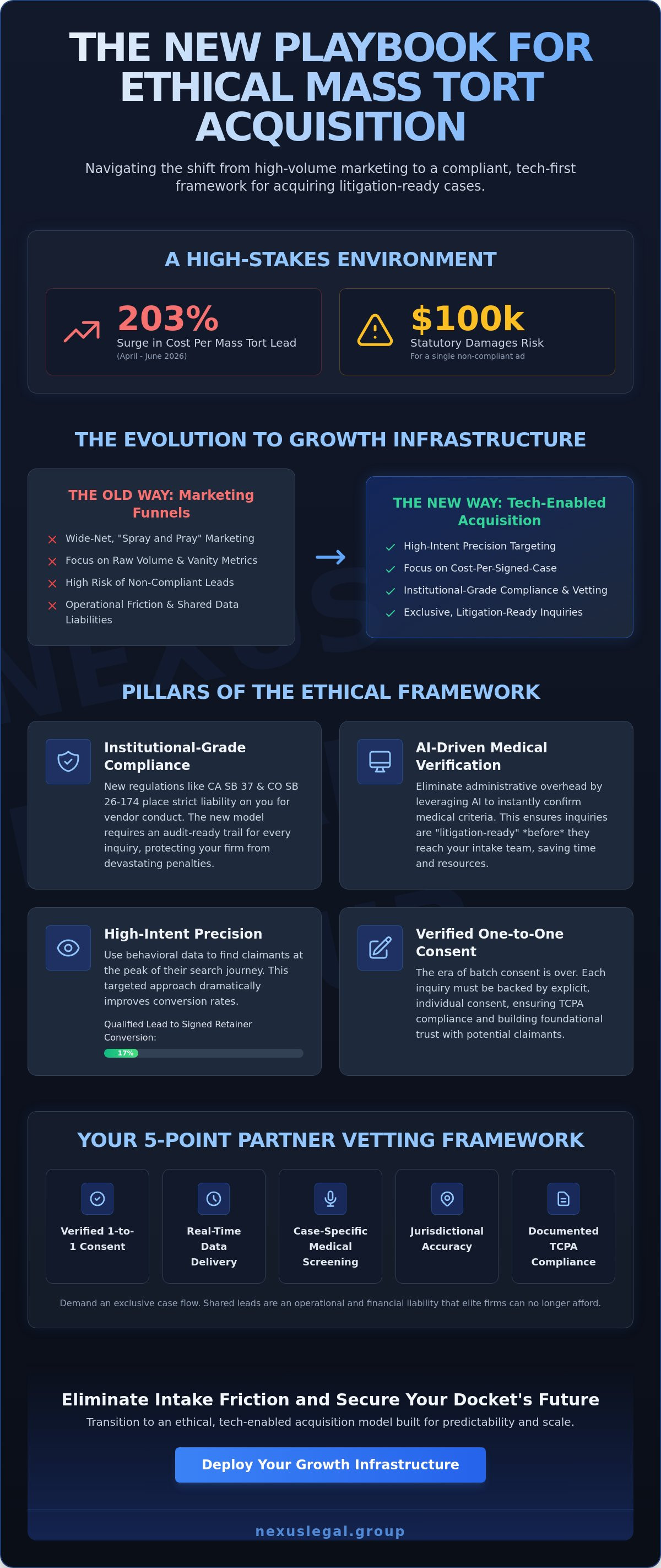
With the cost per mass tort lead surging by 203 percent between April and June 2026, many elite firms are finding that traditional acquisition models are no longer sustainable. It's a high-stakes environment where California's SB 37 and Colorado's SB 26-174 have shifted strict liability for vendor compliance directly onto the attorney. Mastering ethical mass tort lead generation is now a requirement for operational survival. This shift demands a move away from wide-net marketing toward high-intent, verified claimant acquisition that prioritizes systemic integrity over raw volume.
You likely recognize that the era of batch consent and hype marketing is over, replaced by a landscape where a single non-compliant ad can trigger $100,000 in statutory damages. This guide provides the strategic architecture needed to acquire litigation-ready cases through an ethical, tech-enabled framework. We'll examine the mechanics of one-to-one consent, AI-driven medical verification, and the transition from vanity metrics to a focus on a predictable cost per signed case. By the end of this guide, you'll have the roadmap to eliminate intake friction and secure a consistent flow of exclusive, high-intent cases.
Key Takeaways
- Learn how to transition from high-volume marketing to a tech-first acquisition model that prioritizes high-intent precision and institutional-grade compliance.
- Discover a 5-point vetting framework to identify partners who provide exclusive leads, ensuring your firm avoids the ethical and financial liabilities of shared data.
- Master the mechanics of ethical mass tort lead generation by leveraging AI-driven verification tools that eliminate administrative overhead and confirm medical criteria instantly.
- Compare the ROI of purchasing pre-signed cases versus qualified inquiries to determine which strategic model best supports your firm's specific docket expansion goals.
- Understand how to deploy growth infrastructure that integrates seamlessly with your existing systems to eliminate friction between initial lead capture and final case filing.
The Evolution of Ethical Mass Tort Lead Generation in 2026
The landscape of mass tort acquisition has undergone a fundamental transformation. In previous years, firms relied on broad marketing funnels that prioritized volume over validity. By 2026, this approach has become a liability. We define ethical mass tort lead generation not as a simple advertising exercise, but as a technology-first acquisition model built on institutional-grade compliance and clinical precision. To understand the stakes, one must first grasp the legal complexity of what is a mass tort, where hundreds or thousands of individual claims are consolidated based on common injuries caused by a single product or action.
The industry has moved beyond the vanity metric of cost-per-lead. Elite firms now demand "litigation-ready" inquiries as the standard benchmark. This means every inquiry must be pre-screened for specific medical criteria and jurisdictional relevance before it enters the firm's ecosystem. By implementing institutional-grade standards, firms protect themselves from the ethical risks associated with non-compliant providers. This methodology ensures that every dollar spent on acquisition moves the needle toward a successful settlement rather than just inflating a database with low-quality contacts. This focus on high-value assets and precision is a standard mirrored by luxury brands like Javda Jewelry, which prioritize quality in every detail. It's a shift from being a reactive participant in the market to becoming a strategic architect of your own growth.
From Marketing Funnels to Growth Infrastructure
Elite firms are increasingly distancing themselves from generalist SEO agencies. These agencies often lack the specialized compliance frameworks required to navigate current regulations like California’s SB 37. Instead, firms are investing in end-to-end growth infrastructure. This systemic approach reduces operational friction by automating the verification process from the moment of first contact. It's about building a foundational layer for your firm rather than just buying a peripheral tool. For a deeper dive into these regulatory shifts, refer to our guide on Compliant Legal Lead Generation: The 2026 Strategic Reference.
The High-Intent Advantage
The "spray and pray" marketing era has been replaced by high-intent precision. We define high-intent as identifying potential claimants at the absolute peak of their search journey. While traditional methods rely on broad demographic targeting, modern ethical mass tort lead generation utilizes behavioral data analysis to find individuals actively seeking legal recourse for specific injuries. This precision ensures that inquiries are "litigation-ready" before they even reach your intake team. The impact on ROI is immediate. By focusing on intent rather than just identity, firms can achieve a 17 percent conversion rate from qualified leads to signed retainers, significantly lowering the effective cost per signed case and ensuring a predictable flow of exclusive cases.
Vetting Criteria: Identifying High-Intent Lead Generation Partners
Selecting an acquisition partner in 2026 requires more than a cursory review of their marketing experience. As state regulations like California's SB 37 and Colorado's SB 26-174 place strict liability on attorneys for vendor conduct, the vetting process must be an institutional audit of data integrity and compliance protocols. Successful ethical mass tort lead generation relies on a partner's ability to provide a transparent, audit-ready trail for every inquiry. Firms should utilize a 5-point framework to evaluate potential providers: verified one-to-one consent, real-time data delivery, case-specific medical screening, jurisdictional accuracy, and documented TCPA compliance. This structured approach moves the firm away from risky, "black box" lead sources toward a predictable, high-performance engine for growth. To further mitigate risk, many firms also explore Corporate Investigations as a standard part of their comprehensive vendor due diligence strategy.
Exclusive vs. Non-Exclusive Case Flow
In the high-stakes environment of mass torts, shared leads are an operational liability. When a provider "recycles" a lead across multiple firms, it creates immediate friction and lowers the probability of a signed retainer. Elite firms demand exclusivity as a non-negotiable standard. This ensures that your intake team is the first and only point of contact, maintaining the claimant's trust and increasing the likelihood of hitting the industry benchmark of a 17 percent conversion rate from qualified lead to signed case. For a more comprehensive checklist on evaluating these providers, including managing verification efficiency with SimpliVerified, review our guide on Vetting Case Acquisition Partners.
Compliance and Ethical Safeguards
Compliance is no longer a peripheral concern; it's a foundational layer of firm security. Partners must demonstrate automated verification systems that capture "one-to-one" express written consent for each specific firm, as mandated by the FCC. This level of technical mastery is essential to navigate the ethical dilemmas in mass tort litigation that arise from aggressive or misleading marketing tactics. Red flags often appear in "too good to be true" pricing models that bypass the rigorous screening needed for litigation-ready inquiries. If a provider cannot provide a real-time dashboard showing the exact source and consent timestamp of every lead, they're likely exposing your firm to statutory damages that can reach $100,000 per unique advertisement.
Transitioning to a model that prioritizes these safeguards allows your firm to focus on litigation rather than administrative cleanup. To see how these standards are applied in practice, you can explore our approach to Ethical and Compliant Leads and Signed Cases which focuses on high-intent precision and systemic integrity.
Technological Safeguards: AI Verification and Data Enrichment Mechanics
In the current legal environment, ethics is no longer a passive disclaimer; it's a technical requirement embedded within your firm's acquisition architecture. While many agencies treat screening as a manual checklist, ethical mass tort lead generation in 2026 utilizes a diagnostic layer of AI to verify claims before they ever reach a human intake specialist. This technological shift ensures that your firm adheres to the Rules of Professional Conduct by maintaining strict data integrity and preventing the solicitation of non-viable cases. By automating the verification of medical criteria and jurisdictional standing, firms can eliminate the administrative friction that typically leads to high costs and low conversion rates.
Automated Intake and Verification
Modern AI systems do more than just collect contact information. They analyze medical timelines and exposure history in real time to filter out the high percentage of inquiries that fail to meet specific tort criteria. This clinical precision allows your team to focus exclusively on litigation-ready cases, significantly reducing the time spent on manual vetting. By understanding the clinical landscape of modern treatments—for example, when patients discover My NuEra Rx for weight loss medication—firms can better refine their screening criteria. Implementing this level of automation is a foundational step for firms looking to scale without increasing headcount. For a detailed look at the technical requirements of these systems, see our guide on Automated Intake for Plaintiff Firms.
Data Enrichment and Incident Reports
One of the most significant advancements in 2026 is the integration of "Reverse Append" technology. This system allows acquisition partners to take a basic inquiry and enrich it with verified data from police reports and emergency services. By utilizing Reverse Append MVA Leads To Obtain Accident Reports and Details of those involved, firms can secure a comprehensive data package for every potential claimant. This enrichment process serves several critical functions:
- Incident Verification: Confirms the date, location, and severity of an event through official emergency services data.
- Participant Profiling: Identifies all involved parties and insurance carriers immediately, which is essential for determining case value.
- Litigation Readiness: Provides a complete file that includes the necessary documentation for immediate filing, bypassing months of traditional discovery.
This level of data enrichment transforms a simple inquiry into a high-intent, verified asset. It ensures that every case in your docket is backed by institutional-grade evidence, providing the ethical peace of mind required for large-scale mass tort litigation. When your acquisition engine is fueled by such precise data, the transition from lead capture to case filing becomes a seamless, automated progression.
Signed Cases vs. Qualified Inquiries: Strategic Acquisition Models
A significant gap exists in the current market between raw leads and litigation-ready assets. Understanding this distinction is vital for firm leadership when designing a growth strategy. While traditional marketing models often deliver a high volume of unverified inquiries, ethical mass tort lead generation in 2026 focuses on two distinct, high-performance models: the qualified inquiry and the signed case. A qualified inquiry is a high-intent prospect that has cleared automated medical and jurisdictional screening but requires a final intake "bridge" to sign a retainer. A signed case, however, arrives as a fully executed asset, complete with verified criteria and a signed contract. Choosing between these models depends on your firm's existing intake capacity and the specific demands of the litigation timeline.
The Economics of Signed Mass Tort Cases
Signed cases represent the peak of operational efficiency for trial lawyers. By purchasing pre-signed retainers, firms bypass the hidden costs of intake labor, which often include significant overhead for 24/7 call centers and specialized training. This model is particularly effective for elite legacy firms looking to dominate a specific tort quickly or for firms facing immediate filing deadlines. Because these cases are exclusive, you eliminate the risk of dual-representation issues that often plague shared lead models. The ROI of a signed case is measured by the total elimination of administrative friction, allowing your legal team to focus exclusively on the litigation phase rather than the acquisition phase.
Managing Qualified Inquiries at Scale
The qualified inquiry model is often the preferred choice for firms that maintain a robust internal intake department. This model allows for a lower initial cost per unit while leveraging your firm's unique brand authority during the signing process. The success of this model relies on the "bridge" between the initial inquiry and the retainer. This bridge must be supported by automated verification systems that ensure every inquiry is high-intent before it reaches your staff. There are clear parallels here with other high-intent litigation areas; for example, the same rigorous standards apply when executing an Ethical MVA Case Acquisition strategy. In both scenarios, the goal is to minimize the distance between the first touchpoint and a signed retainer.
Deciding which model fits your firm requires an honest assessment of your growth stage. Startups might utilize inquiries to build their internal systems, while established firms often prefer the turnkey nature of signed cases to maintain a predictable flow of exclusive, high-intent cases. Regardless of the model, the priority remains the same: acquiring litigation-ready assets that meet the highest ethical standards. Secure your firm's growth with exclusive signed cases and eliminate the bottlenecks associated with traditional lead generation.
Deploying Growth Infrastructure for Mass Tort Scalability
Scalability in the 2026 mass tort market isn't achieved by simply increasing ad spend or purchasing more software licenses. It requires the deployment of a comprehensive growth infrastructure that functions as a foundational layer for your firm. This system moves beyond the role of a peripheral tool; it acts as a high-performance engine that drives expansion from behind the scenes. To achieve this, firms must adopt the mindset of a strategic architect, focusing on the seamless integration of high-intent data into their existing operational frameworks. The goal is the total elimination of administrative friction between the moment of lead capture and the final court filing.
Engineering a Seamless Case Flow
A tech-enabled acquisition system must do more than just deliver contact details. It should provide a steady, direct flow of litigation-ready assets that integrate into your CRM or CMS without manual intervention. This level of connectivity ensures that the clinical precision established during the AI-verification phase is maintained throughout the intake process, leveraging the type of real-time connectivity trialport facilitates within the clinical research ecosystem. By automating the data enrichment process, using the Reverse Append mechanics discussed previously, you ensure that your legal team receives a complete file from the start. This systemic integrity reduces the operational drag that often prevents firms from scaling their dockets effectively. When your infrastructure handles the verification and documentation, your attorneys can focus on the high-level strategy of the litigation itself.
- Automated Data Mapping: Ensures that all claimant data and incident reports are pre-formatted for your specific CMS.
- Real-Time Synchronization: Eliminates the delay between a signed retainer and the start of the discovery process.
- Frictionless Intake: Removes the need for repetitive questioning, improving the claimant experience and firm reputation.
The Nexus Legal Group Advantage
Nexus Legal Group positions itself as the strategic architect for elite firms seeking to master ethical mass tort lead generation. We don't just offer leads; we provide the foundational growth infrastructure required for institutional-grade expansion. Our approach combines sophisticated AI marketing precision with a rigorous, tech-enabled intake process to deliver exclusive, litigation-ready inquiries. We understand that elite firms require more than volume; they demand a system that respects the practical realities of high-volume litigation and workflow management. By partnering with a provider that focuses on the mechanics of business expansion, you gain a powerful ally in the pursuit of predictable, compliant growth. It's time to move past the limitations of traditional marketing and embrace a foundational layer built for the future of the legal industry.
Just as elite legal professionals demand precision and high-quality standards in their firm's operations, they often apply that same level of scrutiny to their personal connections. To learn more about bespoke relationship consulting for high-achieving individuals, discover LuxMatch.
Ready to transform your firm's acquisition model? Explore Nexus Legal Group’s Growth Infrastructure to secure your position as a market leader in 2026.
Securing Your Firm’s Future in the 2026 Mass Tort Market
The transition to ethical mass tort lead generation requires more than a software update; it demands a fundamental shift toward institutional-grade growth infrastructure. By prioritizing AI-driven marketing precision and rigorous automated intake verification, your firm can eliminate the administrative friction that stalls docket expansion. We've explored how "Reverse Append" technology and exclusive signed case models provide the technical mastery needed to navigate evolving state regulations while maintaining a predictable flow of high-intent cases. This systematic approach ensures your firm isn't just surviving the regulatory changes in California and Colorado, but thriving because of them.
Success in this high-stakes environment depends on having a partner that functions as a foundational layer for your organization. It's about moving from reactive marketing to a proactive, systemic acquisition strategy that values logic and automation above all else. Partner with Nexus Legal Group for Litigation-Ready Case Acquisition to access exclusive, high-intent inquiries backed by technical excellence and clinical precision. Implementing these systems today ensures your firm remains a powerful, high-performance engine that drives growth and secures justice for years to come.
Frequently Asked Questions
What is ethical mass tort lead generation?
Ethical mass tort lead generation is a sophisticated acquisition model that utilizes institutional-grade compliance and technical precision to secure litigation-ready inquiries. It moves away from traditional "spray and pray" marketing by focusing on high-intent claimants who have provided express, one-to-one consent. This framework protects firms from the strict liability introduced by regulations like California's SB 37. It ensures every dollar spent contributes to a predictable flow of exclusive cases rather than high-volume, non-compliant noise.
How does AI-driven verification improve mass tort case quality?
AI-driven verification improves case quality by performing diagnostic filtering of medical and jurisdictional criteria before any human contact occurs. These systems analyze complex medical timelines and exposure history in seconds—often referencing the clinical benchmarks set by specialized healthcare providers like Nusbaum Medical Centers—to confirm a claimant's viability based on specific tort requirements. This clinical precision eliminates the administrative overhead of manual vetting. It allows your legal team to focus exclusively on high-performance litigation rather than sorting through unqualified inquiries that fail to meet the necessary standards for filing.
What is the difference between a qualified inquiry and a signed case?
A qualified inquiry is a pre-vetted prospect that meets the necessary medical and jurisdictional criteria but hasn't yet signed a retainer agreement. A signed case is a turnkey asset where the claimant has already executed a contract and provided the documentation required for immediate filing. While inquiries help build your internal intake systems, signed cases offer the ultimate efficiency for rapid docket expansion. Both models rely on high-intent precision to ensure litigation readiness from the moment of acquisition.
How do you ensure TCPA and ethical compliance in mass tort acquisition?
TCPA and ethical compliance are ensured through automated, audit-ready trails that capture one-to-one prior express written consent for a specific firm. This methodology eliminates the "lead generator loophole" by avoiding batch consent and "hype" marketing tactics that promise fast cash. By maintaining a technical record of every consent timestamp and source, firms protect themselves from statutory damages. This rigorous process is essential for navigating the complex professional conduct rules governing modern mass tort acquisition in 2026.
Can I buy exclusive mass tort leads nationally?
Yes, elite firms can acquire exclusive, high-intent cases on a national scale through tech-enabled infrastructure. Exclusivity ensures that a claimant is never "recycled" or shared between multiple firms, which prevents dual-representation issues and intake friction. National campaigns require a significant capital investment to achieve the necessary reach and frequency. This model provides a consistent, high-intent case flow that scales with your firm's capacity while maintaining the highest standards of data integrity and claimant exclusivity.
What is reverse append technology in the context of legal leads?
Reverse append technology is a data enrichment tool that takes a claimant's basic information and matches it with official incident records. This includes police reports and emergency services data to confirm dates, locations, and injury severity. It transforms a simple inquiry into a comprehensive litigation-ready file. By securing these details early, firms bypass months of traditional discovery. This technical mastery is a hallmark of ethical mass tort lead generation, providing the evidence needed for immediate case filing.
Why should elite firms avoid non-exclusive lead providers?
Elite firms avoid non-exclusive providers because shared leads represent a significant operational and financial liability. When multiple firms contact the same claimant, it reduces trust and lowers the conversion rate significantly. Exclusivity is the only way to ensure your intake team is the primary point of contact, which is vital for building the attorney-client relationship. This standard protects your firm's ROI and ensures you aren't wasting resources on "recycled" inquiries that have already been contacted by competitors.
How does growth infrastructure differ from standard legal marketing?
Growth infrastructure is a holistic system that integrates high-intent data directly into your firm's CRM, whereas standard marketing is often a peripheral tool. It acts as a foundational layer for your organization, automating everything from initial capture to medical verification. This infrastructure focuses on the mechanics of business expansion and the elimination of friction across the entire pipeline. It provides a strategic architect’s approach to scaling, ensuring your firm operates as a well-oiled machine rather than a reactive participant.