Reverse Append Accident Report Leads: The 2026 Guide to Data-Driven MVA Case Acquisition
Learn how reverse append accident report leads transform basic inquiries into high-value MVA cases. Our 2026 guide helps you cut costs and streamline intake.
The most expensive component of your firm's intake process isn't the lead itself; it's the time your staff spends chasing fragmented data that leads to a dead end. You've likely experienced the frustration of investing in high-volume digital inquiries only to find they lack the critical police report details required to establish liability. This operational friction is why elite firms are shifting their strategy toward reverse append accident report leads. By using sophisticated data enrichment, you can transform a simple name or phone number into a comprehensive, verified overview of the incident.
We understand that scaling your case volume often feels like a trade-off against case quality. It's a difficult balance to maintain when your intake team is bogged down by manual verification and incomplete participant profiles. This guide promises to show you how to eliminate that friction by implementing reverse append technology as a mechanical filter for your MVA acquisition. You'll discover how to automate the verification of accident severity and access enriched data sets that make your inquiries litigation-ready from the first touch. We'll break down the 2026 standards for data-driven acquisition, focusing on how to reduce your cost-per-signed-case while securing the precise details that drive higher settlement values.
Key Takeaways
- Learn how reverse append accident report leads allow your firm to convert single data points into authoritative police report data, eliminating the guesswork from case selection.
- Understand the mechanics of cross-referencing digital inquiries against national emergency services databases to verify accident severity programmatically.
- Discover why enriched, appended data significantly reduces the "friction gap" in intake, leading to shorter call durations and higher conversion rates.
- Explore the 2026 framework for integrating automated verification into your growth infrastructure to move seamlessly from data append to a signed retainer.
- Identify the clinical precision required to scale MVA case acquisition through systems that prioritize high-intent litigation over raw lead volume.
What are Reverse Append Accident Report Leads?
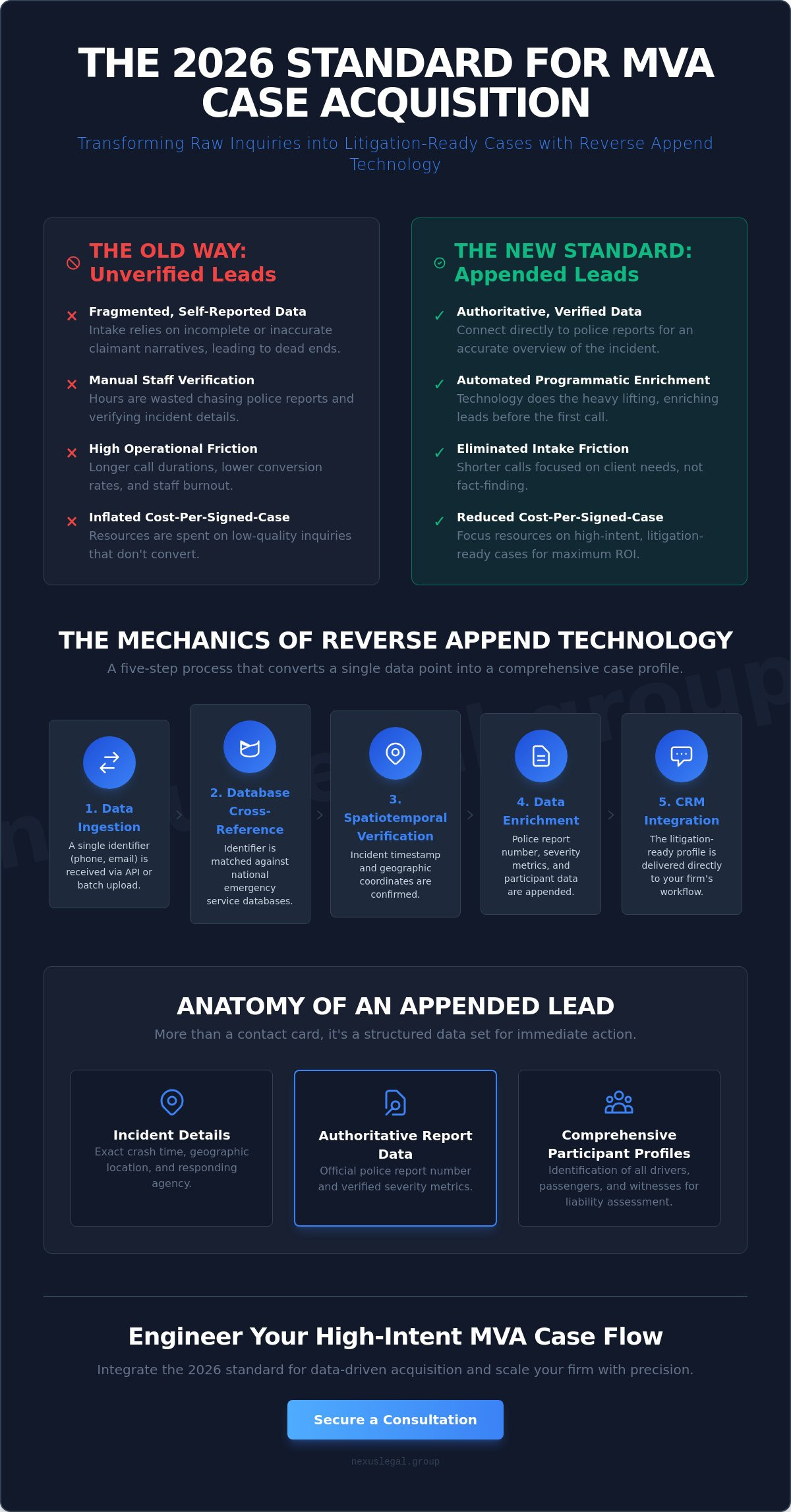
In the context of modern MVA case acquisition, a reverse append is a technological process that utilizes a single known identifier to programmatically extract comprehensive incident data from official records. Unlike traditional lead generation where you rely on a claimant's self-reported narrative, reverse append accident report leads provide a direct bridge to authoritative police reports. This transformation shifts the intake burden from manual investigation to automated verification. By the time your intake team picks up the phone, they aren't asking if an accident happened; they're confirming details already validated by law enforcement databases.
The shift toward this data-backed model in 2026 is driven by the necessity for operational efficiency. As digital lead costs rise, firms can't afford to waste resources on unverified inquiries. To understand the underlying logic, one can look at The Mechanics of Data Appending, which describes how specific data points like a name or address are used to match and retrieve additional missing information from a centralized database. In the legal space, this translates to using a phone number or email to resolve a person's identity and link them to a specific accident report number through advanced identity resolution.
The Core Components of an Appended Lead
An appended lead isn't just a contact card; it's a structured data set designed for immediate action. It begins with primary identifiers such as a phone number, email address, or even a vehicle identification number (VIN). Once matched, the system retrieves enriched data points including the exact crash time, the geographic location of the impact, and the specific responding agency. Most importantly, it provides detailed participant profiles. This includes identifying drivers, passengers, and witnesses, allowing your firm to assess liability and potential case value before the first intake call is ever placed. This level of transparency ensures that your reverse append accident report leads are ready for litigation from the moment they enter your CRM.
For firms representing professional drivers or those in other high-risk vocations, having this data upfront is invaluable; as these individuals often require specialized financial services, you can learn more about Special Risk Term to see how they help high-risk professionals secure life insurance.
Why Elite Firms are Moving Away from Unverified Leads
Traditional "blind" intake processes carry significant hidden costs that erode your margin. When your staff spends hours chasing leads that turn out to be minor fender benders or fraudulent claims, the cost-per-signed-case skyrockets. This cycle often leads to attorney burnout, as high-level legal talent is forced to sift through low-quality inquiries. In the current competitive environment, the demand for litigation-ready inquiries has made unverified leads a liability rather than an asset. By integrating the philosophy of high-intent acquisition found at Nexus Legal Group, firms ensure their growth is built on a foundation of verified, actionable data that eliminates friction and maximizes ROI.
The Mechanics of Reverse Append Technology
The operational efficiency of a modern law firm depends on the integrity of its data pipeline. Reverse append technology functions as a high-performance engine that converts fragmented digital inquiries into high-utility assets. This process isn't a simple lookup; it's a multi-stage technical sequence designed to eliminate the ambiguity inherent in traditional lead generation. By following a structured mechanical flow, firms can ensure that every inquiry they pursue is backed by documented evidence.
- Step 1: Data Ingestion. The process begins with the input of digital lead data via a real-time API or a secure batch upload. This initial data often consists of a single identifier like a phone number or email address.
- Step 2: Database Cross-Referencing. The system immediately cross-references these identifiers against a vast network of national emergency services and police report databases to find a match.
- Step 3: Spatiotemporal Verification. Once a match is identified, the technology verifies the incident timestamp and geographic coordinates. This ensures the inquiry correlates precisely with a documented crash event.
- Step 4: Data Enrichment. The system programmatically appends the official police report number and severity metrics. This stage transforms a lead into a comprehensive case profile.
- Step 5: CRM Integration. The litigation-ready inquiry is delivered directly to the firm’s CRM, allowing intake teams to act with full situational awareness.
By implementing reverse append accident report leads, firms remove the "discovery" phase from their intake calls. You aren't calling to find out if an accident happened; you're calling to secure a case you've already verified.
AI-Driven Precision in Data Matching
Modern systems utilize machine learning to minimize false positives during the matching phase. These algorithms analyze reporting patterns and lag times to ensure the correlation between a digital lead and an accident report is statistically sound. Real-time data access is mandatory for this to work. If your data isn't current, your intake team will always be a step behind. Identity resolution is the programmatic process of correlating fragmented digital footprints into a verified legal persona linked to a specific crash event. This precision is what separates elite firms from those struggling with low-intent inquiries.
Ethical and Compliant Data Sourcing
Operating within the Ethical and Regulatory Landscape of 2026 requires more than basic due diligence. It demands a structural commitment to the Drivers Privacy Protection Act (DPPA) and state-specific privacy mandates. Firms must confirm that their data providers maintain permissible use protocols for legal marketing and case evaluation. Compliance isn't an optional feature; it's a foundational requirement for sustainable growth. Nexus Legal Group maintains these rigorous ethical standards, ensuring that every lead is obtained through transparent and law-abiding channels. Utilizing verified case acquisition systems allows your firm to scale volume without compromising its professional standing or regulatory standing.
Appended Data vs. Unverified Leads: A Strategic Comparison
Efficiency is the metric that defines the gap between a growing firm and a stagnant one. When you compare raw digital inquiries to reverse append accident report leads, the difference isn't just in the volume of data provided, but in the structural integrity of the acquisition process itself. Just as legal professionals require this level of data precision, real estate agents can discover Landvoice to access high-quality leads on expired listings and FSBO properties. This shift from subjective narrative to objective fact fundamentally alters your conversion potential.
The "Friction Gap" represents the time and resources lost during the initial intake phase. Traditional leads require an extensive discovery process to determine if a case is even worth pursuing. By contrast, verified inquiries arrive with the accident report details already attached. Your intake team doesn't need to ask where the impact occurred or which agency responded. They already have the report number. This preparation reduces call duration and allows your staff to focus on building rapport and securing the retainer rather than playing investigator.
Severity assessment is another critical advantage of the data-driven model. Before the first phone call is even placed, your firm can prioritize high-value cases based on objective metrics like airbag deployment, ambulance transport, or vehicle tow-away status. This clinical approach to case selection ensures that your most talented intake specialists are dedicated to the highest-intent inquiries. It also serves as a primary layer of fraud mitigation. By cross-referencing every lead against official records, you can immediately identify and discard fabricated incidents that would otherwise drain your department's resources.
Identifying high-severity cases often involves recognizing symptoms that aren't immediately obvious, such as upper neck injuries. Law firms can better support their clients by helping them discover Precision Spinal Care, which specializes in addressing complex post-accident symptoms like throat tightness and swallowing discomfort that may be linked to the upper neck.
Operational Metrics for Case Acquisition
The most revealing metric in this comparison is the cost-per-signed-case (CPSC). While raw leads might have a lower initial purchase price, their true cost is inflated by low conversion rates and high labor overhead. Enriched data sets support more accurate case valuation during the initial screening, ensuring that your marketing spend is allocated to cases with the highest settlement potential. This precision has a direct impact on staff morale. Eliminating the "dialing for dollars" grind of unverified lists allows your team to operate as high-level consultants, which significantly reduces turnover in the intake department.
The Quality Hierarchy in MVA Case Acquisition
To scale effectively, firms must categorize their acquisition channels into a clear hierarchy of intent and friction:
- Level 1: Raw Digital Leads. These are characterized by low intent and high friction. They often lack verified contact information and require significant labor to qualify.
- Level 2: Verified Inquiries. These offer medium intent and reduced friction. Basic contact details have been confirmed, but the incident specifics remain self-reported.
- Level 3: Appended, Litigation-Ready Cases. This is the gold standard for High-Intent MVA Case Acquisition. These inquiries are backed by official accident reports, providing the clinical precision required for immediate litigation.
Choosing to operate at Level 3 isn't just a marketing decision; it's a commitment to an engineering-first growth strategy that prioritizes data integrity over raw lead volume.
Integrating Appended Leads into Your Growth Infrastructure
Purchasing data is a tactical move; integrating it into a comprehensive growth framework is a strategic one. Standalone data tools often fail to deliver a high ROI because they create information silos that your intake team must manage manually. To truly leverage reverse append accident report leads, the enrichment process must be a foundational component of your operational ecosystem. When data flows seamlessly from the point of identification to the final signed retainer, your firm can operate with a level of clinical precision that manual processes simply cannot match.
The goal is to automate the intake workflow so that human intervention is reserved for high-value decision-making. In a well-engineered system, the moment a digital inquiry is received, the reverse append process triggers automatically. The system retrieves the police report number, verifies the crash details, and populates your CRM with a litigation-ready profile. This ensures that your intake specialists aren't wasting time on data entry or manual verification. Instead, they're immediately engaging with high-intent claimants who have already been vetted by your internal systems. This connectivity allows you to scale your case volume without a proportional increase in administrative overhead.
Building a Scalable Case Acquisition System
A robust law firm growth infrastructure is the only way to ensure your acquisition efforts aren't bottlenecked by slow, manual tasks. By utilizing accident report enrichment for lawyers, you can dominate local markets by moving faster than competitors who still rely on claimant-reported data. Automated verification acts as a quality control filter, ensuring that only cases meeting your specific severity and liability criteria reach your desk. This systemic approach transforms your firm from a reactive lead buyer into a proactive case acquirer.
Data Governance for Modern Plaintiff Firms
As you scale, managing large datasets of sensitive accident information becomes a significant operational responsibility. You must maintain a clean "source of truth" within your firm’s database to avoid duplicate records and fragmented case files. Effective data governance ensures that every piece of enriched information is stored securely and is easily accessible for future litigation needs. This focus on systemic integrity also helps future-proof your acquisition strategy against evolving privacy regulations. By building your growth on a foundation of ethical and compliant data practices, you ensure long-term stability for your practice. If you want to see how these systems function in a real-world environment, Nexus Legal Group provides the engineering expertise required to build a high-performance acquisition engine.
Nexus Legal Group: Engineering High-Intent MVA Case Flow
The transition from traditional lead generation to high-intent case acquisition requires a partner that understands the mechanical nuances of data integrity. Nexus Legal Group functions as a strategic architect for plaintiff firms, providing the foundational technology needed to dominate the MVA landscape. We don't just provide contact lists; we engineer a continuous flow of litigation-ready inquiries by combining AI-driven precision with rigorous intake verification. This clinical approach ensures that your firm isn't sifting through digital noise, but instead focusing on cases with a documented path to settlement.
By leveraging reverse append accident report leads, we provide a level of transparency that traditional providers cannot match. Our systems are designed to bridge the gap between a digital inquiry and an official police record in real time. This capability allows elite firms to move beyond the limitations of unverified data. When you partner with us, you're investing in a system that prioritizes case quality and liability clarity from the very first touchpoint. It's a shift from a reactive marketing model to a proactive acquisition engine that positions your firm as the logical choice for high-value claimants.
The Nexus Advantage: Precision and Compliance
Our end-to-end infrastructure is built specifically for the complexities of motor vehicle accident case acquisition. We utilize a sophisticated data layer that cross-references inquiries against police reports and emergency services data to ensure unparalleled accuracy. This isn't just about enrichment; it's about establishing a verifiable "source of truth" for every inquiry. Our commitment to ethical, compliant, and exclusive case generation means you don't have to worry about the regulatory risks often associated with high-volume data marketing. We handle the technical heavy lifting of identity resolution and accident verification so your team can focus on what they do best: practicing law.
Next Steps for Scalable Growth
The first step toward a more efficient practice is a cold evaluation of your current acquisition mechanics. If your intake team is still spending a significant portion of their day verifying basic accident details, your system is inefficient. Transitioning to a data-driven acquisition model in 2026 isn't just an upgrade; it's a necessity for survival in a competitive market. You need a system that reduces your cost-per-signed-case while increasing the overall value of your docket. We invite you to contact Nexus Legal Group to engineer your firm’s growth and implement a case acquisition strategy that is built for the future of the legal industry. The path to a frictionless, high-performance practice starts with the decision to prioritize data-backed results over raw lead volume.
Optimizing Your Acquisition Engine for the 2026 Legal Landscape
The shift toward data-driven MVA acquisition is no longer a luxury; it's a structural necessity for operational efficiency. By prioritizing verified incident data over self-reported narratives, you eliminate the friction that typically slows down intake and inflates your cost-per-signed-case. This systemic approach ensures your high-level talent stays focused on litigation rather than administrative discovery. It's about moving from a reactive posture to a proactive, engineering-first strategy.
Implementing reverse append accident report leads allows your firm to move with clinical precision, securing exclusive inquiries that are backed by official records from the moment they enter your CRM. This level of automation doesn't just improve your conversion rates; it fundamentally changes the trajectory of your practice's growth by providing a clean, authoritative source of truth for every case. You're no longer guessing at liability; you're acting on verified intelligence.
It's time to move beyond fragmented lead generation and embrace a master-of-systems approach. Partner with Nexus Legal Group for high-intent MVA case acquisition and leverage our AI-driven marketing precision and rigorous intake verification to secure exclusive, litigation-ready inquiries. You've built a strong practice; now give it the high-performance engine it deserves to thrive.
Frequently Asked Questions
What is the primary benefit of using reverse append for accident leads?
The primary benefit is the immediate validation of incident details, which eliminates the firm's reliance on subjective claimant narratives. By using reverse append accident report leads, firms can verify the date, time, and location of a crash before the first intake call is placed. This structural advantage allows your team to focus exclusively on high-intent inquiries with documented proof of loss, significantly reducing the labor overhead spent on unverified inquiries.
Is reverse append technology compliant with the DPPA?
Yes, this technology is compliant with the Drivers Privacy Protection Act (DPPA) when used for permissible purposes like legal case evaluation and potential litigation. Compliance is maintained by ensuring that data access is restricted to authorized entities with a legitimate legal interest in the incident records. Nexus Legal Group adheres to these rigorous ethical and regulatory standards, providing a secure framework for firms to scale their acquisition efforts without compromising data integrity.
How does reverse append data differ from standard skip tracing?
Standard skip tracing focuses on locating individuals through contact data, while reverse append identifies specific incident details and correlates them to a claimant. While skip tracing might provide a current address, reverse append technology retrieves the police report number, crash severity, and responding agency. This process transforms a simple contact record into a comprehensive case profile, allowing firms to assess the legal viability of an inquiry with clinical precision.
Can reverse append identify the at-fault party in a motor vehicle accident?
Reverse append technology can identify the at-fault party by programmatically retrieving the official law enforcement incident report. These reports typically contain the officer's assessment of the crash dynamics, citations issued—which may lead a firm to explore DUI Defense with the Law Office of Kevin Bessant & Associates—and contributing factors to the accident. Accessing this authoritative data early in the intake process allows your firm to establish liability and determine the potential for recovery before investing significant resources into the case.
What data points are required to initiate a reverse append search?
Initiating a search typically requires a single verified identifier such as a phone number, email address, or a combination of a name and zip code. Once this anchor point is established, the system cross-references national databases to resolve the claimant's identity and link them to a specific accident event. This streamlined input process allows for the rapid generation of reverse append accident report leads, enabling your firm to move from an inquiry to a verified profile in seconds.
How does enriched accident data improve case conversion rates?
Enriched data improves conversion rates by reducing the "friction gap" during the initial intake phase. When your specialists have the accident report details in front of them, they can skip the discovery phase and move directly to rapport building and securing the retainer. This preparation increases the claimant's confidence in your firm's expertise and results in shorter call durations, allowing your team to handle a higher volume of inquiries more effectively.
Is this technology suitable for mass tort case acquisition?
This technology is highly suitable for mass tort case acquisition, particularly for litigations centered on specific geographic incidents or widespread product failures involving motor vehicles. By programmatically identifying individuals involved in documented events, firms can build a high-intent claimant pool with verified proof of injury or involvement. This data-driven approach ensures that mass tort dockets are populated with litigation-ready cases that meet the specific criteria for the litigation at hand.
Does Nexus Legal Group provide the software or the verified leads?
Nexus Legal Group provides a comprehensive case acquisition service that delivers verified, high-intent inquiries rather than just standalone software. We manage the entire technological and intake infrastructure, from the initial data append to the final verification of accident severity. Our goal is to provide elite firms with a consistent flow of litigation-ready cases, allowing you to scale your practice without the burden of managing complex data pipelines or unverified lead lists.