Police Report Leads vs. Emergency Data Leads: A Strategic Guide for Attorneys
Struggling with police report leads vs emergency data leads? This guide helps attorneys leverage both to sign MVA cases faster and scale their firm's intake.
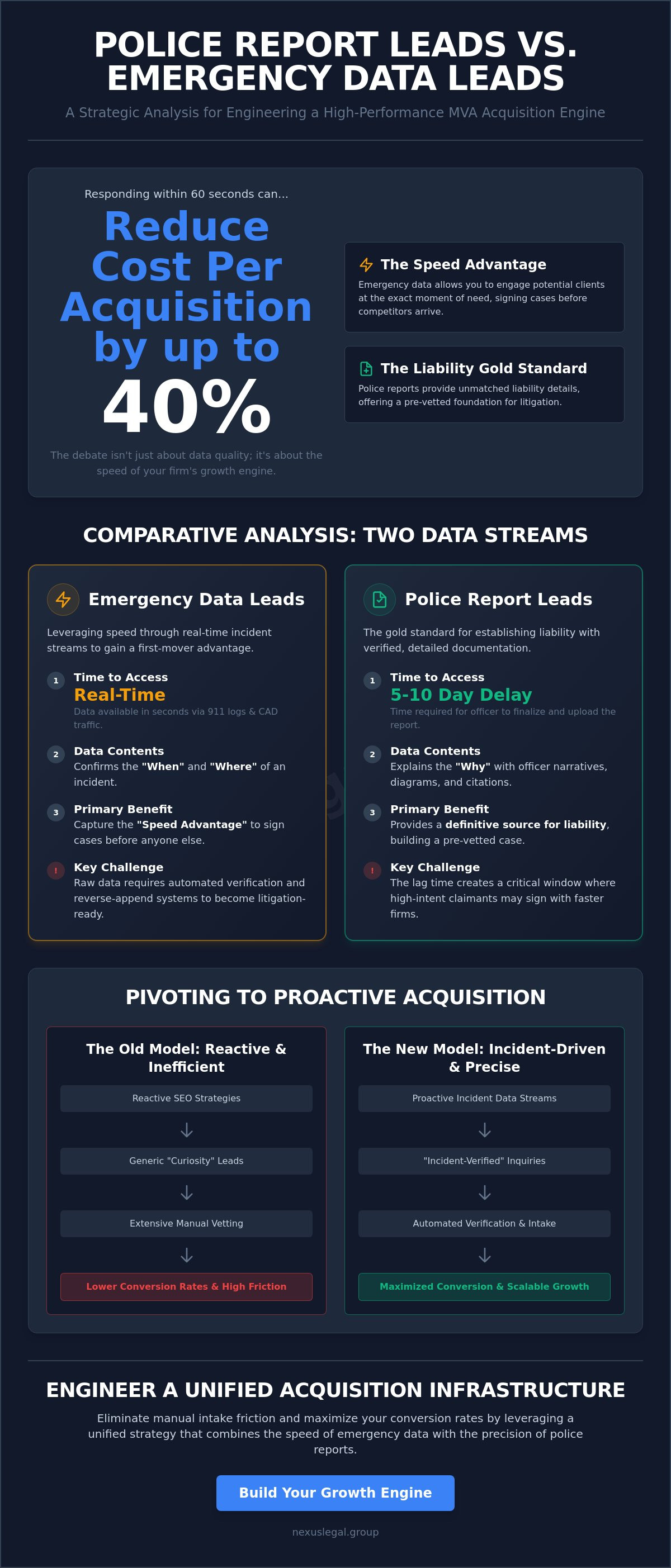
The "gold standard" police report might actually be the primary bottleneck preventing your firm from scaling its motor vehicle accident docket. While these documents offer unmatched liability details, relying solely on them often means your intake team is competing for a lead that has already been signed by a faster firm. In a landscape where responding to a lead within 60 seconds can reduce your cost per acquisition by up to 40 percent, the debate over police report leads vs emergency data leads isn't just about data quality; it's about the fundamental mechanics of your firm's growth engine.
You likely recognize that high-intent leads are becoming increasingly expensive and difficult to secure under new regulatory frameworks like the FCC one-to-one consensual rule. This guide provides a clinical analysis of how to leverage both incident-based data streams to eliminate manual intake friction and maximize your conversion rates. We will dissect the strategic trade-offs between immediate emergency alerts and verified police documentation to help you engineer a scalable, litigation-ready inquiry system that operates with surgical precision and eliminates the lag time that kills high-value cases.
Key Takeaways
- Shift from reactive SEO strategies to proactive, incident-driven acquisition to source high-intent MVA inquiries with clinical precision.
- Master the anatomy of police reports to leverage officer narratives and diagrammatic evidence for immediate liability verification.
- Capture the "speed advantage" by accessing real-time emergency data streams, including 911 logs and CAD traffic, to sign cases before competitors.
- Analyze the critical trade-offs in police report leads vs emergency data leads to engineer a high-performance acquisition engine tailored to your firm's ROI goals.
- Implement automated verification and reverse-append systems to transform raw incident data into litigation-ready opportunities with minimal friction.
Understanding Incident-Driven Case Acquisition in 2026
Incident-driven case acquisition represents a fundamental pivot in how high-performance law firms scale their dockets. In 2026, the strategy has moved beyond passive reliance on organic search rankings toward a proactive, clinical sourcing model. This approach defines incident-driven acquisition as the systematic sourcing of motor vehicle accident (MVA) inquiries based on real-time or recorded accident data. It eliminates the guesswork inherent in traditional marketing, replacing "hope-based" lead generation with precision data streams that target confirmed events.
The shift from reactive SEO-based lead generation to clinical data precision is driven by the need for operational efficiency. While SEO remains a valuable long-term asset, it often produces inquiries at varying stages of the claimant journey. Incident-driven models allow firms to engage potential clients at the exact moment of need. This is why elite plaintiff firms are prioritizing "litigation-ready" inquiries backed by verified accident details over generic leads that require extensive manual vetting. To manage these high-volume data streams effectively, firms like Nexus Legal Group must implement a robust law firm growth infrastructure that can ingest, filter, and assign inquiries in seconds.
The Mechanics of Data-Driven Sourcing
The process begins by identifying two primary data streams. First, Police Accident Reports (PAR) provide a comprehensive view of the incident, often categorized through systems similar to the FBI's Uniform Crime Reporting (UCR) program to ensure standardized data fields. Second, Computer-Aided Dispatch (CAD) data offers a real-time window into emergency responses. When evaluating police report leads vs emergency data leads, it's essential to understand that AI-driven filters are what isolate high-value accidents from minor fender-benders. This technology transitions raw data points into a comprehensive claimant profile before your intake team even picks up the phone.
Why Intent Matters More Than Volume
High lead volume is often a vanity metric that masks operational inefficiency. There's a massive difference between a "curiosity click" from a Google search and an "incident-verified" inquiry. Data-backed intake significantly improves firm-wide conversion metrics by providing the intake department with the litigation-ready facts they need to establish rapport and authority immediately. By utilizing police report leads vs emergency data leads strategically, firms eliminate the friction of uncertainty. You aren't just calling a lead; you're reaching out to a verified accident victim with the relevant details already in hand. This level of preparation is what separates the market leaders from the rest of the field in a competitive landscape.
Police Report Leads: The Gold Standard for Establishing Liability
The police accident report serves as the investigative bedrock for any personal injury claim. Unlike preliminary incident notifications, these documents represent a formal determination of facts by law enforcement officers who have physically inspected the scene, interviewed witnesses, and assessed vehicle positioning. This level of detail is why many elite firms view them as the definitive source for liability. When weighing the benefits of police report leads vs emergency data leads, it's clear that the report provides the "why" behind an accident, whereas emergency data simply confirms the "when" and "where."
This distinction between immediate data and comprehensive reporting is mirrored in the logistics industry; for example, JVP Logística specializes in providing secure mobility and security solutions in Mexico, prioritizing both speed and safety in high-stakes environments.
In the broader context of automotive security and advanced driver assistance, you can learn more about AL Priority USA and their specialized laser defense systems designed for high-performance vehicle protection.
A comprehensive report contains several critical data fields that dictate a case's potential value. These include officer narratives, citations issued for traffic violations, and diagrammatic evidence illustrating the point of impact. Accessing police report generated MVA leads allows your firm to build a pre-vetted foundation for litigation before the initial intake call even concludes. However, this precision comes with a built-in operational hurdle: the lag time. While report fees vary across jurisdictions, often ranging from $6.00 to $20.00 per filing, the real cost is the 5 to 10 days typically required for an officer to finalize and upload the document. This delay creates a window where high-intent claimants may seek representation elsewhere if your firm relies solely on post-report acquisition.
Extracting Liability Indicators
Effective case vetting requires a clinical analysis of environmental factors and officer observations. Reports detail weather conditions, road surface integrity, and lighting, all of which can corroborate or refute a claimant's story. The most valuable data points are often the "Contributing Factors" codes. These standardized markers identify negligence, such as distracted driving or failure to yield, with authoritative finality. Identifying multi-vehicle complexities or the involvement of a commercial carrier within these reports also signals higher insurance policy limits, making the case a priority for your senior partners.
Vetting for Significant Damages
Data-driven firms use vehicle damage descriptions as a reliable proxy for injury severity. A report noting "disabling damage" or "vehicle towed from scene" correlates strongly with high-value medical claims. Furthermore, verifying EMS transport data within the police narrative ensures you aren't chasing low-impact soft tissue cases with limited recovery potential. By aggregating these facts, you can build a litigation-ready file that respects the ethical rules for attorney advertising while ensuring every outreach is grounded in verified evidence. If you want to streamline this process and eliminate the manual search for these documents, consider integrating a system designed for high-intent case acquisition that does the heavy lifting for you.
Emergency Data Leads: Leveraging Speed Through Real-Time Incident Streams
While police reports offer deep liability insights, they fail the critical test of immediacy. Emergency data leads prioritize the "Speed Advantage," allowing firms to identify potential claimants within minutes of an incident. This data stream consists of Computer-Aided Dispatch (CAD) logs, 911 call records, and EMS radio traffic. When evaluating police report leads vs emergency data leads, the primary differentiator is the compression of the response window. Research indicates that law firms responding to inquiries in under 60 seconds can reduce their effective cost per acquisition by 30 to 40 percent. This rapid response is only possible through real-time incident streams that bypass the standard administrative delays of law enforcement agencies.
The technical challenge with raw dispatch data is its inherent anonymity. CAD logs typically provide a location and a timestamp, but they lack the names and contact details found in a finalized report. This is where reverse append accident report leads become a vital component of your growth infrastructure. These systems utilize geolocation data and vehicle registration records to enrich anonymous logs, providing the necessary contact information to initiate outreach while the incident is still active. Selecting between police report leads vs emergency data leads requires a balance between the richness of the data and the urgency of the outreach.
The Role of Reverse Append Technology
Reverse append acts as the technical bridge between a 911 log and a signed case. By cross-referencing accident coordinates with proprietary databases, firms can identify participants and their contact information almost instantly. This automation reduces manual intake labor by eliminating the need for staff to scour public records or wait for manual report uploads. It transforms a raw data point into a high-intent outreach opportunity without the 5 to 10 day delay associated with traditional reports. It's a system designed for firms that value operational velocity above all else.
Capitalizing on the Golden Hour
Claimant intent is at its highest in the immediate aftermath of an accident. During this "Golden Hour," victims are actively seeking guidance and are most receptive to professional intervention. Lead decay is a clinical reality; the longer the gap between the accident and the contact, the lower the conversion rate. By utilizing automated verification systems, firms can secure inquiries while the details are fresh. However, you must manage the "Data Thinness" challenge. Because these leads lack the deep liability narratives of a police report, your intake teams must be trained to verify negligence during the initial screening call to ensure the case meets your firm's criteria.
Comparative Analysis: Police Reports vs. Emergency Services Data
Choosing between police report leads vs emergency data leads requires a fundamental understanding of your firm's operational capacity and growth objectives. It isn't a binary choice; it's a strategic allocation of resources based on the trade-off between velocity and verification. While emergency data offers an immediate entry point into a potential claimant's journey, police reports provide the forensic depth necessary to justify the investment of your firm's litigation budget. Elite firms recognize that the "speed to lead" metric is meaningless if the underlying data doesn't support a viable claim for damages.
The ROI profile for these streams differs significantly. Emergency data leads typically demand a higher volume of intake labor because the lack of liability detail requires your team to perform the vetting manually. However, the cost per signed case can be lower if your intake engine is optimized for sub-60-second responses. Conversely, police report leads offer a higher conversion rate from inquiry to signed case because the liability is already documented. You aren't guessing about negligence; the official record confirms it. Managing this across national jurisdictions adds complexity; different states have varying reporting timelines and access fees, making a unified data ingestion platform essential for firms looking to scale beyond their local market.
The Trade-Off: Speed vs. Precision
Emergency data provides high speed and high volume, but it necessitates an aggressive intake vetting process to filter out minor incidents. Police reports offer lower speed but higher precision, allowing for "elite" case selection based on confirmed injuries and clear liability. Sophisticated firms don't choose one over the other. Instead, they implement a hybrid approach where emergency data triggers the initial contact, and the subsequent police report validates the case's long-term viability. This synergy ensures you're first to the scene without sacrificing the quality of your docket. For firms across various practice areas, including the Law Office of Kevin Bessant & Associates in Michigan, this level of forensic attention to police records is vital for building a robust case strategy.
Compliance and Ethical Integrity
Maintaining compliant legal lead generation is non-negotiable in 2026. You must navigate the Driver's Privacy Protection Act (DPPA) with clinical precision to ensure that data sourcing doesn't trigger regulatory scrutiny. This involves strictly adhering to non-solicitation protocols and utilizing models that respect the FCC's "one-to-one consensual rule" effective January 2025. Under California's SB 37, which took effect in January 2026, attorneys face increased liability for the marketing tactics of their vendors. Ensuring your data partners are fully vetted for ethical integrity is the only way to protect your firm's reputation while pursuing aggressive growth. If you're ready to upgrade your firm's acquisition engine with ethical, data-backed streams, explore our options for high-intent MVA case acquisition today.
Nexus Legal Group: Engineering a Unified Acquisition Infrastructure
Nexus Legal Group bridges the operational gap between raw incident data and the final signed retainer. While many firms struggle with the internal debate of police report leads vs emergency data leads, our infrastructure treats these not as competing products, but as complementary components of a unified growth engine. We specialize in engineering the foundational layer that allows elite plaintiff firms to move beyond simple lead buying and toward a sophisticated, data-centric acquisition model. This approach ensures that your firm isn't just reacting to market changes but is actively defining them.
The true power of our system lies in the synergy of AI driven legal case acquisition and automated verification protocols. By applying clinical precision to every incoming data point, we ensure your intake team isn't wasting resources on low-intent inquiries. We provide the technical mastery required to dominate an MVA market that's increasingly defined by speed, data integrity, and strict regulatory compliance. Our goal is to eliminate the friction of uncertainty that often plagues high-volume practices.
The Nexus CaseFlow Advantage
Our CaseFlow system integrates both police reports and emergency data into a single, frictionless intake stream. This eliminates the manual bottlenecks caused by unverified data and ensures that high-intent, litigation-ready inquiries are prioritized immediately. By automating the verification process, we reduce your firm's administrative overhead while simultaneously increasing the baseline quality of your docket. Trial lawyers can focus on high-level litigation strategy rather than managing fragmented data sources or chasing unverified leads that never convert.
Building for Scalability
Achieving national dominance requires an infrastructure that can handle the complexity of local data sourcing without the associated labor costs. Nexus provides national coverage, allowing your firm to scale into new jurisdictions with the confidence that your acquisition engine is built on a bedrock of technical integrity. We act as a strategic growth architect, positioning our partners to lead the market through operational excellence and clinical data precision. If you're ready to transition from reactive marketing to a proactive growth model, it's time to scale your firm with high-intent MVA inquiries that drive real, measurable results.
Engineering Your Firm's Dominance in a Data-Centric Market
The evolution of the MVA landscape demands a shift from fragmented lead sourcing to a unified, technical approach. Successful firms in 2026 recognize that the choice between police report leads vs emergency data leads isn't a zero-sum game; it's a strategic synthesis of speed and liability verification. By leveraging emergency streams for immediate entry and police reports for forensic validation, you eliminate the lag time that allows competitors to sign high-value cases first.
This operational excellence is only sustainable through an end-to-end growth infrastructure that prioritizes ethical and compliant data sourcing. With AI-driven automated verification, your intake team can focus exclusively on litigation-ready opportunities rather than manual vetting. This transition from reactive marketing to clinical acquisition is the foundational layer for any practice aiming for national scalability. It's about building a system that works for you, not one you have to work for.
Now is the time to audit your current intake pipeline and remove the friction of unverified data. You have the tools to transform your docket into a high-performance engine that operates with surgical precision. Secure litigation-ready MVA inquiries for your firm and position your practice for long-term dominance. Your firm's expansion is waiting for the right data architecture.
Frequently Asked Questions
What is the primary difference between police report leads and emergency data leads?
The fundamental distinction in police report leads vs emergency data leads lies in the trade-off between forensic depth and acquisition velocity. Police reports offer a finalized investigation with established liability narratives and witness statements. Emergency data provides real-time notification via dispatch logs. One confirms the legal viability of the case; the other ensures your firm is the first to establish contact with the claimant before they seek other representation.
How does reverse append technology work for motor vehicle accident cases?
Reverse append technology utilizes geolocation coordinates and vehicle registration markers from raw dispatch logs to identify specific accident participants. By cross-referencing these data points against proprietary consumer databases, the system retrieves verified contact information. This process transforms an anonymous 911 event into an actionable inquiry. It allows your intake team to initiate outreach without waiting for a manual report to be filed or uploaded to a public portal.
Is it legal for attorneys to use police report data for case acquisition?
Utilizing police report data is legal provided your firm adheres to the Driver's Privacy Protection Act (DPPA) and state-specific ethical guidelines. Many jurisdictions permit the use of accident reports for commercial purposes, though some impose "blackout periods" or specific disclosure requirements. It's essential to use an ethical sourcing partner that maintains compliance with the FCC "one-to-one consensual rule" to ensure all inquiries are litigation-ready and legally sound.
Which data stream offers a higher conversion rate for plaintiff law firms?
Police reports typically yield a higher conversion rate from inquiry to signed case because the liability is already documented. However, when comparing police report leads vs emergency data leads, the latter often produces a higher volume of inquiries at a lower initial cost. The optimal conversion strategy involves using emergency data for speed and police reports for final vetting. This ensures you capture high-intent claimants before they contact competing firms.
How long does it take to retrieve a police report compared to emergency dispatch data?
Emergency dispatch data is available within minutes of an accident occurring, providing a significant speed advantage. In contrast, police accident reports generally require five to ten business days for processing and approval by the investigating agency. This delay is the primary bottleneck in traditional case acquisition. Firms that rely exclusively on police reports often find that the most valuable claimants have already secured representation by the time the data is available.
What is DPPA compliance, and why does it matter for MVA lead generation?
DPPA compliance refers to adherence to the Driver's Privacy Protection Act, a federal law that restricts the disclosure of personal information from state motor vehicle records. For MVA lead generation, this means that any data obtained through police reports or DMV records must be handled through legally permissible channels. Non-compliance can result in significant civil penalties and disciplinary action against your firm. Using a verified data partner ensures your acquisition engine operates within these strict legal boundaries.
Can automated intake systems handle both police and emergency data streams?
Sophisticated growth infrastructures are designed to ingest both data streams simultaneously into a single, frictionless workflow. These systems use automated verification to prioritize emergency alerts while waiting for the subsequent police report to validate liability details. This integration allows your intake department to operate with clinical efficiency. It removes the manual burden of switching between different portals and ensures a steady pipeline of litigation-ready inquiries regardless of the data source.
What are the risks of using unverified emergency services data for legal inquiries?
The primary risk involves allocating expensive intake resources to low-value or non-viable cases. Unverified emergency data lacks the "Contributing Factors" codes found in police reports, meaning your team may pursue accidents where your client is at fault or where injuries are negligible. Without automated filtering, your firm faces higher labor costs and potential reputational friction. Implementing a verification layer is necessary to ensure that raw dispatch signals translate into high-intent cases.