Legal Lead Qualification Services: The 2026 Growth Infrastructure Guide
Stop paying for unqualified traffic. Our guide to legal lead qualification services shows you how to build a 2026 growth infrastructure for high-value cases.
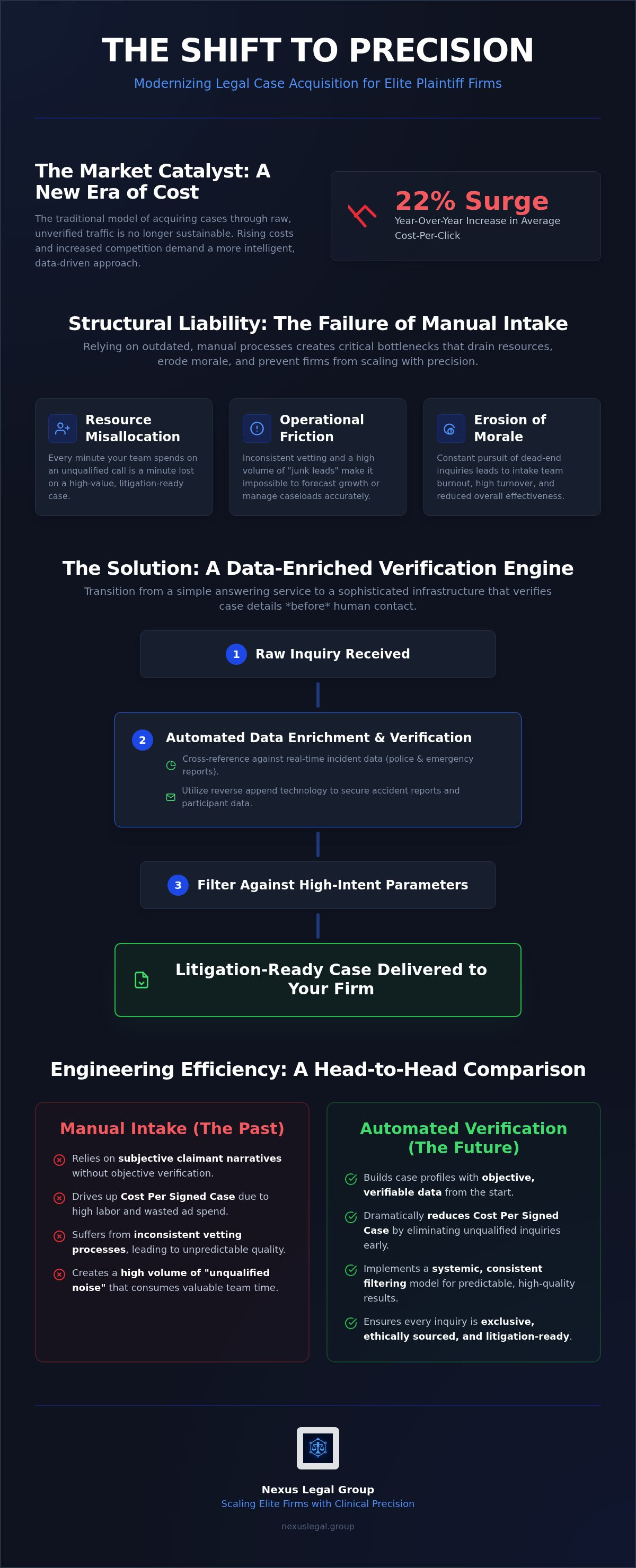
With the legal services vertical seeing a 22% year-over-year surge in average cost-per-click in early 2026, the era of paying for raw, unverified traffic is officially over. For elite plaintiff firms, the traditional model of manual intake is no longer just inefficient; it's a structural liability that drains resources and invites compliance risk. You've likely felt the friction of high manual labor costs and the frustration of generic leads that never actually turn into signed cases. It's a common bottleneck that prevents even the most successful firms from scaling with true clinical precision. Utilizing advanced legal lead qualification services is the only way to maintain a competitive edge in this high-cost environment.
This guide will show you how to implement a sophisticated growth infrastructure that transforms raw inquiries into litigation-ready cases. You'll learn how to leverage data-driven qualification frameworks and incident data enrichment to eliminate the noise from your intake funnel. We'll explore the mechanics of building a system that lowers your cost per signed case while ensuring every inquiry is exclusive and compliant. By the end of this article, you'll understand how to integrate these automated verification systems directly into your existing firm infrastructure to ensure seamless operational continuity and technical mastery of your case acquisition funnel.
Key Takeaways
- Transition from a lead-buying mindset to an end-to-end growth infrastructure that prioritizes litigation-readiness over raw inquiry volume.
- Leverage real-time incident data, including police and emergency services reports, to verify critical case details before your team initiates contact.
- Discover how modern legal lead qualification services utilize reverse append technology to automatically secure accident reports and essential participant data.
- Reduce your cost per signed case by replacing inconsistent manual intake processes with a hybrid model of automated verification and human oversight.
- Learn the specific steps to define high-intent case parameters that ensure every inquiry is exclusive, ethically sourced, and ready for your firm to sign.
Understanding Legal Lead Qualification Services in a High-Intent Landscape
Legal lead qualification services represent the systemic filtering of raw inquiries against rigorous litigation-readiness standards. In the competitive environment of 2026, elite plaintiff firms have moved beyond the traditional concept of lead generation, which often prioritizes volume over value. Instead, they've adopted a case acquisition infrastructure that treats every inquiry as a critical data point within a larger growth system. This transition is essential because the rising costs of manual intake and the shift in consumer search behaviors have fundamentally changed how prospects interact with law firms.
Elite practices recognize that high-intent inquiries are the only viable path to sustainable expansion. These firms don't just buy leads; they invest in systems that provide a continuous stream of verified opportunities. By shifting from manual checklists to automated data-verification layers, firms can operate with a level of precision that was previously impossible. This clinical approach ensures that every signed case meets the high standards of a trial-ready file from the moment it enters the CRM.
The Evolution of Case Vetting
Modern case vetting has evolved from basic contact forms to complex behavioral analysis. It's no longer sufficient to verify a phone number and a name. 2026 standards require a deep dive into intent before a human ever initiates contact. According to 2025 data from SparkToro, approximately 35% of legal queries are now answered by AI Overviews without a user clicking through to a website. This means the prospects who do reach out are more informed and have higher expectations. Utilizing sophisticated legal lead qualification services allows firms to meet this demand by analyzing the quality of the interaction before committing internal resources. This role of intent is vital for reducing firm overhead and ensuring that your team's time is spent only on cases with clear liability.
The Cost of Unqualified Noise
The impact of "junk leads" extends far beyond wasted marketing spend; it creates a structural bottleneck that stalls scalability. Inefficient qualification models are the primary reason many firms see their ROI plateau despite increasing their ad budgets. A clinical approach to inquiry filtering eliminates the friction that prevents rapid growth. Consider the following impacts of unqualified noise:
- Erosion of Intake Morale: Constant pursuit of dead-end leads leads to burnout and high turnover in intake departments.
- Resource Misallocation: Every minute spent on an unqualified call is a minute lost on a high-value case.
- Operational Friction: Inconsistent vetting processes make it impossible to forecast growth or manage caseloads accurately.
By implementing a sophisticated infrastructure, you ensure that only exclusive, litigation-ready inquiries reach your desk, allowing your firm to focus on what it does best: winning cases.
The Mechanics of Data-Enriched Qualification: Beyond the Intake Call
The traditional "answering service" model of intake has become a bottleneck for firms aiming for high-velocity growth. In a landscape where speed and accuracy are paramount, relying solely on a manual interview is a structural risk. Modern legal lead qualification services have evolved into data-driven verification engines that operate long before a human ever picks up the phone. By shifting to a "Data-Enriched" model, firms can cross-reference claimant statements with objective incident data, ensuring that every inquiry is backed by verifiable facts rather than just subjective narratives.
This technical evolution integrates AI-driven marketing precision with rigorous intake verification to create a seamless acquisition funnel. It's about building a comprehensive case profile that includes verified liability and insurance details from the start. This systemic approach doesn't just improve efficiency; it reinforces ethical compliance by maintaining a transparent, data-backed audit trail for every case your firm acquires.
Leveraging Incident Data for MVA Precision
Utilizing police report generated MVA leads allows your firm to verify claim validity with clinical precision. Instead of asking a prospect to recall stressful details, your system already knows the responding agency, the date of the incident, and the initial assessment of fault. This advantage allows your intake team to lead with authority, shifting the conversation from discovery to conversion. Having access to emergency services data ensures that you're pursuing cases where the incident is officially documented, which significantly reduces the risk of fraudulent or unviable claims entering your system.
Automated Verification Systems
The role of reverse append technology is central to this new standard of qualification. By using minimal initial input, such as a name and a date, automated systems can secure accident reports and participant details without manual labor. AI-driven filters then analyze this data against specific litigation criteria, such as:
- Liability Clarity: Automatically flagging cases where the police report indicates a clear at-fault party.
- Insurance Coverage: Identifying the presence of commercial or high-limit policies early in the process.
- Statute Compliance: Ensuring the incident date aligns with current legal timelines.
These automated layers eliminate the human error that often plagues the early stages of the intake funnel. By the time a case reaches your attorneys, it has been vetted through multiple technological layers, ensuring it's truly litigation-ready. For firms ready to move beyond generic lead vendors, adopting a sophisticated growth infrastructure is the most effective way to professionalize case acquisition and eliminate operational friction.
Engineering Efficiency: Comparing Manual Intake to Automated Verification Models
The legacy "Human-Only" model of case vetting is increasingly becoming a liability for firms focused on rapid expansion. Relying solely on manual intake specialists often results in high labor costs, inconsistent vetting standards, and dangerously slow response times. Research from Smith.ai in 2025 indicates that law firms responding to inquiries within 60 seconds are 391% more likely to convert those leads than those waiting just ten minutes. A purely manual team simply cannot maintain this pace consistently across high-volume campaigns without significant resource drain.
In contrast, a hybrid model of legal lead qualification services utilizes human oversight powered by automated data enrichment. This approach doesn't aim to replace the human element; it seeks to eliminate the clerical friction that prevents specialists from doing their best work. By the time a specialist speaks to a prospect, the system has already verified the incident data and liability markers. This shift moves the primary success metric from raw lead volume to the actual conversion rate of signed, litigation-ready cases.
Scalability Through Automation
Manual intake models inevitably fail during mass tort surges or aggressive MVA campaigns. When inquiry volume spikes, human teams become a bottleneck, leading to missed opportunities and "junk" inquiries clogging the system. Implementing automated intake for plaintiff firms creates a frictionless bridge between your marketing efforts and your CRM. This infrastructure allows for infinite scalability, ensuring that every inquiry is vetted against your specific case-profile parameters in real time. It ensures that your firm captures high-intent prospects at the moment of their highest urgency, regardless of how many inquiries are entering the funnel simultaneously.
Risk Mitigation and Compliance
Systemic automation is the most reliable way to maintain ethical standards and regulatory compliance while scaling case volume. In an era of heightened focus on data privacy, manual processes are prone to errors that can lead to HIPAA or TCPA violations. Automated legal lead qualification services provide a clinical level of precision by creating immutable audit trails for every interaction. This systemic integrity ensures that:
- Consent is Verified: Digital timestamps and clear opt-in records are stored automatically.
- Data is Secure: Sensitive claimant information is handled through encrypted, compliant channels rather than scattered manual notes.
- Ethics are Maintained: Every inquiry is screened against non-compliant or unethical sourcing patterns before it reaches your firm.
This technical mastery instills a sense of security, allowing firm partners to focus on litigation strategy rather than worrying about the mechanics of compliant acquisition.
Implementing a Litigation-Ready Qualification Framework
Transitioning from a general intake model to a specialized growth infrastructure requires a four-stage implementation process. This framework ensures that your legal lead qualification services operate as a high-performance engine rather than a manual checklist. By structuring your acquisition funnel around data-backed verification, you eliminate the ambiguity that often plagues high-volume plaintiff practices. This process isn't about simply collecting contact information; it's about building a sequence of technical filters that progressively validate the litigation-readiness of every inquiry.
The implementation follows a logical, linear progression designed to maximize efficiency and minimize friction:
- Step 1: Define specific case-profile parameters. Establish clear thresholds for MVA cases, such as significant injury markers or commercial liability requirements, to ensure your team only handles viable files.
- Step 2: Integrate real-time incident data streams. Connect your infrastructure directly to police and emergency services reports to verify the date, location, and severity of the incident before the first contact.
- Step 3: Deploy automated verification layers. Use AI-driven screening to filter out non-litigable inquiries, such as those outside the statute of limitations or involving property-damage-only claims.
- Step 4: Establish a seamless hand-off. Ensure the verified data flows directly into your firm’s CRM, allowing your legal team to initiate the signing process without manual data entry.
Defining High-Intent Criteria
Identifying behavioral markers is key to distinguishing a curious caller from a signed case candidate. For mass tort eligibility, this requires surgical precision to ensure the claimant meets the exact criteria of the litigation. By analyzing data points like incident recency and medical treatment history, firms can prioritize inquiries that are most likely to result in a successful filing. This clinical approach to filtering allows you to ignore the noise and focus your resources on prospects who've already demonstrated a clear intent to seek legal representation.
The Role of Speed-to-Lead
In the 2026 legal market, speed is a primary differentiator for elite firms. Automated qualification enables sub-60-second response times, which is critical since firms responding within one minute are 391% more likely to convert leads than those waiting just ten minutes, according to 2025 data from Smith.ai. The first firm to qualify the lead and present a retainer usually wins the case. By eliminating the intake bottleneck through systemic automation, your practice can capture high-intent prospects at the moment of their highest urgency, ensuring you don't lose them to a faster competitor.
Nexus Legal Group: Scaling Elite Firms with Clinical Precision
Nexus Legal Group positions itself as the strategic architect of growth infrastructure for elite plaintiff firms. We provide a foundational layer that moves beyond the limitations of traditional lead vendors by offering a comprehensive, end-to-end acquisition model. This system integrates high-performance AI marketing with clinical legal lead qualification services to transform raw data into litigation-ready inquiries. Our approach is built on technical mastery; it ensures that every case entering your firm’s workflow has been vetted against rigorous standards of liability and intent before a human ever initiates contact.
Our proprietary incident data analysis allows us to secure exclusive inquiries that competitors simply cannot access. By utilizing real-time police reports and emergency services data, we eliminate the friction of unverified claims and "junk" inquiries. This isn't just a service; it's a powerful engine designed to drive your practice’s expansion from behind the scenes with absolute precision and systemic integrity. It's a foundational layer that lets you focus on litigation while we handle the mechanics of case acquisition.
MVA and Mass Tort Specialization
We specialize in tailoring qualification frameworks for motor vehicle accidents and complex mass tort litigation. Working with a partner that understands the specific mechanics of personal injury growth is a distinct advantage for firms looking to scale. By utilizing our specialized legal lead qualification services, we offer maximum flexibility by providing both highly qualified inquiries and fully signed cases. This allows you to choose the acquisition model that best fits your current operational capacity. This specialization ensures that your team spends zero time on discovery and maximum time on high-value litigation, which is the only way to maintain a competitive edge in 2026.
Building Your Firm’s Growth Infrastructure
Scaling a modern practice requires a fundamental shift from a lead-buying mindset to an infrastructure-building mindset. It's about creating a system that delivers consistent, predictable results rather than chasing individual, unverified inquiries. Integrating our CaseFlow methodology into your operations is a logical, linear progression toward total operational excellence. By adopting this clinical approach to case acquisition, you ensure your firm is grounded in the practical, rigorous realities of a high-velocity legal market. You don't just need more leads; you need a system that eliminates friction and guarantees litigation-ready opportunities.
Future-Proofing Your Firm’s Case Acquisition
The transition from traditional lead buying to a systemic growth infrastructure is a prerequisite for elite plaintiff firms aiming for market dominance. By integrating data-enriched verification layers and proprietary incident data, you eliminate the operational friction of manual intake and the financial drain of unqualified inquiries. Utilizing sophisticated legal lead qualification services ensures that your practice isn't just reacting to the market but actively engineering its own expansion with clinical precision.
This approach allows your team to focus on high-value litigation while a high-performance engine manages the mechanics of case acquisition behind the scenes. You'll benefit from AI-driven marketing precision and exclusive, litigation-ready inquiries that are verified against objective incident data enrichment before they ever reach your CRM. Establishing this foundational layer is the most reliable path to achieving a lower cost per signed case and maintaining long-term scalability in a competitive landscape.
It's time to professionalize your intake funnel and secure your firm’s position as a strategic architect of its own growth. We look forward to helping you build a more efficient, data-driven practice that thrives on technical mastery.
Frequently Asked Questions
What is the primary difference between lead generation and lead qualification?
Lead generation focuses on the initial acquisition of contact information through various marketing channels. In contrast, legal lead qualification services provide the systemic filtering of those inquiries against rigorous litigation-readiness standards. While generation creates volume, qualification ensures that every prospect meets specific case-profile parameters. This process eliminates the friction of unverified traffic, allowing your firm to focus exclusively on high-intent inquiries that are prepared for immediate legal representation.
How does Nexus Legal Group use police reports for lead qualification?
Nexus Legal Group utilizes police report generated MVA leads to verify the objective validity of a claim before your team initiates contact. Our system integrates real-time incident data to cross-reference claimant statements with official records. By identifying fault, injury markers, and insurance details through these reports, we ensure that every case is backed by verifiable facts. This clinical approach reduces the risk of pursuing unviable claims and provides a technical foundation for your practice’s expansion.
Is automated legal lead qualification compliant with HIPAA and TCPA?
Automated legal lead qualification is designed to maintain strict compliance with HIPAA and TCPA regulations through systemic integrity. Our infrastructure utilizes encrypted data handling and automated audit trails to ensure that every interaction is documented and compliant. By replacing manual, error-prone processes with high-performance automation, we minimize the risk of regulatory violations. This technical mastery instills a sense of security, allowing firm partners to scale their case volume without compromising their ethical or legal obligations.
Can lead qualification services integrate with my existing law firm CRM?
Our case acquisition infrastructure is designed for seamless integration with your existing law firm CRM. We provide a frictionless bridge between our data-driven verification layers and your internal workflow management systems. This connectivity ensures that exclusive, litigation-ready inquiries flow directly into your database in real time. By eliminating manual data entry, your legal team can initiate the signing process immediately, which is essential for capturing high-intent prospects during their highest moment of urgency.
What specific data points are used to verify a high-intent MVA case?
We verify high-intent MVA cases by analyzing several critical data points extracted from emergency services data and police reports. These include the official date of the incident, responding agency details, and the initial assessment of liability. We also utilize reverse append technology to secure accident reports and participant information automatically. This objective data enrichment allows us to confirm significant injury markers and insurance coverage, ensuring every inquiry meets the rigorous standards of an elite plaintiff firm.
Why should elite law firms prioritize litigation-ready inquiries over raw leads?
Prioritizing litigation-ready inquiries allows elite firms to eliminate the high cost of manual intake labor and the frustration of generic leads. Raw leads often lack the necessary liability or intent markers, leading to wasted resources and lower ROI. By focusing on inquiries that have already been vetted through automated verification systems, your firm can operate with clinical precision. This strategy lowers the cost per signed case and ensures that your attorneys spend their time on high-value litigation.
How does reverse append technology improve the quality of accident reports?
Reverse append technology improves the quality of accident reports by automatically securing detailed participant information and incident specifics from minimal initial input. This system identifies missing data points such as insurance limits or secondary vehicles involved without requiring manual research from your intake team. It creates a comprehensive case profile that is far more accurate than subjective claimant narratives. This automation reduces human error and provides your firm with the technical depth required for sophisticated case acquisition.
What is the typical conversion rate for a qualified legal inquiry versus a generic lead?
Conversion rates for qualified inquiries are significantly higher than those for generic leads due to the speed of response and data accuracy. Data from 2025 indicates that firms responding to inquiries within 60 seconds are 391% more likely to convert those leads than firms that wait ten minutes. While generic leads often stall in the intake funnel, qualified inquiries are ready for immediate signing. This efficiency ensures a much higher return on your marketing investment and firm overhead.