How to Reduce Lawyer Client Acquisition Costs in 2026
Stop overpaying for leads. Learn the framework for reducing client acquisition cost for lawyers with data-enriched strategies that deliver high-value cases.
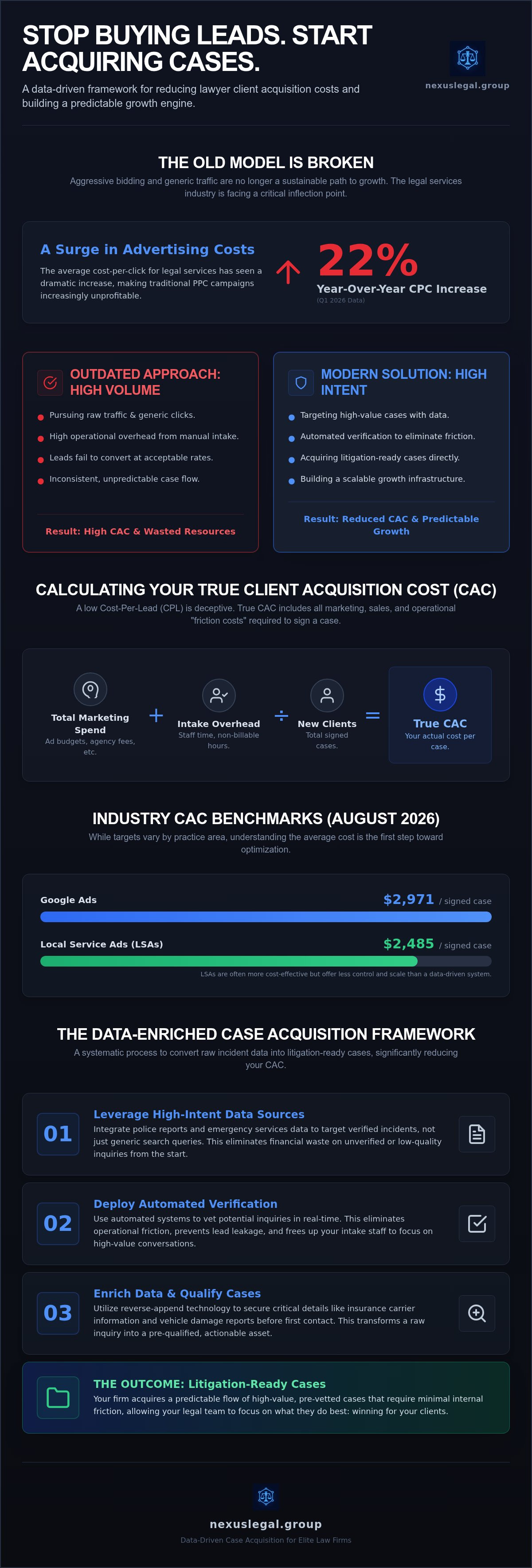
With the legal services industry facing a 22% year-over-year surge in average cost-per-click rates during the first quarter of 2026, the traditional model of aggressive bidding is rapidly becoming unsustainable. You've likely noticed that simply throwing more capital at search engines no longer yields the same volume of retainers. Achieving a sustainable margin now requires a clinical focus on reducing client acquisition cost for lawyers by moving beyond the pursuit of raw traffic. Instead of competing for every generic click, elite firms are pivoting toward high-intent, data-enriched acquisition strategies that prioritize case quality over lead quantity.
It's a common frustration to manage high operational overhead from manual intake while watching generic digital leads fail to convert at acceptable rates. You shouldn't have to settle for inconsistent case flow that hampers your ability to scale. This article details the precise mechanics of reducing CAC by shifting from high-volume lead generation to high-intent, data-enriched case acquisition. We'll explore how to build a predictable growth engine through automated verification and police report integration; ensuring your firm acquires litigation-ready cases that require significantly less vetting and internal friction.
Key Takeaways
- Calculate the true Client Acquisition Cost by integrating total marketing spend with intake overhead to move beyond superficial cost-per-lead metrics.
- Utilize high-intent data sources, such as police reports and emergency services records, to target high-value MVA cases with clinical precision.
- Discover a systematic framework for reducing client acquisition cost for lawyers by transitioning from generic digital marketing to a data-enriched case acquisition model.
- Eliminate operational friction and lead leakage by deploying automated verification systems that vet potential inquiries in real-time.
- Build a scalable growth infrastructure that converts raw inquiries into litigation-ready cases through sophisticated data enrichment and reverse-append technology.
Defining Client Acquisition Cost (CAC) for Modern Law Firms
Understanding the financial mechanics of firm growth begins with a precise calculation of Customer Acquisition Cost (CAC). While many firms focus on the cost-per-lead (CPL) as their primary performance indicator, this metric is often deceptive. A low CPL can mask a high CAC if the leads generated are of poor quality, requiring extensive manual vetting and filtering. To move toward a model of sustainable expansion, you must look at the standard formula: the sum of all marketing and sales expenditures divided by the total number of new clients acquired over a specific period.
Reducing client acquisition cost for lawyers requires an accounting of "friction costs" that usually go unnoticed in standard reporting. These include the hours spent by intake staff on non-responsive inquiries and the technical overhead of managing fragmented lead sources. When these operational inefficiencies are ignored, the true cost of a signed case is significantly higher than what your digital dashboard suggests. CAC is a metric of institutional efficiency, not just marketing spend.
The Role of Opportunity Cost in Legal CAC
The most expensive component of an inefficient acquisition system is the opportunity cost of specialized personnel. Every hour an attorney or senior paralegal spends on a non-qualified consultation is an hour diverted from billable work or strategic case development. High-volume leads often create a "noise" problem where the sheer quantity of inquiries creates an intake bottleneck, artificially inflating your acquisition expenses. Transitioning to high-intent inquiries minimizes this waste by ensuring that human capital is only deployed on cases that meet strict litigation-ready criteria.
Industry Benchmarks vs. Firm Goals
Benchmarks vary across practice areas, making a "one size fits all" target impossible. Research from August 2026 shows that the average CAC for Google Ads sits at $2,971, while Local Service Ads (LSAs) offer a slightly lower average of $2,485. For a motor vehicle accident (MVA) practice, a $3,000 CAC might be acceptable given the projected settlement values, but that same figure could be catastrophic for high-volume, lower-value mass tort claims. Setting target thresholds requires a data-driven approach that factors in settlement timelines and expected case values. If your firm isn't tracking these variables with clinical precision, scalability will remain an elusive goal.
Engineering Precision: Leveraging High-Intent Data to Eliminate Waste
Elite firms no longer rely on the volatility of broad digital auctions. Traditional PPC channels often result in a "junk lead" problem where budget is consumed by informational queries rather than actual claimants. By shifting toward a targeted case acquisition infrastructure, firms can prioritize verified incident data over generic search traffic. This transition is essential for reducing client acquisition cost for lawyers because it eliminates the financial waste associated with unverified inquiries. Precision is the antidote to rising advertising costs.
The mechanics of this precision involve integrating police reports and emergency services data directly into the acquisition workflow. Reverse append technology allows a firm to secure critical accident details, such as insurance carrier information and vehicle damage reports, before the first outbound call is even placed. This data-first approach ensures that intake teams only engage with individuals involved in documented, actionable incidents. It removes the guesswork from the initial contact phase.
The Power of Data Enrichment in Case Acquisition
Data enrichment transforms a raw inquiry into a litigation-ready asset. When you utilize police report generated MVA leads, you aren't just buying contact information. You're acquiring a verified event history. This level of clinical accuracy allows firms to source inquiries that match specific case criteria, such as liability and injury severity, without manual vetting. Implementing these cost-effective client acquisition strategies reduces the labor burden on your staff. It ensures that your resources are focused on high-value cases rather than administrative sorting.
Behavioral Analysis and AI-Driven Precision
Modern systems now use AI-driven legal case acquisition to identify claimant intent at the peak of the decision-making process. AI algorithms analyze patterns in emergency service records and incident timing to predict which claimants are most likely to retain counsel. This eliminates the "spray and pray" methodology of generic digital ads. Reducing client acquisition cost for lawyers is ultimately a function of how much waste you can strip from the system. Firms looking to automate this precision often benefit from a sophisticated growth infrastructure that connects data sources to intake workflows seamlessly. By targeting the right individual with the right data at the right time, firms can scale without increasing their operational friction.
Optimizing the Intake Funnel: How Automation Reduces Operational Overhead
The "Leakage Problem" remains one of the most significant contributors to inflated acquisition budgets in 2026. Research suggests that responding to an inbound lead within 60 seconds can increase conversion-to-consultation rates by 3-4 times compared to a 10-minute delay. When firms rely on manual intake, they essentially guarantee a high rate of lead abandonment. Each second of delay erodes the value of the investment made to generate that inquiry. Optimizing this stage is a critical component of reducing client acquisition cost for lawyers because it ensures that no viable opportunity is lost to a competitor's faster response.
Manual intake doesn't just lose leads; it consumes valuable time on inquiries that will never settle. Automated vetting acts as a cost-saving firewall for the firm by systematically filtering out non-litigable noise before it ever reaches your high-cost personnel. By the time a case reaches your desk, it should already be verified against your specific criteria. This process ensures that your team's energy is reserved for litigation, not administrative sorting.
Automated Intake Verification Frameworks
Implementing automated intake for plaintiff firms allows for the real-time filtration of non-litigable inquiries. These frameworks integrate directly with firm management software, using AI to cross-reference incident data with your firm's specific case requirements. This isn't just about speed; it's about accuracy. When you automate the verification process, you remove the human error inherent in high-volume manual screening. This ensures that only the most promising, high-intent cases move through the funnel, which is a foundational step in reducing client acquisition cost for lawyers.
Reducing Non-Billable Labor Costs
The financial impact of automation is most visible in the reduction of non-billable labor. When your staff is forced into a cycle of "lead chasing," they're essentially acting as expensive administrative filters rather than legal professionals. Shifting their focus toward case management allows the firm to operate with a leaner, more efficient team. Receiving litigation-ready inquiries rather than raw, unvetted data means your intake department doesn't need to be massive to be effective. Automation eliminates the need for large internal intake departments by delivering signed, qualified cases that are ready for immediate action. This structural shift allows you to scale your case volume without a linear increase in payroll expenses.
The Step-by-Step Framework for Reducing Client Acquisition Costs
Systemically reducing client acquisition cost for lawyers requires a transition from reactive marketing to a proactive growth infrastructure. The process begins with a rigorous audit of your current intake funnel to identify points of friction where potential clients drop off. You must calculate the "true cost" of every signed case, which includes not just the ad spend but also the non-billable hours your staff spends on fruitless vetting. Many firms discover that broad-match PPC campaigns are the primary source of waste, as they attract high-volume traffic with low-intent outcomes that saturate intake departments without providing a return on investment.
Once the audit reveals these inefficiencies, you can shift your marketing budget from generic search traffic to data-enriched case acquisition. This involves deploying automated verification tools that standardize the vetting of every inquiry in real-time. By integrating police report and emergency services data, you enrich case profiles before they ever reach a human reviewer. This ensures that your team only reviews litigation-ready inquiries. Continuous monitoring of operational metrics is the final step, allowing you to refine your cost-per-signed-case by aligning your acquisition strategy with actual settlement values and timelines.
Auditing Your Growth Infrastructure
Identify the conversion rates at each stage of your funnel to find where value is leaking. If your lead-to-consultation rate falls below the 15-25% industry benchmark, it signals a failure in either lead quality or response speed. You must eliminate high-cost, low-conversion marketing tactics that prioritize quantity over intent. A successful audit looks beyond the superficial cost-per-lead and focuses on the institutional efficiency of the entire signing process. This data-driven approach provides the clarity needed to scale without increasing overhead.
Tactical Implementation of Data-Driven Sourcing
Partnering with providers who offer exclusive, litigation-ready inquiries is the most direct route to efficiency. Every case your firm accepts must meet strict compliant legal lead generation standards to ensure long-term stability and ethical integrity. Leveraging reverse append technology allows your system to obtain accident reports automatically, providing the necessary documentation to move cases forward instantly. This tactical shift ensures that your firm is not just generating leads, but is architecting a predictable stream of high-value cases.
Scaling Efficiency: Implementing a Growth Infrastructure for Elite Firms
For firms operating at the national level, the era of fragmented marketing is over. Scaling a practice requires more than just a higher ad budget; it necessitates a foundational law firm growth infrastructure that operates with systematic autonomy. Nexus Legal Group provides this end-to-end acquisition system, allowing firms to transition from the unpredictable cycle of buying unvetted leads to building a sophisticated case-flow engine. This shift is essential for reducing client acquisition cost for lawyers because it replaces manual, high-friction processes with automated, verified data streams. By ensuring that every inquiry is ethically sourced and litigation-ready, firms can protect their margins while accelerating their growth.
The Future of National Case Acquisition
Managing high-volume MVA and mass tort acquisition often leads to an unsustainable increase in internal headcount. A technology-first acquisition model solves this by maintaining clinical precision even as volume scales. You don't need a larger intake department if the system delivers cases that are already vetted and signed. This competitive advantage allows elite firms to dominate national markets by responding to data-enriched inquiries with near-instantaneous speed. It's about engineering a system where growth is a function of technological mastery rather than human labor.
Next Steps for Managing Partners
Your first step is evaluating whether your firm's current systems can handle automated growth or if you're still relying on legacy manual workflows. Reducing client acquisition cost for lawyers isn't a one-time fix; it's a structural realignment. Consulting with strategic architects allows you to engineer a lower CAC by identifying and removing systemic friction. If you're ready to move beyond generic lead generation, you should explore the Nexus Legal Group framework to see how an integrated case acquisition system can stabilize your firm's future. The focus must remain on building a scalable, predictable engine that drives results from behind the scenes.
Architecting a Scalable Future for Your Firm
Achieving sustainable growth in 2026 requires more than just capital; it demands a structural shift in how your firm interacts with the market. By transitioning from generic digital auctions to data-enriched case acquisition, you eliminate the operational friction that typically erodes margins. Implementing automated verification and leveraging police report data ensures that your intake team focuses exclusively on high-intent, litigation-ready cases. This systematic approach is the most reliable method for reducing client acquisition cost for lawyers while maintaining clinical precision at scale. You aren't just buying leads; you're building a predictable engine that converts raw incident data into signed retainers.
Focusing on institutional efficiency allows your firm to scale national case volume without a linear increase in headcount. The integration of AI-driven marketing precision and exclusive inquiries creates a foundational layer that protects your practice from the volatility of traditional search platforms. When your growth infrastructure is built on verified data, your path to expansion becomes clear and manageable.
Your firm is ready to move beyond the limitations of manual intake and high-cost bidding. By adopting a technology-first acquisition model, you secure a dominant position in the evolving legal landscape.
Frequently Asked Questions
What is a good client acquisition cost for personal injury lawyers?
A competitive client acquisition cost for personal injury lawyers typically falls between 15% and 20% of the case's projected lifetime value. As of August 2026, research indicates that the average CAC for Google Ads is $2,971, while Local Service Ads average $2,485. Achieving a "good" CAC requires balancing these external costs with internal intake efficiency. Firms that focus on high-intent data often outperform these benchmarks by securing cases with higher settlement potential at a lower operational cost.
How do I calculate CAC for my law firm?
You calculate CAC by dividing your total marketing and sales expenditure by the number of new clients acquired during a specific period. It's vital to include "hidden" expenses such as intake staff salaries, software subscriptions, and the non-billable hours attorneys spend vetting unqualified inquiries. This comprehensive approach provides a realistic view of your institutional efficiency. Reducing client acquisition cost for lawyers starts with identifying every dollar spent from the initial click to the signed retainer.
Can automated intake really reduce my overhead costs?
Automated intake significantly reduces overhead by acting as a digital filter for your firm. Instead of employing a large team to manually screen every phone call or web form, AI-driven systems vet inquiries against your specific litigation criteria in real-time. This eliminates the "leakage problem" caused by slow human response times. By delivering only signed, qualified cases to your legal team, you strip away the administrative labor costs that typically inflate a firm's operational budget.
What is the difference between a lead and a litigation-ready inquiry?
The primary difference lies in data depth and intent. A standard lead is often just basic contact information from someone seeking general legal information. Conversely, a litigation-ready inquiry is enriched with incident data, such as police reports or vehicle damage details, and has been verified for liability. These high-intent inquiries require far less vetting from your staff, making them a foundational component in reducing client acquisition cost for lawyers by maximizing conversion efficiency.
How does police report data help in reducing acquisition costs?
Police report data reduces acquisition costs by providing objective verification of an incident before you commit resources to a claimant. By accessing accident reports and emergency services data, your system can confirm liability, insurance coverage, and the severity of injuries automatically. This prevents your intake department from chasing cases that lack legal merit. Integrating this data allows you to focus your marketing budget on incidents with a high probability of successful litigation.
Is automated lead verification ethical and compliant?
Automated verification is both ethical and compliant when it's integrated into a high-intent acquisition framework. These systems prioritize "litigation-ready" inquiries from individuals who have actively sought legal assistance or were involved in documented incidents. By using automated systems to ensure TCPA compliance and bar association standards, firms can maintain high ethical integrity. This data-driven approach is often more compliant than traditional manual intake because it applies consistent, objective vetting criteria to every potential claimant.
What are the most common causes of high CAC in law firms?
High CAC is usually caused by a combination of broad-match keyword bidding and slow intake response times. When firms compete for generic search terms, they attract a high volume of low-intent traffic that requires expensive manual filtering. Additionally, if your team takes more than 60 seconds to respond to an inquiry, the conversion rate drops significantly. This "leakage" means you're paying for leads that your competitors will sign first due to their faster automated systems.
How can I scale my firm's case flow without hiring more intake staff?
Scaling your firm's case flow without increasing headcount requires a foundational growth infrastructure. By implementing automated verification and data enrichment, you can process a higher volume of inquiries without burdening your existing staff. These systems handle the heavy lifting of vetting and documentation, delivering litigation-ready cases that are ready for immediate action. This allows your senior staff to focus on case management and litigation rather than administrative sorting, enabling aggressive growth without a linear increase in payroll.