Automated Legal Lead Screening: Engineering High-Intent Growth in 2026
Tired of unqualified inquiries? Our guide to automated legal lead screening shows you how to engineer a system that captures high-value, litigation-ready cases.
What if your intake department functioned as a high-precision filter rather than a catch-all net? You've likely seen your staff's productivity erode under the weight of unqualified inquiries, making a robust automated legal lead screening system a necessity for modern firm growth. It's a common friction point where rising costs per acquisition collide with inconsistent manual vetting, leaving high-value cases to slip through the cracks. You aren't alone in feeling that the traditional manual model has become an expensive bottleneck that prevents your firm from scaling effectively.
This article demonstrates how to architect a streamlined, no-nonsense intake engine that operates with clinical precision. We'll show you exactly how to eliminate intake friction and secure litigation-ready inquiries through precision-engineered systems. You'll discover how to drive higher conversion rates for MVA and mass tort cases by using leads backed by verified accident data and reverse-append technology. We'll explore the mechanics of engineering high-intent growth in 2026, ensuring your firm remains a leader in a North American legal technology market projected to reach $36 billion this year. From technical mastery to operational excellence, we're laying the foundation for a system that converts raw data into signed cases.
Key Takeaways
- Learn how to replace inefficient manual vetting with a system-driven engine that eliminates decision fatigue for your intake staff.
- Discover how AI-driven behavioral signals and police report data identify high-intent claimants with clinical precision.
- Implement automated legal lead screening to transform raw inquiries into litigation-ready assets while maintaining strict ethical compliance.
- Follow our instructional guide to audit your current workflow and integrate a foundational layer for firm expansion.
- Gain a competitive edge by accessing exclusive MVA leads verified through emergency services data and reverse-append technology.
The Friction of Manual Intake in Modern Plaintiff Practices
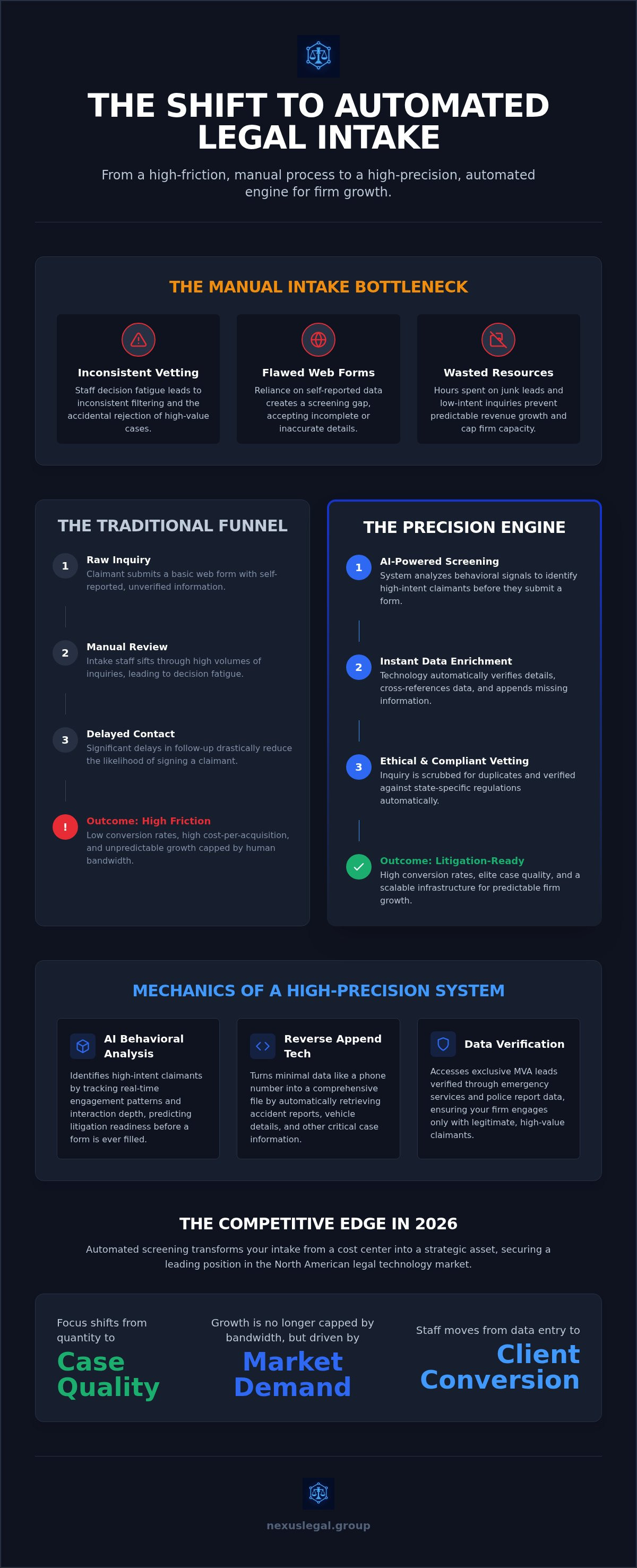
In the current high-volume plaintiff environment, automated legal lead screening functions as a system-driven vetting process that filters potential claimants through algorithmic precision before they ever reach a human intake specialist. This shift is essential because the traditional human-centric model is increasingly unsustainable. High-volume firms often face a massive influx of inquiries that result in decision fatigue for staff, leading to inconsistent vetting and the accidental rejection of high-value cases. As legal technology (legal tech) matures into a nearly $37 billion global market in 2026, elite firms are moving away from simple lead generation toward a comprehensive case acquisition infrastructure. This infrastructure treats every inquiry as a data point to be verified rather than a story to be heard, ensuring that only the most viable cases consume your firm's expensive human resources.
The Opportunity Cost of Unqualified Inquiries
When your intake team spends hours chasing low-intent inquiries, they aren't just wasting time; they're actively losing money. Every minute spent on a junk lead is a minute taken away from a high-value MVA or mass tort case that requires immediate attention. Speed to lead remains the most critical factor in conversion. If a manual process delays contact by even sixty minutes, the likelihood of signing that claimant drops significantly. This reliance on manual labor prevents predictable revenue growth because your firm's capacity is capped by human bandwidth rather than market demand. By removing the friction of manual vetting, you allow your team to focus exclusively on litigation-ready files that drive firm profitability.
Limitations of Standard Web-Form Vetting
Standard web forms are fundamentally flawed because they rely entirely on self-reported data. In motor vehicle accident (MVA) cases, claimants often provide incomplete or inaccurate details about the incident, insurance coverage, or liability. A basic form cannot verify whether a police report exists or if the opposing party was actually at fault. It lacks the connectivity to cross-reference emergency services data or perform a reverse append to find missing accident details. This creates a dangerous screening gap, which is the critical distance between a claimant's raw interest and their actual litigation readiness. Without automated verification layers, your firm remains vulnerable to high acquisition costs and low-quality case files that eventually fall out of the pipeline.
Mechanics of Automated Screening: AI and Data Enrichment
AI-driven marketing has evolved beyond simple keyword targeting into a sophisticated analysis of behavioral signals. Modern automated legal lead screening engines identify high-intent claimants by tracking real-time engagement patterns that correlate with litigation readiness. Instead of waiting for a user to complete a form, these systems analyze navigation paths and interaction depth to predict case viability before the first click. This proactive intelligence ensures that your intake queue is populated with inquiries that have already demonstrated a high propensity for legal action. By identifying these patterns early, firms can prioritize resources on claimants who are actively seeking resolution rather than those merely browsing for information.
Maintaining high standards requires more than just speed; it requires systemic integrity. Automated verification plays a pivotal role in scrubbing inquiries to ensure they align with the ethical use of AI in legal services. These systems verify identity, filter out duplicate submissions, and confirm compliance with state-specific regulations instantly. This level of rigorous vetting protects your firm's reputation while ensuring that every lead meets the necessary threshold for a signed case. Integrating these screening engines directly into your existing law firm growth infrastructure creates a seamless, automated transition from a raw digital inquiry to a litigation-ready file.
The Power of Reverse Append Technology
Reverse append technology is the engine behind data-driven intake. When a potential lead provides minimal information, such as a mobile number, the system automatically retrieves comprehensive accident reports and vehicle details. This process identifies all participants involved in an incident and provides a full demographic profile of the claimant without requiring lengthy manual interviews. Having this verified data on hand before the first call transforms the intake process. Your team isn't just gathering facts; they're confirming a pre-verified narrative, which significantly increases the conversion rate from inquiry to signed retainer.
Leveraging Police and Emergency Services Data
High-fidelity incident data serves as the foundation for modern MVA case acquisition. By sourcing information directly from police and emergency services data streams, automated systems confirm case viability with absolute certainty. The screening engine cross-references these official reports with claimant inquiries to verify dates, locations, and liability in real-time. This automated cross-referencing eliminates the inaccuracies inherent in self-reported data. You're no longer relying on a claimant's memory; you're relying on official documentation. This precision ensures that your firm only invests marketing spend and staff time into cases with a documented foundation for successful litigation.
Solving the Quality Gap: Verification Beyond the Web Form
High-volume plaintiff practices frequently struggle with the disconnect between a digital inquiry and a signed retainer. To bridge this divide, elite firms implement a Precision Vetting framework that treats every lead as a raw asset requiring rigorous industrial-grade validation. This process moves beyond the passive collection of contact information, utilizing automated legal lead screening to verify the claimant's narrative against external data points. By establishing a clinical standard for litigation-ready inquiries, you ensure that your intake team only engages with cases that meet pre-defined liability and insurance thresholds. This systemic approach transforms your intake department from a call center into a high-performance conversion engine.
Recent research into AI in the legal intake process highlights the shift toward using large language models to elicit deeper intent and context from potential clients. Instead of relying on static forms, modern systems engage in dynamic qualification, identifying patterns of high-intent behavior that generic lead lists often miss. This transition is vital because bulk lead lists typically suffer from high churn and low conversion rates. When you prioritize exclusive, high-intent inquiries over recycled data, you're investing in the foundational integrity of your firm's case pipeline rather than just chasing volume.
Ethical and Compliant Case Generation
The regulatory landscape for automated legal marketing in 2026 demands a higher level of transparency and technical accountability. Systems must now navigate complex frameworks, including comprehensive state-level AI regulations that require authentication of AI-generated content and clear disclosures to consumers. Implementing automated screening ensures your firm remains compliant with TCPA and evolving state bar standards by providing a documented audit trail of every lead's origin and verification. This focus on ethical case acquisition protects your firm from litigation risks while maintaining the high standards of professional decorum expected in the legal industry.
Eliminating the 'Solar Cowboy' Lead Model
Personal injury practices are often plagued by the 'Solar Cowboy' model, where generic lead aggregators sell the same non-exclusive inquiries to multiple firms simultaneously. This creates a frantic environment that drives up acquisition costs and frustrates potential claimants. Professional growth infrastructure replaces this chaos with exclusivity and data-backed certainty. By focusing on MVA leads generated through direct incident data, you eliminate the churn associated with unverified inquiries. This exclusivity doesn't just improve conversion; it builds a predictable revenue stream that allows for sustainable firm scalability. You can find more about these systems on our legal technology blog.
Strategic Implementation: Integrating Screening into Your Firm
Transitioning from a manual vetting process to a sophisticated automated legal lead screening infrastructure requires a calculated shift in firm operations. This integration isn't merely a software update; it's a total re-mapping of the journey from the moment a raw inquiry enters the system to the final creation of a litigation-ready file. For partners, the primary goal is to transform the intake department into a high-efficiency closure unit where data-enriched inquiries replace the uncertainty of cold calls. Success in 2026 is defined by how effectively you can remove human error from the initial vetting phase. This allows your team to focus on the high-value legal work they were hired to perform. It's about building a foundational layer for firm expansion.
Step 1: Audit Your Current Case Flow Mechanics
Before deploying new systems, you must conduct a rigorous audit of your existing intake efficiency. Start by identifying the specific points where manual verification or data entry creates a bottleneck. If your intake specialists spend more than ten minutes gathering basic accident details that could be retrieved automatically, your overhead is inflated. You should calculate the true cost of 'dead-end' inquiries by measuring the total staff hours spent on cases that are ultimately rejected due to poor liability or lack of insurance. This data provides the baseline volume required to justify a transition to automated infrastructure. It ensures your investment is grounded in clear financial logic rather than guesswork. Most elite firms find that their current manual processes are far more expensive than they initially realized.
Step 2: Deploying Data-Driven Acquisition
Once you've identified the inefficiencies, the next stage involves selecting a system that prioritizes high-fidelity data sources, such as police reports and emergency services records. This ensures your inquiries are pre-verified before they reach your CRM. Integration is key; the screening engine must communicate directly with your existing legal management software to maintain a seamless flow of information. This connectivity allows your intake staff to handle inquiries with a level of confidence that is impossible with unverified leads. To deepen your technical understanding of these processes, you can learn more about scaling MVA case flow through mechanical automation. Precise data mapping ensures that every accident detail is correctly attributed to the claimant file without manual intervention.
Setting precise key performance indicators (KPIs) is the final piece of the implementation puzzle. You should track lead-to-signed-case conversion rates and the average time-to-contact for high-intent inquiries. When your staff is equipped with data-enriched files, their role shifts from investigating facts to securing retainers. This shift requires specific training to ensure they can leverage the provided accident data to build immediate rapport and authority with the claimant. They aren't just taking a call; they're finalizing a pre-verified case. This professional approach reduces friction and increases the likelihood of a successful sign-up.
Nexus Legal Group: Litigation-Ready Inquiries Through Precision
Nexus Legal Group isn't a traditional marketing agency; we're the strategic architects of your firm's growth infrastructure. We provide a foundational layer that allows elite plaintiff firms to scale with clinical precision and technical mastery. By focusing on the mechanics of high-intent acquisition, we transform how firms think about case volume and quality. Our systems utilize automated legal lead screening to ensure that every inquiry is backed by verified data before it ever reaches your intake specialists. This approach eliminates the friction of traditional intake and replaces it with a steady stream of litigation-ready files that are ready for immediate action.
The competitive edge we provide is rooted in the fidelity of our data sources. We specialize in police-report-generated MVA leads and emergency services data, which offer a level of accuracy that self-reported inquiries simply cannot match. This official documentation confirms liability and insurance coverage instantly, removing the guesswork from your case acquisition process. When you combine this with our reverse-append technology, your firm gains access to comprehensive accident reports that identify all parties involved without manual research. This isn't just lead generation; it's a precision-engineered acquisition engine designed for the specific needs of modern trial lawyers.
Exclusive Access to MVA and Mass Tort Cases
For elite firms, exclusive inquiries are the only viable path to sustainable growth. Bulk lead lists and shared inquiries create a race to the bottom that erodes your firm's profitability and staff morale. Our approach prioritizes exclusivity, ensuring that every inquiry is delivered directly to your firm without the noise of competitor interference. This is particularly critical in complex litigation environments where speed and data integrity are paramount. You can explore our Mass Tort Case Acquisition Strategy to see how we apply these same mechanical principles to larger, multi-district litigation opportunities. By maintaining a clinical standard for every inquiry, we ensure that your marketing spend translates directly into signed, high-value cases.
Engineering Your Firm's Future
The legal industry is undergoing a permanent shift toward tech-enabled case acquisition. Firms that rely on manual vetting will find themselves unable to compete with the speed and accuracy of automated systems in the 2026 market. Implementing automated legal lead screening is no longer a luxury; it's a requirement for firms that intend to lead the market and maintain predictable revenue growth. We invite you to audit your current growth infrastructure and discover the missing layers in your acquisition engine. Our consultation process identifies specific bottlenecks and demonstrates how our automated verification systems can drive higher conversion rates for your firm through ethical, high-intent acquisition.
Architecting a High-Performance Intake Infrastructure
The transition toward tech-enabled case acquisition is no longer a future projection; it's the current reality for elite plaintiff firms. By replacing manual intake friction with data-driven verification, you've learned how to secure exclusive, litigation-ready inquiries that drive predictable revenue. Integrating police reports and emergency services data ensures your team focuses only on high-intent cases with verified liability. Investing in automated legal lead screening transforms your firm's intake from a cost center into a high-performance growth engine, providing the foundational infrastructure needed for sustainable expansion.
Nexus Legal Group stands ready to serve as the architect of this transition. We provide the end-to-end systems that allow you to scale without sacrificing case quality or ethical compliance. It's time to move beyond the limitations of generic lead lists and embrace a clinical standard of case acquisition. Your firm's future depends on the integrity of your systems, and building that foundation starts with a commitment to operational excellence.
Frequently Asked Questions
What is automated legal lead screening and how does it differ from traditional intake?
Automated legal lead screening is a technology-driven vetting process that utilizes algorithmic precision to qualify potential claimants before they reach a human specialist. Unlike traditional intake, which relies on manual interviews and subjective staff judgment, this system uses AI-driven marketing and real-time data verification to identify high-intent inquiries. This mechanical approach eliminates the friction of human decision fatigue, ensuring that only cases meeting strict litigation criteria enter your firm's pipeline.
How does reverse append technology improve the quality of MVA leads?
Reverse append technology improves lead quality by automatically securing comprehensive accident reports and participant details from minimal initial data, such as a phone number. This process identifies vehicle information and demographic data without requiring lengthy manual interviews. By enriching a raw inquiry with official documentation, the system provides your intake team with a pre-verified narrative. This level of technical mastery ensures that every MVA lead is backed by factual incident data before the first contact.
Is automated lead screening compliant with attorney ethical standards?
Yes, automated screening systems are engineered to maintain strict compliance with TCPA regulations and state bar ethical standards. By providing a documented audit trail of lead origin and verification, these systems ensure transparency in the acquisition process. This rigorous verification layer protects your firm's reputation and licensure. It ensures that every signed case is generated through ethical, compliant marketing practices that meet the high standards of professional legal decorum required in 2026.
Can automated screening systems integrate with my existing case management software?
Modern automated legal lead screening engines are designed as a foundational layer that integrates seamlessly with major legal CRMs and case management software. This connectivity ensures a friction-free flow of data from the initial inquiry to the final litigation-ready file. By mapping accident details and participant data directly into your existing infrastructure, these systems eliminate manual data entry. This integration allows your firm to maintain a high-performance growth engine without disrupting your current operational workflows.
What data sources are used to verify high-intent motor vehicle accident inquiries?
High-intent inquiries are verified through high-fidelity data streams, including police reports and emergency services records. These official sources provide objective confirmation of incident dates, locations, and liability, which are critical for MVA case viability. By cross-referencing these data streams with claimant inquiries in real-time, the system filters out inaccurate self-reported details. This reliance on institutional data sources ensures that your firm invests resources only in cases with a documented foundation for successful litigation.
How does automated vetting reduce the cost per signed case for plaintiff firms?
Automated vetting reduces the cost per signed case by eliminating the overhead associated with manual intake and the pursuit of unqualified inquiries. When your staff only engages with litigation-ready files, their conversion efficiency increases significantly. This mechanical precision reduces the churn often found in high-volume personal injury practices. By lowering the time spent on unviable inquiries, your firm can reallocate human resources to high-value legal work, directly improving your overall lead-to-signed-case conversion rate.
What makes an inquiry 'litigation-ready' compared to a standard lead?
An inquiry becomes litigation-ready once it's been enriched with verified incident data, such as a confirmed police report or emergency services record. Standard leads often rely on unverified, self-reported information that may lack proof of liability or insurance coverage. A litigation-ready inquiry has passed through a multi-layered screening process that confirms the narrative's factual accuracy. This ensures that the case meets the specific legal thresholds required for your firm to initiate representation and drive successful outcomes.
How can elite firms scale mass tort acquisition through automated screening?
Elite firms scale mass tort acquisition by deploying automated screening engines that can process high volumes of inquiries with algorithmic precision. These systems identify behavioral signals and intent patterns specific to mass tort litigation in real-time. By automating the initial vetting and verification stages, firms can manage massive influxes of potential claimants without increasing their intake headcount. This tech-enabled infrastructure provides the scalability needed to secure a significant share of high-intent cases in competitive litigation environments.