Automated Case Acquisition Systems: The 2026 Guide for Elite Plaintiff Firms
Stop buying bad leads. Our 2026 guide to automated case acquisition systems shows elite firms how to get verified, litigation-ready cases and scale with prec...
This guide will show you how to move away from fragmented, manual processes and toward a unified infrastructure that delivers litigation-ready cases with clinical precision. We'll explore how to leverage incident data, such as police reports and emergency services records, to create a predictable and scalable case flow. You'll discover the mechanics of automated verification and reverse append technology that reduces administrative overhead while significantly increasing your conversion of high-intent litigation inquiries.
Key Takeaways
- Understand why shifting from commodity lead buying to automated case acquisition systems is the only way to scale with clinical precision in 2026.
- Learn how leveraging police reports and emergency services data ensures your pipeline is built on verified, high-intent incident records.
- Discover the critical role of exclusive lead sourcing and ethical compliance in protecting your firm's reputation and conversion rates.
- Identify the specific intake bottlenecks that are currently inflating your administrative overhead and how to eliminate them through automated verification.
- Build a strategic roadmap for transitioning your firm from manual vetting to a tech-enabled growth model that delivers litigation-ready cases.
Defining Automated Case Acquisition Systems in 2026
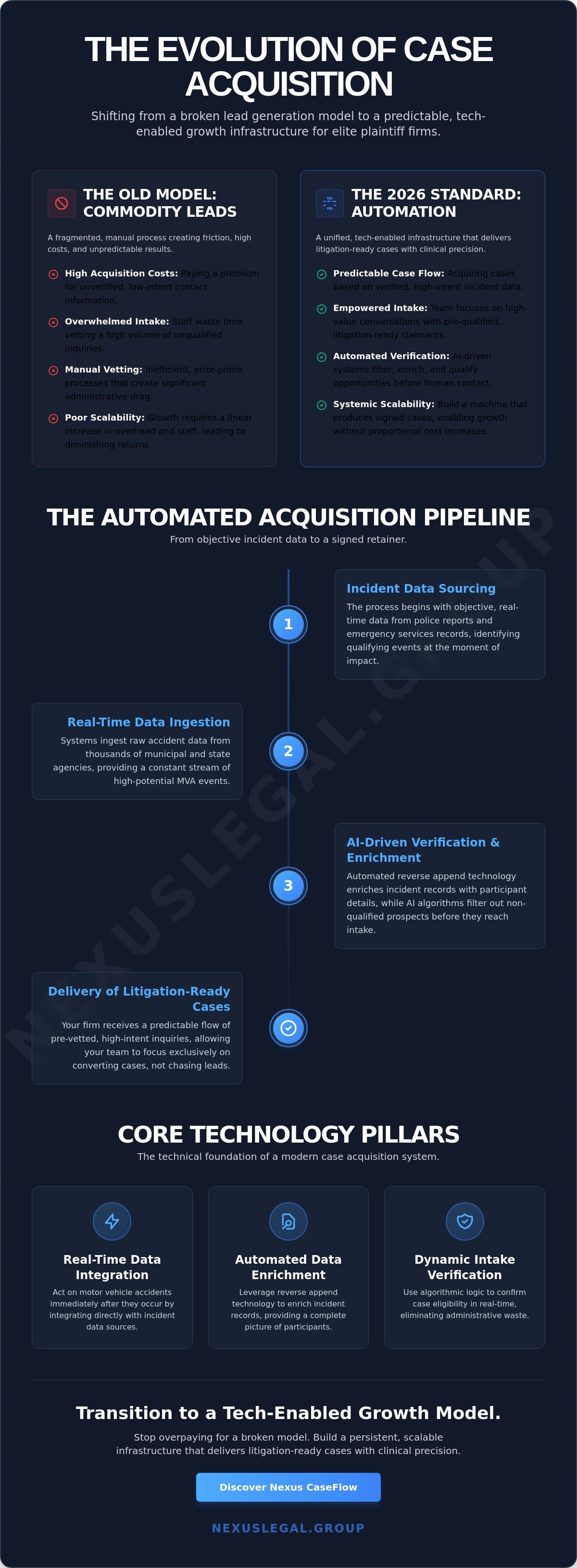
Automated case acquisition is not a marketing tactic; it's a foundational growth infrastructure. In 2026, elite plaintiff firms have moved beyond the "commodity lead" model. Buying leads is a transactional event where you pay for contact information that may or may not be valid. In contrast, automated case acquisition systems represent a persistent, tech-enabled pipeline that manages the entire lifecycle of an inquiry. This paradigm shift sits at the intersection of Legal technology (Legal Tech) and operational engineering, focusing on systemic integrity rather than volume alone.
The Evolution from Lead Gen to Growth Infrastructure
Legacy lead generation models don't work for high-volume firms because they create friction. When you buy a batch of leads, your team has to manually vet, call, and follow up, often with diminishing returns. High-performing practices are now transitioning toward a comprehensive Law Firm Growth Infrastructure. This model integrates case acquisition directly into the firm's workflow, providing an end-to-end flow that is predictable and scalable. It's about building a machine that produces signed cases, not just a list of names.
Key Capabilities of Modern Acquisition Systems
A robust system relies on three technical pillars to maintain clinical precision. First, real-time incident data integration allows firms to act on motor vehicle accidents immediately after they occur. Second, automated reverse append technology enriches these records with participant details, providing a complete picture of the incident. Finally, dynamic intake verification uses algorithmic logic to confirm eligibility in real-time. These automated case acquisition systems eliminate the administrative burden of manual vetting, allowing your firm to scale without a linear increase in overhead. By automating the identification and enrichment of these cases, firms secure a higher conversion of high-intent litigation inquiries while maintaining strict ethical standards. To ensure these technical gains translate into long-term market authority, many top-tier firms work with Epic Web Results to synchronize their acquisition technology with a robust digital growth strategy.
The Mechanics of High-Intent Data: From Incident to Inquiry
The lifecycle of a high-intent inquiry begins long before a potential client searches for an attorney. Within sophisticated automated case acquisition systems, the process starts at the moment of impact. Raw data from incident reports provides the objective foundation for the entire pipeline. This isn't about guessing who might need a lawyer based on search history; it's about identifying individuals who have objectively experienced a qualifying event. By moving the point of acquisition closer to the incident, firms can engage with claimants at their highest point of need.
This technical evolution relies on the integration of AI-driven lead management to process vast streams of data with speed and accuracy. Instead of waiting for a lead to find you, the system proactively identifies the event, verifies the details, and enriches the record. This creates a streamlined path from the accident scene to a signed retainer, minimizing the time-to-contact that often dictates conversion rates in personal injury litigation.
Leveraging Police and Emergency Services Data
Modern systems ingest raw accident data from thousands of municipal and state agencies. This data serves as the primary filter for identifying high-value participants in motor vehicle accidents. By analyzing Police Report Generated MVA Leads, the system can distinguish between minor fender-benders and significant commercial vehicle collisions. This level of granularity allows firms to target specific accident types that align with their litigation expertise. Emergency services data adds another layer of verification, confirming the severity of the incident and the immediate medical response involved.
Reverse Append: Turning Data into Actionable Inquiries
The most critical technical hurdle in data-driven acquisition is the transition from a report number to a reachable claimant. This is where reverse append technology becomes essential. This process involves taking fragmented data from an accident report, such as a name or a vehicle license plate, and cross-referencing it against secure, compliant databases. The goal is to ethically retrieve accurate contact information for the parties involved.
- Data Enrichment: The system pulls missing details to create a comprehensive participant profile.
- Verification: Cross-referencing multiple data points ensures the inquiry belongs to the actual party involved.
- Compliance: Every step must adhere to strict privacy regulations and attorney advertising rules.
Using these automated case acquisition systems ensures that your outreach is based on verified facts rather than speculative marketing data. If you're looking to refine your firm's pipeline, you can explore how these technical layers integrate into a unified acquisition strategy.
Evaluating System Integrity: Compliance, Exclusivity, and Depth
Exclusivity is the cornerstone of effective acquisition. When a lead is distributed to multiple firms, the value of that data evaporates instantly. It triggers a race to the bottom where the fastest dialer wins, often at the expense of client experience and firm reputation. A truly integrated system ensures that every inquiry is delivered exclusively to one firm, preserving the intent of the claimant and the strategic advantage of the practice. This depth of verification ensures that your intake team isn't just processing contact forms; they're managing qualified opportunities, which can be further optimized by the AI-focused performance and search strategies of RANE Digital to ensure only high-intent traffic enters your acquisition funnel.
The High-Intent vs. Low-Intent Spectrum
Distinguishing between high-intent and low-intent inquiries is essential for optimizing your intake funnel. Broad digital marketing often captures individuals who are merely researching or looking for general information. These are low-intent leads that require significant manual vetting. In contrast, incident-verified inquiries are born from objective events, such as a documented motor vehicle accident. By focusing on Automated Legal Intake Verification, firms can bypass the noise of traditional SEO leads. The ultimate metric for success isn't the number of inquiries, but the conversion rate of signed cases that enter the litigation pipeline.
Ethical Standards and Risk Mitigation
Compliance is the non-negotiable floor for any technological solution in the legal sector. As state bar associations refine their advertising rules for 2026, firms must ensure their acquisition partners operate with total transparency. This is particularly critical in mass tort acquisition, where the chain of custody for data must be impeccable. Using Compliant Legal Lead Generation frameworks protects your firm from regulatory scrutiny and brand damage. A secure system doesn't just find cases; it documents the ethical retrieval of every data point, ensuring that every signed retainer is built on a foundation of professional integrity.
Strategic Implementation: Transitioning to a Tech-Enabled Growth Model
Integration is the next hurdle for any elite firm. If your data doesn't flow seamlessly into your CRM or case management software, the system's efficiency is compromised. Manual re-entry is a failure point that introduces errors and slows down your response time. Your acquisition infrastructure should function as a direct extension of your internal software, pushing litigation-ready data into your pipeline in real-time. This connectivity, often enhanced by AI-powered contact centers like Nexdial, allows your team to focus on strategy rather than administrative upkeep or manual outreach.
Training your intake team is equally vital. They must shift their mindset from "lead qualifying" to "client onboarding." When a case is delivered through a sophisticated system, the vetting is already done. Your staff isn't calling a cold lead; they're speaking with a verified claimant who has already been screened for liability and injury severity. This requires a more sophisticated, high-touch approach that prioritizes immediate engagement and professional empathy to secure the signed retainer.
This emphasis on high-touch engagement is a strategy mirrored in other sectors; for instance, Throughmotion Ltd. assists healthcare providers and nonprofits in growing their audiences through similar engagement-focused methodologies.
Reducing Operational Friction
Automation effectively eliminates the "speed to lead" problem that plagues personal injury practices. In 2026, claimants expect an immediate response. If you're struggling to scale your internal team, you can use Outsourced Legal Intake Services as a bridge, or explore AI lead Gen to implement digital representatives that handle sales automation. This ensures 24/7 coverage without the overhead of additional full-time staff. Measuring the ROI of these automated case acquisition systems becomes simple when you track the sharp increase in conversion rates from inquiry to signed case.
Scaling Volume without Increasing Overhead
The beauty of a mechanical acquisition pipeline is its inherent scalability. You can increase your inquiry volume for MVA or Mass Tort cases without a linear increase in your administrative headcount. Quality control remains high because the verification logic is hard-coded into the system. Growth Infrastructure is a force multiplier for elite firms that allows for aggressive expansion while maintaining a lean operational footprint. You can begin this transition by auditing your firm's current acquisition pipeline to identify hidden friction points.
Nexus CaseFlow: The Institutional Standard for Case Acquisition
Nexus Legal Group operates as the strategic architect for firms ready to move beyond the volatility of traditional lead buying. We provide the foundational layer of growth infrastructure that elite practices require to dominate their markets. By implementing our automated case acquisition systems, firms gain access to a refined, end-to-end pipeline that handles every stage of the process: from raw incident data to litigation-ready signed cases. This isn't a peripheral tool; it's a high-performance engine designed for firms that value operational excellence and clinical precision.
Elite firms choose Nexus because we solve the transparency and quality issues that plague the industry. Our commitment to ethical, compliant, and exclusive inquiries ensures that your firm's reputation is never at risk. We don't just deliver data; we deliver certainty. Every case is verified through a rigorous technical protocol that filters for high-intent claimants who have objectively suffered a qualifying event. This systematic approach allows your practice to scale with predictable results, removing the guesswork from your business expansion strategy. For firms reaching this level of maturity, Pinnacle Global Advisory provides the corporate finance and M&A expertise necessary to navigate high-stakes growth and transitions.
Integrated MVA and Mass Tort Solutions
Our infrastructure is designed to handle both high-volume motor vehicle accident cases and complex mass tort litigation. We combine real-time police report data with sophisticated, AI-driven marketing to identify and secure claimants before they are reached by competitors. The primary benefit of our system is the delivery of signed cases rather than raw inquiries. This eliminates the administrative burden on your intake team and ensures a faster path to litigation. You can see these automated case acquisition systems in action by visiting our Videos page for detailed system demonstrations.
Partner with Nexus Legal Group
We don't believe in one-size-fits-all solutions. Every acquisition system we build is customized to meet the specific growth targets and practice areas of our partners. Whether you're looking to dominate a local market for MVA cases or scale a national mass tort campaign, we provide the technical mastery and institutional support to make it happen. Our team works with you to integrate our data streams directly into your existing workflow, ensuring a seamless transition to a tech-enabled growth model. If you're ready to eliminate operational friction and secure a predictable flow of high-value cases, the next step is a strategic consultation to audit your current infrastructure. You can scale your firm's case flow with Nexus Legal Group and experience the difference of an institutional-grade acquisition partner.
Architecting a Scalable Future for Your Practice
Nexus CaseFlow provides the institutional standard for this transition. Through AI-driven marketing precision and rigorous automated intake verification, we deliver exclusive, litigation-ready inquiries directly to your pipeline. It's time to stop overpaying for low-quality noise and start building a predictable, scalable case flow that drives your firm forward. Scale your firm's growth with Nexus CaseFlow today. The path to sustained market dominance begins with a system built for the technical realities of modern litigation.
Frequently Asked Questions
What is an automated case acquisition system?
An automated case acquisition system is a comprehensive growth infrastructure that identifies, verifies, and delivers signed cases with clinical precision. It replaces traditional, manual lead generation by using sophisticated algorithms to manage the entire acquisition lifecycle. These automated case acquisition systems integrate data from incident reports directly into a firm's workflow, ensuring that every inquiry is backed by an objective event. It's about building a machine that produces results rather than just contact lists.
How do automated systems ensure legal compliance?
These systems maintain compliance by hard-coding state bar advertising rules and privacy requirements directly into the verification logic. Every data point retrieved from police or emergency services is documented to ensure a clear chain of custody. This transparent sourcing mitigates the risk of regulatory scrutiny. By automating these checks, firms don't have to rely on manual oversight to ensure that their outreach remains ethical and within legal boundaries.
Can these systems integrate with my existing law firm CRM?
Seamless integration with existing CRMs and case management software is a standard feature of institutional-grade systems. This connectivity allows litigation-ready data to flow directly into your internal pipeline without manual entry or data silos. It eliminates the friction of redundant administrative tasks and ensures your intake team can act on inquiries instantly. This technical synergy is essential for maintaining a high-performance growth model that scales without increasing your firm's overhead.
What is the difference between a lead and a litigation-ready inquiry?
A lead is a broad, often unverified inquiry that requires significant manual vetting to determine its value. In contrast, a litigation-ready inquiry has already been screened for insurance coverage, injury severity, and liability. These inquiries are born from verified incidents, such as documented motor vehicle accidents. By the time they reach your intake team, the primary work of qualification is complete, allowing your staff to focus on onboarding rather than filtering noise.
How does reverse append technology work for MVA cases?
Reverse append technology takes fragmented details from an accident report, such as a vehicle plate or partial name, and cross-references them against secure, compliant databases. The process retrieves accurate participant contact information ethically and legally. It allows automated case acquisition systems to bridge the gap between a raw incident report and an actionable inquiry. This ensures your firm's outreach is based on verified facts, significantly increasing the likelihood of securing a signed case.
Why is police report data critical for high-intent MVA acquisition?
Police report data is the objective foundation needed to identify high-value motor vehicle accident opportunities. These reports contain critical details on fault, vehicle types, and the severity of the impact. Using this data as a filter ensures that your acquisition pipeline is built on verified incidents rather than speculative digital marketing leads. It allows for precise targeting of specific accident types, such as commercial vehicle collisions, that align with your firm's litigation expertise.
How quickly can a firm see results after implementing an automated system?
Firms typically see a reduction in administrative overhead and an improvement in conversion rates within weeks of technical deployment. Because the system identifies high-intent opportunities in real-time, the acceleration of your case flow happens quickly. Once the integration with your CRM is active, the transition from manual vetting to automated delivery creates an immediate impact. The speed of results depends on your firm's internal capacity to onboard the litigation-ready inquiries the system generates.
Is automated case acquisition suitable for mass tort litigation?
Yes, these systems are highly effective for mass tort campaigns where processing large datasets with precision is required. The same verification logic used for MVA cases is applied to identify claimants who meet specific mass tort criteria. This ensures that your firm only invests in inquiries that are likely to result in successful litigation. The scalability of the infrastructure allows you to manage high inquiry volumes without a linear increase in your intake staff.