4LegalLeads vs Nexus: Comparing Lead Generation vs. Growth Infrastructure in 2026
Choosing between 4LegalLeads vs Nexus? Discover if a lead provider or a growth engine is better for acquiring signed cases and scaling your firm in 2026.
The Evolution of Legal Client Acquisition: Volume vs. Intent
For decades, the formula for law firm growth was a straightforward numbers game: generate the highest volume of inquiries and rely on a robust intake team to filter out the viable cases. This traditional lead generation model, built on real-time web forms and live calls, served its purpose. However, in the hyper-competitive 2026 legal market, simply being first to respond to a generic web inquiry is no longer a sustainable strategy for elite plaintiff firms.
The market has shifted from a race for volume to a demand for intent. Today’s leading firms recognize that the true cost of acquisition isn't just the price of a lead, but the operational drag of chasing unqualified prospects. This has given rise to a new paradigm: growth infrastructure. This model moves beyond transactional lead delivery to provide an end-to-end, data-driven system designed to acquire litigation-ready cases, particularly for high-value practice areas like Motor Vehicle Accidents (MVA) and Mass Torts.
Understanding the Traditional Lead Model
The traditional approach to client acquisition focuses on capturing immediate, surface-level interest. This model uses broad digital marketing campaigns to drive traffic to landing pages, where a potential client fills out a form or initiates a call. The benefits are clear: a consistent flow of inquiries and broad coverage across many practice areas and locations.
However, this model has inherent limitations:
- The Qualification Burden: A "lead" is simply a contact, not a qualified case. The significant and costly burden of vetting for injury severity, liability, insurance details, and other critical criteria falls entirely on your firm's intake department.
- "Speed to Lead" Anxiety: Because these leads are often sent to multiple firms or are based on simple web searches, intake teams are in a constant, high-pressure race to make contact first, often leading to burnout and operational inefficiency.
- Inconsistent Quality: The intent of someone filling out a generic web form can vary wildly. They may be casually researching, seeking free advice, or have a non-viable claim, all of which consumes valuable intake resources.
The Rise of Growth Infrastructure
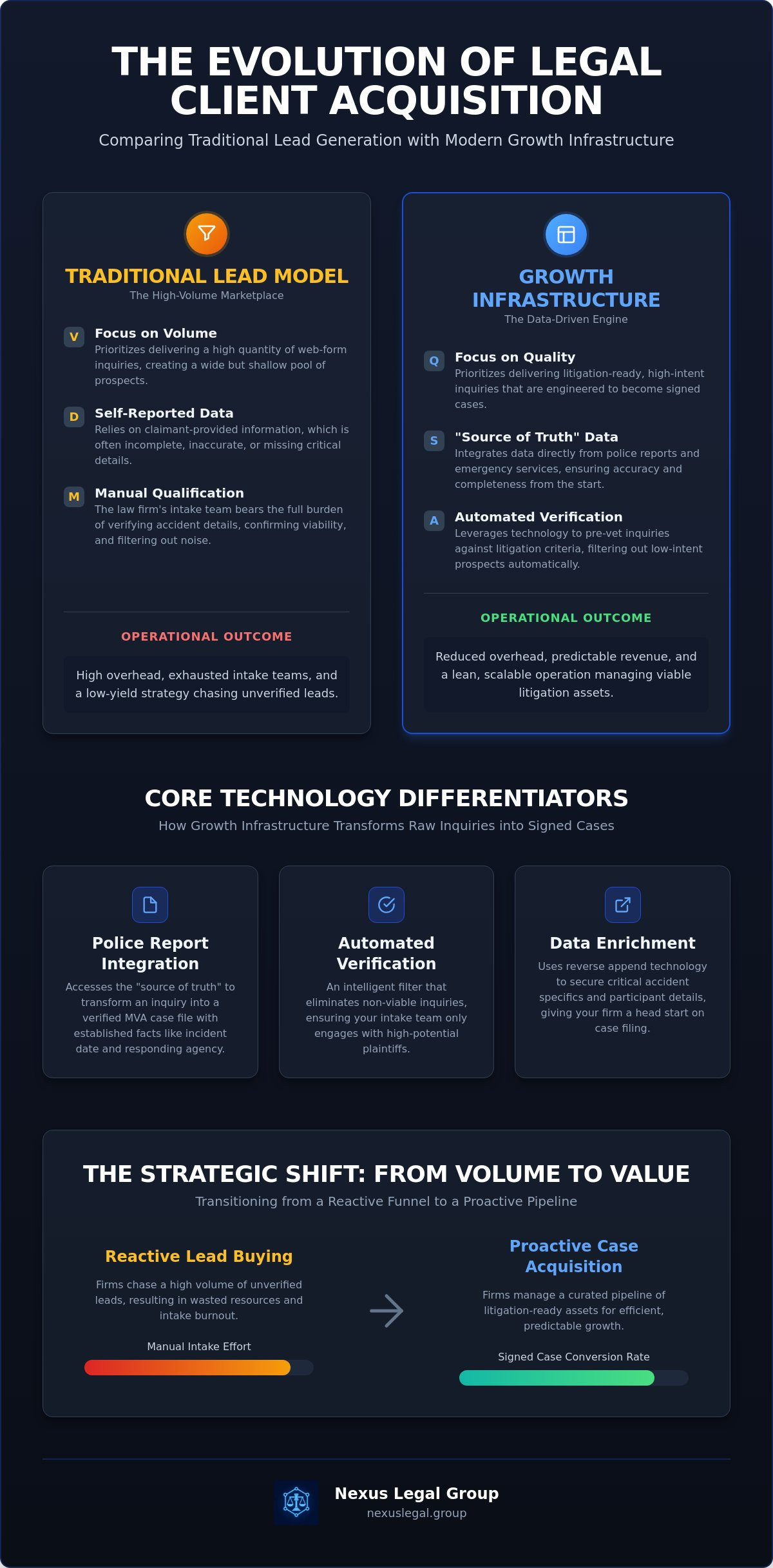
Growth infrastructure is not a lead vendor; it is a foundational layer for systemic firm expansion. Where traditional lead generation provides a list of potential clients, growth infrastructure delivers a predictable flow of verified, high-intent case opportunities. It is a systemic approach to acquiring litigation-ready inquiries by integrating deep data, automated verification, and seamless CRM delivery.
This model is built on clinical precision. Instead of casting a wide net, it uses sophisticated data sources to identify individuals with a high probability of having a valid claim—often before they have even started searching for an attorney. By eliminating the friction and guesswork from the intake process, it allows elite firms to focus their resources on what they do best: litigating and winning cases.
Data Mechanics: Incident-Based Data vs. Web Forms
The fundamental difference between traditional leads and litigation-ready inquiries lies in the source of the data. The old model relies on a prospective client to self-report their interest through a web form. The new model leverages objective, incident-based data to identify high-intent individuals from the moment a qualifying event occurs.
Nexus utilizes official police reports and emergency services data to power its MVA case acquisition engine. This isn't just a different data source; it's a completely different class of information. It provides a verified, factual starting point that is impossible to replicate with a standard web lead. This data contains the critical details—participant information, incident specifics, and preliminary liability indicators—that trial lawyers need to evaluate a case effectively.
The Power of Incident-Based Data
An inquiry generated from a police report represents a fundamentally higher level of intent than one from a generic search query. The individual is a confirmed participant in a specific, documented event. Nexus's automated systems collect and process this data, providing a critical head start on case development.
This approach offers several distinct advantages:
- Verified Event: The case acquisition process begins with a confirmed, documented motor vehicle accident, not an anonymous web search.
- Higher Intent Signal: Accessing data from official reports targets individuals directly involved in a qualifying incident, eliminating the noise from casual researchers. For more on this, see our guide to police report generated MVA leads.
- Early Case Valuation: With access to the initial accident report, your firm can more accurately assess case viability and potential value from the very first interaction.
Enrichment Beyond the Initial Inquiry
Raw data alone is not enough. The Nexus platform employs sophisticated reverse append technology to enrich the initial incident data. This process cross-references information across multiple databases to fill in missing details, confirm contact information, and build a comprehensive profile of the potential claimant and the event.
This level of data enrichment transforms a raw data point into an actionable legal opportunity. It significantly reduces the investigative burden on your firm, allowing you to bypass the time-consuming initial research phase and move directly to client engagement. By the time an inquiry reaches your CRM, it comes with a detailed dossier that empowers your team to have a more meaningful and informed conversation.
Automated Verification: Reducing Intake Overhead
One of the most significant hidden costs in a law firm is the operational overhead of manual intake. A high volume of low-quality leads can cripple profitability, forcing you to scale your intake department just to keep up with the task of filtering out unqualified inquiries. This is where the distinction between a "lead" and a "litigation-ready inquiry" becomes a critical factor in your firm's financial health.
A lead is an unvetted contact who has expressed general interest. A litigation-ready inquiry, as delivered by Nexus, is a pre-qualified opportunity that has already been vetted against your firm's specific case criteria. Nexus’s AI-driven verification engine acts as a powerful, automated filter, ensuring that your team only engages with prospects who meet your precise requirements for injury type, liability, jurisdiction, and other key factors.
The Verification Workflow
The Nexus system is designed to create a seamless, efficient flow from data acquisition to your firm's desktop. This automated process eliminates the manual friction points that slow down traditional intake models.
- Capture: An inquiry is generated through high-intent channels, primarily by sourcing data from police reports and emergency services records.
- Verification: The inquiry is processed through an automated vetting system. AI algorithms check the data against your firm’s custom criteria, such as confirming specific injury types, validating incident reports, and ensuring there are no conflicts.
- Delivery: Once verified, the litigation-ready inquiry, complete with enriched data, is delivered directly and exclusively to your law firm’s CRM for immediate action by your team.
This structured workflow provides a predictable and scalable engine for case acquisition. For a deeper analysis of how this impacts firm performance, explore our guide on automated intake for plaintiff firms.
Comparing the Intake Burden
The operational difference between the two models is stark. A traditional, high-volume lead flow necessitates a large intake department trained for speed and rapid-fire qualification. The primary goal is to contact the lead before a competitor does, often at the expense of thoroughness. This creates a stressful, reactive environment that is difficult to scale efficiently.
In contrast, the Nexus growth infrastructure delivers a lower volume of exceptionally high-quality inquiries. This allows your firm to operate with a smaller, more specialized intake team focused on client conversion, not qualification. Automated verification effectively eliminates the "speed to lead" anxiety, as each inquiry delivered is exclusive, verified, and ready for a substantive conversation. Your team can invest its time in building rapport and signing cases rather than chasing dead ends.
Selecting the Right Framework for Your Firm's Growth Stage
Choosing a client acquisition strategy is not a one-size-fits-all decision. The optimal approach depends on your firm's practice areas, growth objectives, and operational capacity. The critical question is whether you need to buy individual leads or invest in a systemic infrastructure for growth.
A traditional lead provider can be a viable option for firms with broad, general practice areas that rely on high volume to find viable cases. It can serve as a starting point for firms that have not yet developed a specialized intake process or are testing new geographic markets on a limited budget.
However, for plaintiff firms focused on scaling high-value MVA and Mass Tort practices, investing in law firm growth infrastructure becomes a strategic imperative. This approach is designed for firms that have moved beyond the "any case is a good case" mindset and are focused on maximizing their cost-per-signed-case (CPSC) and building a predictable, scalable revenue engine.
The Trial Lawyer's Decision Matrix
To determine the right path for your firm, evaluate your current operations against these key metrics:
- Intake Conversion Rate: Are your intake specialists spending more than 80% of their time disqualifying leads? If so, your cost-per-acquisition is likely inflated by operational waste, and an automated verification system could deliver a significant ROI.
- Capacity for High-Volume Chasing: Does your firm have the staffing and resources to effectively manage a constant influx of hundreds of unvetted web leads per month? Or would your team be more effective focusing on a smaller number of high-intent, pre-qualified opportunities?
- Cost-per-Lead vs. Cost-per-Signed-Case: The price of a traditional lead is often low, but the fully-loaded cost to convert it into a signed case can be extremely high. Shifting focus from the upfront cost of an inquiry to the final CPSC provides a much clearer picture of acquisition efficiency.
Mass Tort Considerations
Nowhere is the need for a sophisticated infrastructure more apparent than in mass tort litigation. The complexity, compliance requirements, and scale of these campaigns demand far more than a simple web lead can provide. A successful mass tort case acquisition strategy requires a system that can deliver ethically sourced, highly qualified claimants and even signed retainers.
Growth infrastructure provides the necessary framework for scaling a mass tort practice without exponentially increasing headcount. By leveraging data and automation, it ensures that every potential claimant is rigorously vetted for exposure, injury, and other key criteria, delivering a predictable flow of cases that meet the precise requirements of the litigation.
Conclusion: Nexus as the Infrastructure for Elite Plaintiff Firms
The choice between a traditional lead provider and Nexus represents a choice between two different business philosophies. One is a transactional relationship focused on delivering volume; the other is a strategic partnership focused on building a scalable, efficient, and predictable growth engine.
The Nexus platform was engineered with the clinical precision required by elite plaintiff firms. By moving away from the unpredictability of web forms and leveraging deep data from police reports and emergency services, we provide an end-to-end system that delivers litigation-ready inquiries, not just unverified leads. The future of legal growth will be defined by those who can effectively integrate AI, deep data, and automated systems to eliminate inefficiency and maximize case value.
The Nexus Advantage in 2026
Our commitment is to provide the foundational growth layer that empowers your firm to scale mechanically. This is achieved through:
- End-to-end growth infrastructure designed to deliver litigation-ready inquiries.
- Exclusive integration with police reports and emergency services data for unparalleled intent.
- AI-driven automated verification to eliminate intake overhead and reduce your cost-per-signed-case.
Ready to Scale Mechanically?
If your firm is ready to move beyond the limitations of traditional lead generation, the first step is to analyze your current acquisition metrics. Understand the true cost of your intake process and the conversion rate of your existing lead sources.
We invite you to consult with a Nexus growth architect to audit your intake flow and explore how a data-driven infrastructure can be tailored to your firm's goals. Visit Nexus Legal Group to learn more about our case acquisition frameworks and take the first step toward building a more profitable and predictable future.