TCPA Compliance for Law Firm Advertising: 2026 Checklist
Ensure TCPA compliance for law firm advertising with our 2026 checklist. Learn how to verify consent, map intake workflows, and manage marketing risk today.
What if a contact record looks complete, but your firm can’t connect its consent evidence to the campaign and communications it plans to run? That gap is why TCPA compliance for law firm advertising takes more than a checkbox or a vendor’s assurance. Your team needs to know how consent was obtained, how campaign instructions are carried out, and how opt-outs move through advertising and intake workflows.
If you’re unsure which records apply to each contact, or how a partner’s practices affect your firm’s operational risk, start by mapping the process. Consent documentation, campaign execution, and internal handoffs can involve multiple teams and vendors. Make accountability visible at each stage, from collection through follow-up.
This 2026 checklist gives your team a repeatable process for reviewing controls before launch and while campaigns are active. You’ll assess consent provenance, campaign details, vendor responsibilities, suppression handling, and escalation paths. Use it to identify questions for qualified counsel and prospective partners, and verify current legal requirements against authoritative sources before making decisions.
Key Takeaways
- Map contact methods, lead sources, intake steps, and follow-up paths to identify what needs review.
- Build an evidence trail that connects each contact to its source, collection details, campaign, and displayed consent language.
- Clarify who owns evidence access, workflow execution, escalation, and auditability across firm, agency, and lead-provider models.
- Use this TCPA compliance for law firm advertising checklist before launch and during active campaigns, adapting it to your firm’s review process.
- Evaluate acquisition partners by asking what they can document and how their processes fit your controls. Verification is not a guarantee of compliance.
TCPA Compliance for Law Firm Advertising: Define the Campaign and Its Risk Points
TCPA compliance for law firm advertising starts with a practical question: what communications does the campaign generate, and how does each contact reach the firm? The Telephone Consumer Protection Act is a federal law addressing certain calls and text messages. A foundational overview of the Telephone Consumer Protection Act of 1991 can provide context, but it cannot determine whether a particular campaign meets current requirements.
An advertisement is only one part of the contact path. The source of an inquiry, the technology used to initiate a call or text, the message’s purpose, and the steps that follow can all shape the questions counsel needs to evaluate. An operational review helps identify evidence gaps and control points. It does not determine whether a specific campaign complies with the law.
Which law firm advertising activities should the review cover?
Map the full journey, from advertisement and lead capture through firm contact, intake, and follow-up. Include inbound and outbound calls, text messages, and automated workflows. Don’t limit the inventory to systems the firm owns. Third-party collection, contact, and suppression processes can also affect campaign execution.
- Identify who collects information and where each lead enters the workflow.
- Record which organization initiates calls or texts and which systems support those communications.
- Determine how opt-out requests are received, routed, and reflected in later contact activity.
Use this map as the working scope for review. It helps teams spot handoffs where records, instructions, or opt-out information could become disconnected.
Who should review TCPA questions inside and outside the firm?
Assign internal owners across marketing, intake, operations, and compliance. That way, campaign decisions, contact execution, and escalation each have a clear point of accountability. Document every vendor’s role, including what information it can provide and how issues are raised. Contract language can clarify responsibilities, but it does not by itself resolve how legal responsibility applies to a campaign.
Qualified counsel should assess the current federal and FCC framework, relevant court decisions, and state-specific requirements against the facts and technology involved. Review before launch and whenever the campaign, vendor, or workflow changes. Because requirements can depend on those details, use current authoritative sources and counsel review rather than treating a generic checklist as a legal determination.
Consent, Contact Data, and Opt-Outs: Build an Evidence Trail
A usable evidence trail lets your firm reconstruct how a contact entered a campaign and what happened next. A name, phone number, or consent flag alone may not show where the information came from, what language appeared at collection, or which campaign was involved. For TCPA compliance for law firm advertising, preserve the context around each record so your team and counsel can assess it against the planned contact activity.
Design records so a reviewer can connect each contact to its source and collection event. Where available, capture the lead source, landing page or form, collection timestamp, campaign identifier, contact method, and version of the disclosure presented. Preserve the consent language itself, not just a database field indicating that consent was recorded. Store related evidence where authorized reviewers can retrieve and examine it.
What should firms document about consent and lead provenance?
Start with a record-level trail, then check whether the evidence matches the campaign that will use the contact. For example, if an inquiry came through a third-party form, the firm should be able to identify the source and review the disclosure shown at submission, where that information is available. Ask whether the evidence supports the intended contact method and campaign under current guidance. A field or form entry is not, by itself, a legal conclusion about sufficiency. Have qualified counsel assess the facts.
How should opt-outs and contact restrictions move through the workflow?
Suppression controls are reliable only when requests can travel from the point of receipt to every relevant system and provider. Document how staff and vendors receive a request, when it was received, and how it is routed to the teams or systems that manage outreach and intake. Identify who confirms the change has been applied and how the firm handles requests that are unclear or disputed.
- Route: Identify the owner for requests received by phone, text, intake staff, or a provider.
- Propagate: Check that relevant outreach and intake systems receive the restriction, including vendor-managed workflows.
- Escalate: Define what staff should do if a request cannot be matched to a record, a system is unavailable, or contact history is contested.
Test the workflow with a documented internal scenario, such as a request received by intake that must also be reflected in a separate outreach system. Record the result and resolve gaps before relying on the process. Ask vendors what evidence they can provide about collection and suppression handling, then compare their answers with the firm’s records. If you’re assessing a case-acquisition partner, review Nexus Legal Group’s legal growth infrastructure as a starting point for discussing documentation and operational roles. Any legal assessment still requires current authoritative guidance and qualified counsel.
Compare In-House, Agency, and Lead-Provider Controls Before Launch
The operating model affects who can access campaign evidence, change contact workflows, and respond when a concern is raised. Before launch, compare the responsibilities each party actually performs, not just the titles used in a proposal. For TCPA compliance for law firm advertising, process documentation makes those boundaries easier to examine. Broad assurances alone don’t show how a particular campaign is managed.
| Operating model | Evidence and workflow questions | Accountability to clarify |
|---|---|---|
| Firm-managed | Can the firm retrieve collection records, campaign details, and contact history? | Who owns campaign setup, contact execution, opt-out handling, and internal escalation? |
| Agency-managed | What campaign records can the agency share, and how does the firm review changes? | Who controls creative, collection flow, contact activity, and issue reporting? |
| Lead-provider managed | Can the provider explain the source and collection context for each record? | Who handles contact, restrictions, disputed records, and communication with the firm? |
These are diligence prompts, not universal allocations of legal responsibility. A campaign may combine operating models, so document actual handoffs and verify that stated controls match its contact methods and technology.
Which vendor questions reveal the actual campaign workflow?
Ask vendors to walk through a contact’s path from collection to any call, text, or intake handoff. Find out how the firm can access consent context and source records, which party initiates communications, and how contact restrictions reach each relevant workflow. Request written escalation procedures for complaints, disputed consent, and data-quality concerns. Specific answers and sample process documentation are more useful for review than a general compliance assurance.
How can firms compare evidence and accountability consistently?
Use the same criteria for every provider: record retrieval, process transparency, role clarity, and issue reporting. For each one, note what the provider can demonstrate, what the firm controls, and what remains unclear. Confirm that the documented process corresponds to the campaign under review. Have qualified counsel assess contractual language and its legal implications. A contract can inform diligence, but it does not settle how the law applies.
- Evidence access: Can authorized firm personnel retrieve relevant records?
- Workflow ownership: Are collection, contact, and restriction-handling roles identified?
- Escalation: Is there a documented path for raising and tracking concerns?
- Auditability: Can the parties explain what happened and when using available records?
Keep the comparison with campaign materials and review notes. This gives your team a consistent basis for resolving gaps before launch and deciding what needs further operational or legal review.
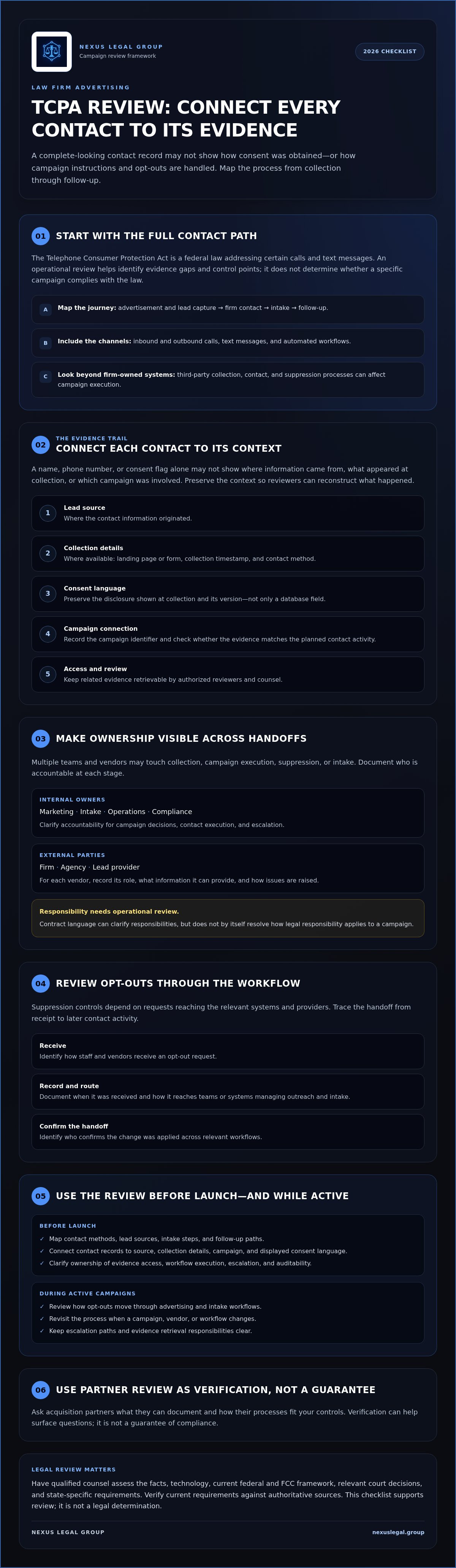
Use This Pre-Launch and Ongoing TCPA Review Checklist
Use this sequence as a repeatable operational review, not a substitute for legal advice. For TCPA compliance for law firm advertising, the goal is to confirm that campaign materials, contact data, systems, and assigned responsibilities work together. Keep a record of what the team reviewed and what remains unresolved.
What should the team confirm before a campaign goes live?
Complete these checks before launch. If you cannot verify a control, record the gap and route it for resolution rather than treating an assumption as approval.
- 1. Define the campaign. Record its purpose, audience, creative, collection flow, contact methods, and planned follow-up.
- 2. Trace the data source. Identify how and where contact information was collected, the campaign context, and which supporting records are available.
- 3. Review consent evidence. Preserve the applicable disclosure and collection evidence. Ask qualified counsel to assess whether it supports the planned contact activity under current guidance.
- 4. Map responsibilities. Identify which parties collect information, initiate calls or texts, manage intake, and receive contact restrictions. Confirm that the firm can access relevant records.
- 5. Test the workflow. Use an appropriate test process to check routing and suppression across relevant systems and vendor handoffs. Document the result and any unresolved issue.
- 6. Record approval. Log the reviewer, approval date, materials and workflow reviewed, open questions, and counsel’s guidance where applicable. Tie approval to the version assessed.
What should teams monitor after launch?
Approval is a checkpoint, not a reason to stop reviewing. Repeat the assessment during active campaigns and whenever a material part of the process changes.
- 7. Review activity and exceptions. Monitor complaints, opt-out handling, data discrepancies, and contact patterns that differ from the approved workflow.
- 8. Escalate control failures. If evidence is incomplete or routing, suppression, or another control appears to fail, promptly send the issue to the designated owner. Consider pausing affected activity while the firm assesses the issue with appropriate internal teams and counsel.
- 9. Reassess changes. Review the campaign again when its scope, creative, contact method, data source, vendor, technology, or applicable guidance changes. Update the approval record and test affected workflows before relying on revised controls.
Keep the checklist and supporting records together so reviewers can see what was approved, what was tested, and how exceptions were handled. Adapt the steps to your firm’s workflows and counsel’s guidance.
Choose a Compliance-Forward Acquisition Partner Without Treating It as a Guarantee
A partner should fit the firm’s review process, not replace it. Use the campaign checklist to assess what the provider can document, which tasks it performs, and how issues move between provider and firm. A compliance-forward approach is a useful diligence topic, but no provider’s positioning or verification process guarantees that every campaign meets applicable legal requirements or eliminates risk.
When may an acquisition partner fit a firm’s operating model?
Start by defining the outcome your firm is evaluating: high-intent inquiries, signed cases, or a defined combination. Then assess whether the partner’s sourcing and verification approach supports your review and intake processes. Nexus Legal Group provides high-intent motor vehicle accident inquiries and automated verification. Its MVA acquisition services use police reports, emergency services data, and reverse append technology to obtain detailed accident reports and participant details. Ask which records and process details are available for the specific offering under consideration, and confirm those details with the company.
Keep roles explicit. The firm should identify who owns legal review, campaign approval, intake, and ongoing monitoring, while documenting the provider’s agreed responsibilities and escalation path. Automated verification can inform operational review. It is not a legal assessment of consent or campaign compliance.
What should firms validate before engaging a provider?
Request process documentation that describes lead sourcing, verification steps, available record-level evidence, and the handling of complaints, opt-outs, and disputed records. Ask who receives each issue, how it is routed to the firm, and what information can be used to investigate it. Compare the answers with the firm’s controls, then refer legal questions to qualified counsel using current authoritative sources.
- Evidence: What can the provider show about the source and collection context for a record?
- Workflow: Which party initiates contact, handles restrictions, and manages intake handoffs?
- Escalation: How are complaints, incomplete records, or process failures communicated and tracked?
- Fit: Do the documented controls match the campaign’s contact methods, technology, and review needs?
Review the provider’s answers alongside your firm’s campaign records and counsel’s guidance. For broader context on ethical, compliance-forward lead practices, see the Compliant Legal Lead Generation guide. Treat the discussion as structured diligence, not a transfer of the firm’s legal review responsibilities.
Make Your Campaign Review a Repeatable Practice
Strong TCPA compliance for law firm advertising depends on connecting campaign details to reliable records and accountable workflows. Trace each contact to its source and consent context, confirm how opt-outs reach relevant systems, and define who owns review, execution, and escalation across the firm and its partners.
Use the checklist before launch and revisit it as campaigns, vendors, or processes change. Treat documentation and vendor assurances as inputs for operational diligence, not as a legal conclusion. Have qualified counsel assess applicable requirements against current authoritative guidance and the facts of your campaign.
Nexus Legal Group describes its services as ethical and compliance-forward, with high-intent MVA inquiry acquisition and automated verification. These capabilities can inform a partner evaluation, but they don’t guarantee compliance or eliminate legal risk. Ask what evidence and process details are available for the specific offering you’re considering.
A structured review gives your team a clearer basis for decisions and productive conversations with counsel and prospective partners. Build the process, document what you learn, and keep improving it as campaigns evolve.
Frequently Asked Questions
Does the TCPA apply to law firm advertising calls and text messages?
Yes, the TCPA may apply to calls and text messages used in law firm advertising, but its application depends on the communication, its purpose, the technology involved, and other facts. Review how contacts are collected and reached rather than assuming every call or text is treated identically. Federal and state requirements may differ, so ask qualified counsel to assess the specific campaign under current law.
What consent records should a law firm request from a lead provider?
Request records that connect each contact to its source, collection method, timestamp, and campaign context, along with the consent language and disclosure presented at submission. Ask whether the provider can retrieve evidence tied to the intended contact method and share it with the firm for review. A consent field alone may not establish the full context. Have counsel assess whether the available evidence is sufficient for the planned campaign.
Can a law firm rely on a vendor’s TCPA compliance assurances?
No. A vendor’s assurance can inform diligence, but it doesn’t replace the firm’s review of campaign facts, available records, and operating controls. Ask the provider to document how information is collected, who initiates contact, how restrictions are handled, and how concerns are escalated. Clarify responsibilities in writing, then ask qualified counsel to review legal questions. Contracts and verification processes don’t guarantee compliance or eliminate risk.
How should law firms handle a request to stop calls or texts?
Record the request, including when and how it arrived, then route it promptly to the people and systems responsible for outreach and intake. Current federal rules generally require covered revocation requests to be honored within 10 business days and allow consumers to use reasonable means to revoke consent. Confirm the current standard and any stricter applicable state rules with counsel. Test that suppression updates reach relevant vendors and systems.
What happens if a law firm cannot verify where a lead came from?
An unverified source creates an evidence and review gap. The firm may be unable to establish the collection context, identify the disclosure shown, or assess whether the record supports the planned contact activity. Don’t treat a missing source record as proof of a violation or as proof that the lead is usable. Escalate the record, seek supporting documentation from the provider, and ask counsel how to proceed before relying on it.
Do TCPA rules apply to every marketing call or text in the same way?
No. Applicable requirements can depend on the communication’s purpose, contact method, technology, consent evidence, and other campaign facts. A promotional message and a purely informational contact may raise different legal questions, while state requirements may add another layer. Avoid applying one campaign’s assessment to all outreach. Have qualified counsel evaluate the actual message, workflow, and jurisdictions relevant to the campaign using current authoritative guidance.
How often should a law firm review its TCPA advertising controls?
Review controls before launch, monitor them during active campaigns, and reassess whenever campaign scope, creative, contact methods, data sources, vendors, or technology change. Also review complaints, opt-out handling, and unexpected contact patterns as part of ongoing oversight. Set a repeatable internal review cadence that fits your operations, and update it with counsel’s guidance when applicable requirements change. Keep dated records of approvals, tests, findings, and corrective actions.