Reducing Law Firm Intake Overhead: The Data-Driven Infrastructure for Elite Firms
Stop wasting your marketing budget. Learn how reducing law firm intake overhead with data-driven automation can deliver litigation-ready cases and boost your...
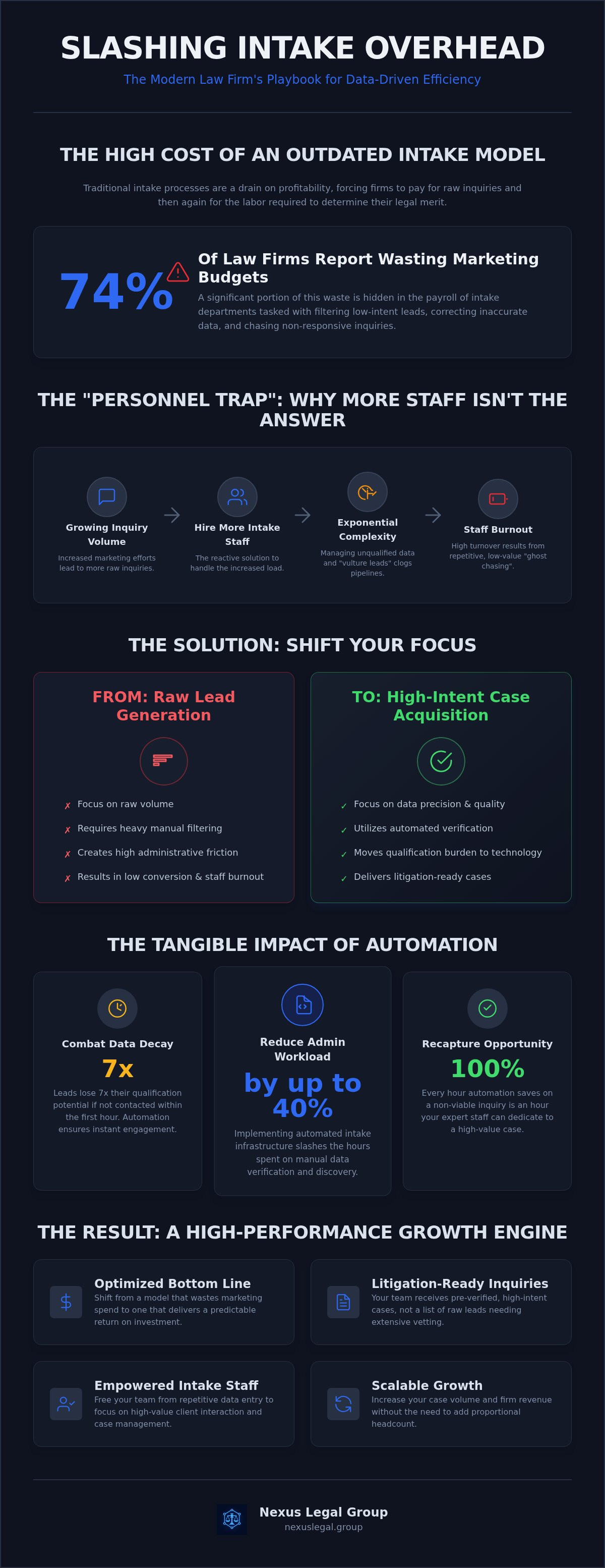
Did you know that 74% of law firms report wasting a significant portion of their marketing budget on leads that never reach a signed contract? You're likely familiar with the friction of an overextended intake department, where staff burnout from chasing non-responsive inquiries is the norm rather than the exception. When your team spends hours manually vetting unqualified leads or correcting inaccurate incident data, you aren't just losing time; you're eroding the firm's bottom line. Effectively reducing law firm intake overhead requires a shift from manual labor to a sophisticated, data-driven infrastructure.
We'll show you how high-intent MVA acquisition and automated verification protocols eliminate the administrative bloat that plagues traditional growth models. You'll discover a method for transforming your intake funnel into a high-performance engine that delivers predictable, litigation-ready cases. By the end of this guide, you'll understand how to achieve a leaner department with higher conversion rates by leveraging police report data and systemic automation. It's time to replace manual vetting with technical mastery to ensure your firm's growth is both scalable and sustainable.
Key Takeaways
- Learn how to optimize your bottom line by reducing law firm intake overhead through the shift from manual vetting to automated, data-driven verification protocols.
- Understand the critical distinction between raw leads and litigation-ready inquiries to ensure your team focuses exclusively on high-value, actionable cases.
- Discover how to leverage reverse append technology and police report data to bypass the discovery phase and secure accident details instantly.
- Identify specific administrative friction points in your current funnel to scale your case volume without the need for additional headcount or staff burnout.
- Explore how integrating end-to-end growth infrastructure allows your firm to maintain ethical compliance while securing exclusive MVA and mass tort inquiries.
The Hidden Mechanics of Intake Overhead in Plaintiff Firms
Most firm partners view overhead through the lens of fixed costs like office leases and software subscriptions. However, in 2026, the most aggressive drain on profitability is the administrative burden of manual lead vetting. When we discuss reducing law firm intake overhead, we aren't just looking for cheaper software; we're addressing the systemic inefficiency of processing raw, unverified data. Traditional lead generation functions as a regressive tax on your firm’s growth. It forces you to pay twice: first for the inquiry itself, and second for the labor required to determine if that inquiry has any actual legal merit.
There's a direct, measurable correlation between lead intent and administrative friction. High-intent inquiries move through your system with minimal intervention, while low-intent "leads" require constant chasing. Statistics show that 74% of law firms report wasting money on marketing, and a massive portion of that waste is buried in the payroll of intake departments tasked with filtering out the noise. To scale effectively, you must stop treating intake as a sales problem and start treating it as a data infrastructure problem.
The Personnel Trap: Why Hiring More Intake Staff Isn't the Answer
Hiring more intake coordinators is a reactive solution that yields diminishing returns. As your inquiry volume grows, the complexity of managing unqualified data increases exponentially, not linearly. This environment creates a breeding ground for "vulture leads"—inquiries that are non-responsive, lack insurance, or have already signed with other firms. These leads clog your pipelines and exhaust your best employees. Staff burnout and high turnover in intake aren't management failures; they're the natural result of forcing talented people to perform repetitive, low-value data entry and "ghost chasing."
Quantifying the Cost of Manual Data Verification
Think about the cumulative hours your team spends hunting for basic accident reports or verifying insurance coverage. This manual discovery process is a relic of an era before advanced Legal technology became the standard for elite firms. Research indicates that implementing the right automated intake infrastructure can reduce a firm’s administrative workload by up to 40%. Without these systems, your attorneys are often forced to conduct case evaluations based on incomplete or inaccurate data, leading to wasted investigative resources and missed filing deadlines.
- Opportunity Cost: Every hour spent on a non-viable inquiry is an hour lost on a high-value case.
- Data Decay: Manual verification is slow, and leads lose 7x their qualification potential if not reached within the first hour.
- Evaluation Risk: Inaccurate data leads to poor litigation decisions and wasted retainers.
We define intake friction as the primary driver of non-billable overhead, representing the systemic resistance encountered when manual labor is used to compensate for deficient data.
Transitioning from Lead Generation to High-Intent Case Acquisition
The traditional legal marketing model relies on raw lead volume, a strategy that inadvertently increases administrative friction. When you purchase bulk leads, you're essentially buying a list of phone numbers that requires significant labor to filter. In contrast, a litigation-ready inquiry is a pre-verified opportunity where the claimant has already demonstrated high intent and met specific criteria. Shifting your focus from raw volume to high-intent acquisition is the most effective way of reducing law firm intake overhead. It moves the burden of qualification from your human staff to a sophisticated technological infrastructure.
Elite firms are moving toward an institutional model where growth is driven by data precision rather than aggressive sales tactics. By utilizing AI-driven marketing precision, you can identify serious MVA claimants who are actively seeking representation. This systemic approach ensures that your intake team isn't wasting their energy on "window shoppers" or non-responsive inquiries. Instead, they're managing a streamlined flow of cases that are already primed for a retainer.
The Lead-to-Case Ratio: A Metric for Operational Efficiency
Raw lead volume is a vanity metric that often masks deep operational inefficiencies. If your firm generates 500 leads but only signs 10 cases, your intake department is performing a massive amount of non-billable labor. Elite firms prioritize the lead-to-case ratio because it directly reflects the health of their profit margins. When you integrate Automated Intake for Plaintiff Firms, you shorten the "speed to lead" window. This is critical because research shows that responding within one hour makes you seven times more likely to qualify a lead. High-intent data enrichment allows your team to hit these benchmarks without adding more headcount.
Sourcing Litigation-Ready Inquiries for Motor Vehicle Accidents
Identifying the markers of a high-intent claimant happens long before the first phone call. These markers include the presence of a police report, the severity of vehicle damage, and immediate medical treatment. When your intake team receives an inquiry enriched with this data, the nature of the conversation changes. They don't have to subject the caller to a cold, clinical interrogation to verify the facts of the accident. Instead, they can focus on empathy and building a relationship, which significantly improves the conversion rate from inquiry to signed case.
This strategic advantage is especially vital in competitive national markets where exclusive inquiries are the only way to avoid a "race to the bottom" on acquisition costs. If you're looking to stabilize your case flow, consider how high-intent acquisition can serve as the foundational layer of your firm's expansion. By securing inquiries that are already vetted against police report data, you eliminate the guesswork that typically creates administrative bloat.
Engineering Efficiency Through Automated Verification and Enrichment
The most significant bottleneck in the intake funnel is the manual discovery phase. Traditionally, intake coordinators spend the first ten to fifteen minutes of a call acting as amateur investigators, trying to extract basic accident facts from a potentially traumatized claimant. This process is inherently flawed because it relies on the memory and technical knowledge of the caller. By the time a lead reaches your department, it should already be enriched with external data points that bypass this interrogation. Reducing law firm intake overhead requires a transition to an infrastructure where data verification happens before the first human interaction.
Automation doesn't just speed up the process; it ensures systemic integrity. When you integrate police reports and emergency services data directly into your intake flow, you're replacing subjective claims with objective evidence. This data-driven approach provides your trial lawyers with a critical head start, allowing them to evaluate the merits of a case with litigation-ready information on day one. It transforms intake from a defensive filtering process into an offensive case-building strategy.
The Power of Police Report Data for Precision Vetting
Confirming liability is the most time-consuming aspect of manual vetting. Relying on a claimant's version of events often leads to "ghost inquiries" where the accident details either can't be verified or the liability is split in a way that makes the case unviable. Utilizing Police Report Generated MVA Leads allows your firm to confirm participant details and officer assessments instantly. This level of precision vetting ensures that your team only spends their energy on inquiries where the foundational facts are already documented by law enforcement.
Reverse Append Technology: The Future of Legal Intake
Claimants rarely have their insurance carrier details or specific vehicle identification numbers ready during an initial call. Reverse append technology solves this by using limited data points to pull comprehensive profiles from authoritative databases. This system automatically fills the gaps in claimant-provided information, securing insurance limits and vehicle data without requiring your staff to conduct manual research or follow-up calls. Research from legal intake guides indicates that the implementation of automated enrichment and verification protocols can reduce a firm’s administrative workload by up to 40%. This efficiency allows your department to process a higher volume of cases without increasing headcount. By securing these details through a technological layer, you eliminate the human error that typically leads to wasted investigative resources later in the litigation cycle.
- Liability Confirmation: Objective data from police reports overrides subjective caller accounts.
- Resource Allocation: Staff focus on signing cases rather than hunting for accident reports.
- Data Integrity: Automated systems capture accurate insurance and vehicle info that claimants often forget.
Implementation: Scaling Your Growth Infrastructure Without Adding Headcount
Scaling a plaintiff practice often triggers a reflexive hiring spree in the intake department. This approach is fundamentally flawed because it attempts to solve a data quality problem with human labor. Implementing a robust Law Firm Growth Infrastructure allows you to increase case volume while maintaining or even reducing your current headcount. The transition begins with a clinical audit of your current funnel to identify administrative friction points where inquiries stall due to missing or unverified data. By reducing law firm intake overhead through technical integration, you ensure that your existing team operates at peak efficiency rather than drowning in administrative noise.
Establishing clear Key Performance Indicators (KPIs) is essential for monitoring this automated growth infrastructure. Elite firms move beyond tracking "cost per lead" and instead focus on the cost per signed case and the inquiry-to-retainer velocity. When your intake staff handles verified inquiries rather than cold leads, their role shifts from investigators to closers. This transition requires training that emphasizes empathy and relationship management, as the technical facts of the accident are already confirmed via automated enrichment protocols.
Phase 1: Eliminating the Vetting Bottleneck
The first phase of implementation requires a shift from a quantity-first to a quality-first acquisition mindset. Instead of processing 500 unverified leads to find 10 viable cases, your system should deliver 15 litigation-ready inquiries that result in 12 signed retainers. This reduction in raw volume, coupled with an increase in case quality, allows you to reallocate staff time from manual data entry to high-value client interaction. When the vetting bottleneck is eliminated, your intake coordinators can spend more time ensuring the claimant feels supported, which directly improves your firm's reputation and referral potential.
Phase 2: Integrating Data Enrichment Protocols
Technical integration involves setting up automated triggers that link your acquisition system with your existing CMS or CRM platform. When a high-intent inquiry is captured, the system should automatically initiate accident report retrieval and reverse append protocols. This ensures that by the time an intake coordinator opens the file, the insurance carrier details and liability markers are already populated. Maintaining ethical and compliant data handling is paramount; your infrastructure must align with standards like ABA Formal Opinion 512 regarding the use of technology and AI. Monitoring the impact of these verified inquiries will show a marked increase in sign-up velocity, as the time spent "chasing" details is replaced by immediate case evaluation.
The Nexus Approach: Litigation-Ready Inquiries as an Overhead Solution
Nexus Legal Group doesn't just offer leads; we provide the end-to-end growth infrastructure that elite firms require to dominate the 2026 legal landscape. By integrating AI-driven marketing precision with real-time data enrichment, we solve the core issue of reducing law firm intake overhead. Most firms are trapped in a cycle of hiring more staff to process lower-quality data. Our systems break this cycle by delivering inquiries that have already passed through rigorous automated verification protocols. This approach ensures your firm isn't just busy, but productive. It positions your practice as a technical leader capable of handling high-value cases with clinical efficiency.
Our methodology focuses on the mechanics of business expansion. We act as a foundational layer for your organization, providing a sense of controlled urgency that is deeply focused on the elimination of friction. Every inquiry we deliver is designed to be litigation-ready, meaning the administrative heavy lifting is completed before the case ever reaches your desk. This technical mastery instills a sense of security, allowing you to focus on the high-level legal strategy that wins cases.
Exclusive MVA Case Acquisition: Engineering Predictability
In the motor vehicle accident space, predictability is a luxury that few firms can afford. Our model is built on police report data, which serves as the ultimate source of truth for liability and injury confirmation. When you partner with Nexus Legal Group, you're securing exclusive inquiries that are litigation-ready from the moment they enter your CRM. This level of verification allows your trial lawyers to bypass the initial discovery friction and focus on high-value casework. It's a strategic advantage that transforms your intake department from a cost center into a high-performance engine. You're no longer paying for the opportunity to vet; you're paying for a verified result.
Scaling Mass Tort Portfolios with Precision
Mass tort litigation presents a unique administrative challenge due to the sheer volume of potential claimants. Managing thousands of inquiries manually is a recipe for administrative bloat and high turnover. We apply the same automated verification and reverse append protocols to mass tort acquisition, ensuring that every claimant is vetted against specific criteria before they reach your team. This precision reduces the burden on your staff and allows you to scale your portfolio without an exponential increase in headcount. It's a no-nonsense approach where every process serves a functional purpose in your firm's growth.
The 2026 legal market rewards firms that prioritize systemic integrity over raw volume. By leveraging our foundational infrastructure, you position your practice for sustainable, scalable growth. The next step for partners seeking to eliminate friction in their intake funnel is to request a consultation for systemic growth. We'll show you how to move from chasing leads to managing a predictable, litigation-ready case flow that protects your margins and maximizes your firm's potential.
Optimizing Your Firm's Growth Architecture for 2026
Transitioning your firm from a labor-intensive intake model to a data-driven infrastructure is no longer optional for elite practices. By focusing on high-intent case acquisition and leveraging automated verification protocols, you effectively eliminate the administrative friction that stalls growth. We've explored how reducing law firm intake overhead depends on replacing manual discovery with objective data points like police reports and emergency services enrichment. This systemic shift allows your team to focus on high-value client interactions rather than chasing unverified leads. When your infrastructure handles the technical vetting, your staff can finally perform the high-level work they were hired to do.
Implementing these specialized systems ensures your firm remains competitive and lean while maintaining ethical compliance. It's time to stop treating intake as a personnel problem and start treating it as a technical advantage. Your path to a more profitable, litigation-ready practice starts with the right foundational layer. We're here to help you engineer that success and secure your firm's future.
Frequently Asked Questions
What is the primary cause of high intake overhead in plaintiff firms?
The primary cause of administrative bloat is the manual vetting of low-intent or unverified leads. When your staff spends hours chasing non-responsive inquiries or correcting inaccurate incident data, they aren't performing high-value work. This labor-intensive process creates a hidden tax on your growth that erodes firm profitability over time.
How can automated verification reduce the need for a large intake team?
Automated verification protocols pre-screen inquiries against objective data points before they ever reach a human coordinator. By using technology to filter out non-viable cases, your existing team can focus exclusively on signing high-value retainers. This shift allows you to handle a larger case volume without the reflexive need to hire more administrative staff.
What role do police reports play in reducing law firm administrative costs?
Police reports provide an objective foundation for liability and injury confirmation, which bypasses the need for lengthy discovery calls. Utilizing police report generated MVA leads ensures that your team starts with verified incident data. This significantly lowers the labor cost associated with initial case evaluation and prevents investigative resources from being wasted on unviable claims.
Can high-intent case acquisition actually lower my cost-per-case?
Yes, high-intent acquisition lowers the total cost-per-case by drastically improving the conversion rate from inquiry to signed retainer. While the upfront cost for a litigation-ready inquiry may be higher than bulk leads, the reduction in labor hours spent on unqualified calls is a key factor in reducing law firm intake overhead and protecting your margins.
What is reverse append technology in the context of legal lead generation?
Reverse append technology uses limited claimant data points to automatically retrieve comprehensive profiles from authoritative databases. This process fills critical gaps in information, such as insurance carrier details and vehicle identification, without requiring your intake staff to conduct manual research. It ensures that your team has a complete case file before the first interaction.
Is it possible to scale a law firm without hiring more administrative staff?
Scaling without additional headcount is achievable by implementing a data-driven growth infrastructure that prioritizes quality over raw volume. By automating the vetting and enrichment phases of your funnel, your firm can process a higher volume of litigation-ready inquiries. This technical mastery allows your current team to operate at a much higher capacity.
How does pre-verification impact the conversion rate from lead to signed case?
Pre-verification ensures that every inquiry your staff handles meets specific, objective criteria for a viable case. When intake coordinators work with verified data, they don't have to act as interrogators. They can focus on building rapport and securing the signature immediately, which drastically shortens the time-to-sign and increases overall conversion velocity.
What metrics should I track to measure intake efficiency?
You should move beyond raw lead volume and focus on metrics like inquiry-to-retainer velocity and cost per signed case. Tracking the administrative time spent per qualified inquiry provides a clear picture of your operational health. These data points are essential for reducing law firm intake overhead and ensuring your growth remains predictable and sustainable.