
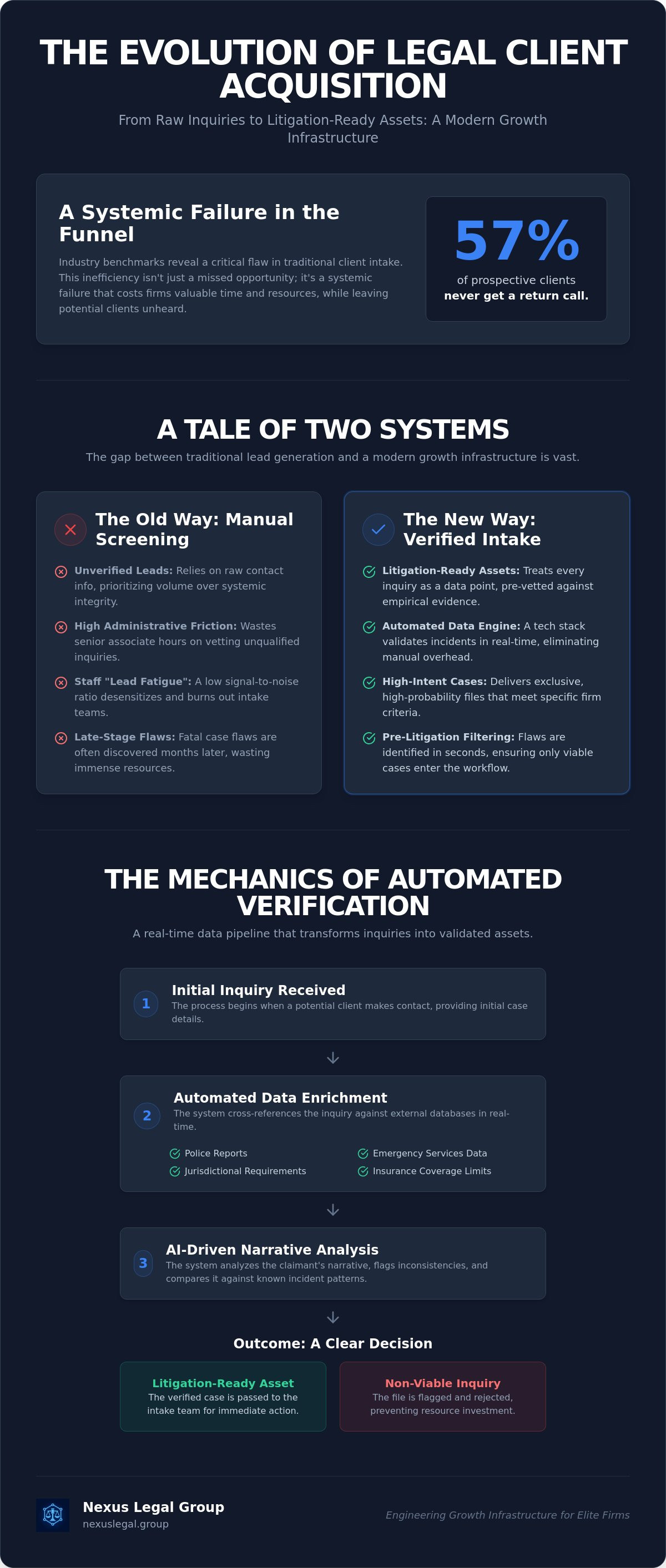
Industry benchmarks reveal that 57% of prospective clients who contact a law firm never receive a return call, which exposes a systemic failure in the traditional legal growth funnel. In a regulatory environment where California’s SB 37 now mandates direct attorney responsibility for acquisition methods, the old ways of manual lead vetting are no longer sustainable. You need a system that does more than just answer the phone. Implementing a verified intake for trial lawyers allows you to treat every inquiry as a data point in a sophisticated, automated triage engine that pre-litigates cases before a human ever picks up the phone.
It's frustrating to watch your high-value trial teams lose hours to administrative friction and inconsistent lead quality from traditional marketing. We understand that your goal is a scalable stream of high-intent cases without the burden of manual overhead. This article teaches you how to engineer a growth infrastructure that transforms raw inquiries into litigation-ready assets through automated verification and data-driven systems. We'll examine the mechanics of technical data enrichment and show you how to bridge the gap between an unstructured initial inquiry and a signed retainer.
Key Takeaways
- Understand the transition from traditional lead generation to a data-driven infrastructure that treats inquiries as litigation-ready assets.
- Identify the technical requirements for integrating police reports and emergency services data into your top-of-funnel acquisition strategy.
- Evaluate the operational advantages of an AI-driven growth infrastructure over manual screening models to eliminate administrative friction and overhead.
- Follow a systematic implementation framework for verified intake for trial lawyers to increase signature rates and ensure regulatory compliance.
- Explore how high-performance firms utilize specialized systems to scale their MVA and Mass Tort case acquisition with clinical precision and technical mastery.
Defining Verified Intake for the Modern Trial Lawyer
Verified intake is the technical intersection of real-time incident data, AI-driven vetting, and high-intent marketing strategies. It represents a fundamental departure from the antiquated practice of purchasing raw contact lists or unvetted "leads." For a sophisticated firm, verified intake for trial lawyers acts as a pre-litigation filter. It ensures every case entering the workflow is backed by empirical evidence, such as police reports or emergency services records, before a human ever initiates contact. While a standard lead is often nothing more than a name and a phone number, a verified inquiry is a litigation-ready asset. It has already been cross-referenced against jurisdictional requirements, liability markers, and insurance coverage limits.
Traditional lead generation fails elite firms because it prioritizes volume over systemic integrity. When you rely on unverified data, you're essentially outsourcing your firm's initial due diligence to a third party that lacks your professional standards. This creates a massive disconnect between your marketing efforts and your trial team's needs. By implementing a verified intake for trial lawyers, you bridge this gap, transforming the intake department from a simple call center into a high-performance data-processing engine that feeds your Legal case management system with high-probability files.
The Evolution from Lead Gen to Growth Infrastructure
By 2026, the standards for client acquisition have shifted toward a more mechanical, systems-based approach. The industry has moved toward lead generation for trial lawyers that functions as an integrated growth infrastructure rather than a series of disconnected marketing campaigns. Trial success in this environment requires more than just a contact form; it requires a technological stack that can validate an accident in real-time. Elite firms no longer settle for shared leads that result in a frantic race to the phone. They require exclusive, verified data to maintain a competitive edge in high-stakes plaintiff litigation and ensure that every signed retainer meets their specific criteria for liability and damages.
The Cost of Unverified Intake Systems
Operating without a verification layer creates a "hidden tax" on your most valuable human capital. When senior associates or specialized intake teams spend their hours vetting unqualified inquiries, they aren't just wasting time; they're increasing firm-wide operational friction. This inefficiency leads to "lead fatigue," where your staff becomes desensitized to new inquiries due to a low signal-to-noise ratio. Beyond the immediate labor costs, unverified data negatively impacts case valuation and settlement timelines. If the foundation of a case isn't validated at the point of entry, your team may spend months discovering fatal flaws that a data-driven intake system would have identified in seconds. This systemic failure eventually erodes the firm's profitability and slows its overall growth trajectory.
The Mechanics of Automated Verification and Data Enrichment
Moving from the conceptual framework of growth infrastructure to technical execution requires a fundamental shift in how your firm handles incoming data. High-intent MVA case acquisition isn't a volume game; it is a depth-of-data game. The technical stack required for this level of precision goes far beyond a standard CRM. It functions as a real-time data pipeline that cross-references inbound inquiries against external incident databases. By the time an intake specialist sees a notification, the system has already performed a series of automated checks to confirm the incident's existence, the date of loss, and the geographic jurisdiction. This level of verified intake for trial lawyers ensures that your team isn't gambling on the accuracy of a caller's memory during a high-stress moment.
AI-driven automated verification identifies litigation-ready inquiries by analyzing the narrative structure of the intake and comparing it against known incident patterns. If a claimant's story doesn't align with the physics of the reported accident or the timeline of emergency response, the system flags the file for immediate rejection. This real-time filtering prevents your firm from investing resources in non-viable files. If you're looking to eliminate these manual bottlenecks, exploring a systemic infrastructure approach can help you focus only on the cases with the highest probability of success.
Leveraging Police and Emergency Data
Integrating police report generated MVA leads into your workflow provides an objective layer of truth that subjective intake forms can't match. To implement this, your top-of-funnel acquisition must sync with municipal and state reporting agencies. This allows your system to verify participant details and incident mechanics immediately. By confirming the "at-fault" party and the severity of vehicle damage through official records, you prevent your intake department from chasing claimants who lack a viable path to recovery. Accuracy at this stage is the difference between a high-performing firm and one that is perpetually bogged down by administrative noise.
Reverse Append and Incident Enrichment
Reverse append technology is the secret weapon of the 2026 trial lawyer. In a legal context, this means taking a single data point—like a phone number or a license plate—and using it to pull a comprehensive accident profile from third-party databases. Instead of asking a potential client for every detail, your system automatically populates the file with insurance carrier info, vehicle identification numbers, and even preliminary weather conditions at the time of the crash. This gives your team a massive competitive advantage. You'll know the case details better than the claimant does before the initial call even begins. This data-first approach transforms verified intake for trial lawyers from a simple screening process into a sophisticated asset-enrichment engine.
Manual Screening vs. AI-Driven Growth Infrastructure
The traditional "Human-First" model of legal intake relies on the subjective judgment of staff members who are often overwhelmed by volume. This approach creates a bottleneck. It limits your firm's operational velocity. In contrast, a "Data-First" infrastructure utilizes verified intake for trial lawyers to establish an objective baseline of case quality before any human interaction occurs. While manual screening is prone to fatigue and inconsistent application of criteria, an automated system applies rigorous standards with mathematical precision. This transition is no longer optional for firms aiming for elite status. Industry research indicates that nearly half of potential clients never receive a response within a reasonable timeframe; this is a failure often rooted in manual overextension and the lack of a technical triage layer.
Critics often question whether AI can handle the emotional and legal nuance of a complex personal injury case. The reality is that modern systems don't replace human empathy; they provide the technical scaffolding that allows empathy to be applied effectively. By processing unstructured narrative data into structured benchmarks, automated intake for plaintiff firms identifies critical liability markers that a tired employee might overlook. This ensures that your trial attorneys spend their time on high-value strategy rather than filtering out non-viable inquiries. Automation turns a messy first conversation into a clean data set that is ready for immediate legal analysis.
Precision in High-Intent Case Acquisition
Achieving high-intent acquisition requires identifying behavioral signals that distinguish a casual browser from a claimant ready to sign. AI monitors digital engagement patterns to determine readiness. To implement this, you must set strict criteria for what constitutes a "verified" inquiry. This includes the immediate validation of incident location and date, confirmed presence of emergency services at the scene, and cross-referencing of insurance coverage data points. The difference between "interested" and "ready to sign" is often measured in minutes. Firms that respond within one hour are significantly more likely to qualify a lead. Automation makes this speed possible at scale.
Eliminating Human Error in Vetting
Standardized, automated questioning ensures that every inquiry is vetted against the same ethical and compliance benchmarks. This eliminates the risk of "runner or capper" violations, which is critical under regulations like California's SB 37. Automated vetting prevents high-value cases from slipping through the cracks by applying "litigation-ready" benchmarks to every file. Only a small fraction of law firms have implemented automated workflows, leaving a massive competitive gap for those who adopt these systems early. By removing human error from the initial vetting stage, you ensure that your signed cases are both legally sound and highly profitable.
Implementing a High-Intent Intake Framework
Implementation begins with a rigorous audit of your firm's existing conversion metrics. You must identify the specific friction points where high-value inquiries stall. If your firm mirrors the industry average, where 57% of prospective callers never receive a return call, you have a structural leak that marketing spend alone cannot fix. By analyzing the time-to-response and the drop-off rate between initial contact and signature, you establish a baseline for your new growth infrastructure. This audit should categorize why cases are rejected, allowing you to refine your filters before they reach your expensive human staff.
Once you've identified the leaks, the next step involves integrating objective incident data sources, such as police and EMS records, directly into your top-of-funnel acquisition. This allows you to deploy automated verification layers that pre-qualify inquiries before any human contact occurs. Using verified intake for trial lawyers as your primary filter ensures that every file your intake team touches has already been validated against the mechanics of the accident. Finally, you must establish a feedback loop where trial results and settlement values dictate future intake criteria. This creates a self-optimizing system that prioritizes cases with the highest potential for recovery.
Engineering the Case Flow
Building a data driven case acquisition model requires mapping the journey from the incident scene to the signed retainer with clinical precision. This journey isn't a straight line; it's a series of automated checkpoints. First, the system captures the raw inquiry. Second, it enriches that inquiry with reverse append data. Third, it verifies the liability markers through official reports. If the file passes these stages, it's routed for an immediate signature. This alignment ensures your marketing spend is strictly tied to "litigation-ready" outcomes rather than just raw call volume. If you're ready to modernize your firm's pipeline, you can explore our case acquisition infrastructure today.
Compliance and Ethical Standards
Navigating the 2026 regulatory landscape requires a technical solution for ethical compliance. With California's SB 37 becoming effective on January 1, 2026, attorneys now face direct liability for the marketing practices of their third-party vendors. Your intake framework must ensure TCPA and ethical compliance through automated logging and verification of every touchpoint. This isn't just about avoiding fines; it's about maintaining transparency with claimants. Automated vetting processes provide a standardized, objective experience that protects the firm's reputation and ensures that every signed case is obtained through ethical, compliant methods.
Nexus Legal Group: Growth Infrastructure for Elite Firms
Nexus Legal Group operates as the foundational layer for high-performance firms that recognize case acquisition is a technical engineering challenge rather than a simple marketing exercise. We don't just provide leads; we deliver a comprehensive growth infrastructure that eliminates the operational friction inherent in manual vetting. Our systems utilize a sophisticated pipeline that transforms raw incident data into validated, litigation-ready assets. By the time a case reaches your trial team, it has been subjected to a rigorous verification process that includes police report generation and emergency services data cross-referencing. This end-to-end infrastructure ensures that your firm's growth is grounded in empirical data rather than subjective inquiries.
The implementation of verified intake for trial lawyers through the Nexus platform allows your firm to scale without increasing administrative overhead. Our AI-driven marketing precision delivers exclusive inquiries that are routed directly into your workflow, bypassing the noise of shared lead pools. This systematic approach ensures that your trial attorneys spend their time on high-value litigation strategy while our engine handles the mechanics of case validation and data enrichment.
Litigation-Ready Inquiries with Clinical Precision
Our approach to clinical precision involves a deep integration with incident data sources to ensure every file meets elite standards. Nexus CaseFlow is specifically engineered for the MVA and Mass Tort sectors, where the cost of pursuing a non-viable case is exceptionally high. By using a system designed for the specific rigors of trial work, you ensure that every inquiry is exclusive and high-intent. If your firm is ready to move beyond the limitations of traditional marketing, you should start with a growth infrastructure assessment to identify your current technical gaps and potential for expansion.
The Nexus Advantage: Beyond Lead Generation
Elite plaintiff firms trust Nexus because we provide a level of technical mastery that standard agencies can't replicate. Our delivery model relies on reverse append technology and automated verification to enrich every file before it enters your workflow. Transitioning to a verified intake for trial lawyers model requires a shift in operational philosophy. You must first replace your manual screening protocols with an automated verification layer. This allows you to focus your human capital on high-level litigation strategy while our engine handles the mechanics of case validation. The result is a seamless, scalable system that drives consistent, high-value outcomes for the nation's top firms.
Engineering Your Firm's Future Growth Infrastructure
Transitioning from a manual, human-centric intake model to a data-driven infrastructure is the only sustainable path for elite plaintiff firms in 2026. You've seen that success requires more than just high call volume; it demands a technical stack capable of pre-litigating inquiries through real-time incident validation. By integrating police reports and emergency services data at the top of your funnel, you eliminate administrative friction and ensure your trial team focuses strictly on high-value assets. This shift transforms your firm from a reactive organization into a proactive, high-performance engine.
Implementing a system of verified intake for trial lawyers provides the structural integrity needed to scale without increasing overhead. Nexus Legal Group offers the AI-driven marketing precision and end-to-end infrastructure required to deliver exclusive, litigation-ready MVA inquiries directly into your workflow. It's time to replace outdated lead generation with a sophisticated growth framework that prioritizes clinical precision and ethical compliance. Secure your litigation-ready case flow with Nexus Legal Group today and position your firm at the forefront of the modern legal landscape. You have the tools to turn raw data into a powerful engine for expansion.
Frequently Asked Questions
What is the difference between legal intake and verified intake?
Verified intake for trial lawyers differs from standard legal intake by adding a technical validation layer to the initial data collection. Traditional intake simply records what a caller says; however, verified systems cross-reference those statements against objective data sources like police reports and emergency services records. This ensures that every inquiry meets specific liability and damage criteria before it enters your case management system. It moves the process from subjective data collection to objective asset validation.
How does reverse append technology work for MVA leads?
Reverse append technology utilizes a single identifier, such as a phone number or vehicle license plate, to retrieve a comprehensive accident profile from third-party databases. Instead of relying on a claimant's memory, the system automatically pulls vehicle identification numbers, insurance carrier details, and preliminary accident mechanics. This allows your firm to enter the initial conversation with more information than the potential client. It creates a significant strategic advantage during the qualification stage.
Can automated intake systems handle mass tort qualification?
Automated systems are highly effective for mass tort qualification because they apply rigid, standardized criteria to large volumes of data. By monitoring behavioral signals and digital engagement, these systems identify high-intent claimants who meet specific litigation benchmarks. This approach eliminates the inconsistencies of manual screening. It ensures that only those with the highest probability of recovery are routed to your legal team for signature, maintaining a high signal-to-noise ratio in your pipeline.
Is automated legal verification compliant with ethical standards in 2026?
Automated legal verification is designed to exceed 2026 ethical standards, including regulations like California's SB 37. These systems maintain compliance by providing a transparent, auditable log of every interaction and data point retrieved. By removing the human element from the initial solicitation and vetting process, you eliminate the risks associated with "runner or capper" violations. Automation ensures that your acquisition methods remain strictly ethical and fully compliant with state bar requirements.
What data points are most critical for verifying an MVA inquiry?
The most critical data points for MVA verification include the official incident date, the specific geographic location, and the presence of emergency services at the scene. Additionally, confirming the existence of a police report and the preliminary at-fault determination is essential for establishing liability. A truly verified inquiry also includes reverse-appended insurance coverage limits and participant details. This provides a complete picture of the case's valuation before the first call even occurs.
How does verified intake reduce law firm overhead?
Verified intake for trial lawyers reduces law firm overhead by automating the labor-intensive process of manual lead vetting. By filtering out non-viable inquiries through technical means, you prevent senior associates and specialized intake staff from wasting billable hours on unqualified files. This systemic approach reduces administrative time per new matter significantly. It lowers the cost per signed case while eliminating the "lead fatigue" that often plagues high-volume firms.
What should a trial lawyer look for in a case acquisition partner?
A trial lawyer should prioritize a partner that offers a technical growth infrastructure rather than just a lead list. Look for a provider that grants exclusive access to high-intent data and utilizes automated verification layers. Your partner must demonstrate a deep understanding of the 2026 regulatory landscape. They should provide an end-to-end solution that integrates police reports and emergency services data directly into your firm's pipeline for maximum operational efficiency.