
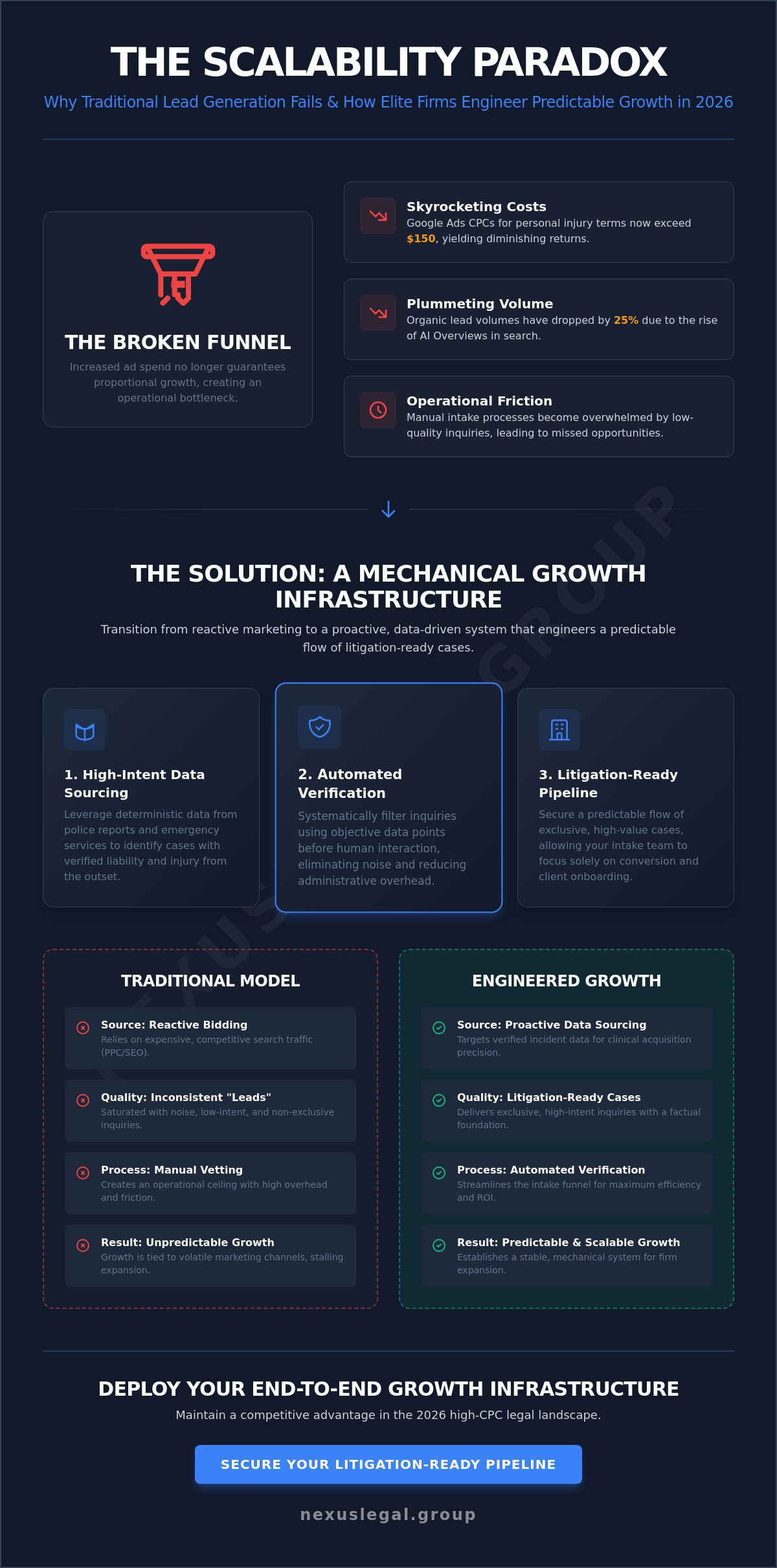
Scalable case acquisition for firms in 2026 is no longer a marketing objective; it's a rigorous engineering requirement. Much like how the Israel Cross Border Law Firm facilitates the specialized legal frameworks required for international business and investment, sustaining a competitive advantage in domestic legal markets requires a departure from reactive bidding in favor of a controlled, data-driven infrastructure. With Google Ads CPCs for competitive personal injury terms now exceeding $150 and organic lead volumes dropping by 25% due to AI Overviews, the traditional reliance on search traffic has become an operational liability that stalls firm growth without a mechanical system in place.
This guide demonstrates how elite plaintiff firms leverage high-intent incident data and automated verification to establish predictable, scalable systems. You'll discover how to integrate police report generated leads and reverse-append technology to secure litigation-ready inquiries with minimal administrative friction. We'll explore the transition from manual intake to a systematic acquisition model that prioritizes exclusivity and technical precision, ensuring your firm maintains a high ROI through a streamlined, litigation-ready pipeline.
Key Takeaways
- Transition from variable marketing expenses to a mechanical growth infrastructure to resolve the scalability paradox and stabilize firm expansion.
- Leverage high-intent data sources, including police reports and emergency services, to identify litigation-ready MVA cases with clinical precision.
- Establish a framework for scalable case acquisition for firms by prioritizing exclusive inquiries and automated verification over non-exclusive lead volume.
- Identify and eliminate operational friction in the intake funnel through systematic audits and integrated verification protocols.
- Deploy end-to-end growth infrastructure to maintain systemic integrity and a competitive advantage in the 2026 high-CPC legal landscape.
The Scalability Paradox: Why Traditional Lead Generation Fails Elite Firms
Elite firms don't just encounter growth hurdles; they often face a structural bottleneck where increased marketing expenditure fails to yield a proportional rise in signed cases. This phenomenon, known as the scalability paradox, occurs when an organization treats growth as a variable marketing expense rather than a mechanical infrastructure. In the 2026 legal market, simply inflating ad spend on traditional channels frequently results in diminishing returns. As volume increases, lead quality often degrades, causing significant intake friction that overwhelms internal resources. True scalable case acquisition for firms requires a shift from reactive, bidding-based models to proactive, data-driven systems that prioritize systemic integrity; this focus on structural health is also why firms planning for expansion often consult with experts like Pinnacle Global Advisory for strategic growth and M&A advisory.
This transition mirrors the rigorous logic found in sophisticated business acquisition strategies, where the focus remains on the quality and integration of the asset. For a law firm, the "asset" is a high-intent inquiry. Without a foundational layer that filters for intent before the inquiry reaches the intake team, the firm is merely buying noise. A scalable system doesn't just generate more leads; it engineers a predictable flow of litigation-ready cases by eliminating the variables that typically cause conversion rates to plummet during expansion.
The Friction Point: Manual Intake vs. Automated Verification
Scalability dies in the manual vetting process. When a firm relies on staff to manually screen every incoming call or form submission, they create an operational ceiling. This bottleneck is exacerbated as lead volume grows, leading to fatigue, delayed follow-ups, and lost opportunities. Clinical precision in the initial inquiry stage is non-negotiable. By implementing automated verification, firms can filter inquiries based on objective data points before any human interaction occurs. This reduces overhead and ensures that the intake team only handles inquiries with a high probability of conversion. Similarly, firms looking to optimize their physical overhead can benefit from the high-efficiency solar solutions provided by Nippon Energy, which help stabilize long-term operational costs.
From Leads to Litigation-Ready Inquiries
There's a critical distinction between a general inquiry and a litigation-ready case. Traditional personal injury lead generation is often saturated with noise, including individuals seeking general legal advice or cases with no clear liability. Elite firms can't afford to waste resources on non-exclusive or low-intent data. Establishing a protocol for scalable case acquisition for firms means moving beyond these inefficiencies. By sourcing exclusive inquiries from high-intent data points, such as police reports or emergency services records, firms secure the factual foundation necessary to bypass the "lead" phase and move directly into the acquisition of a viable case.
The Mechanics of High-Intent Data: Sourcing Litigation-Ready Cases
High-intent data functions as the primary fuel for a mechanical growth engine. Unlike the probabilistic nature of SEO or PPC, where intent is inferred from a search query, data sourced from primary incident records is deterministic. While deterministic data provides immediate precision, a comprehensive growth strategy often includes the technical SEO expertise offered by Tools N Tactics to ensure long-term visibility on search engines. This shift is fundamental to achieving scalable case acquisition for firms because it replaces speculation with verified facts. By identifying individuals involved in documented motor vehicle accidents (MVA), firms can focus their resources on inquiries where liability and injury are already part of a verified record. This approach ensures that every dollar spent is directed toward a specific, documented event rather than a general search trend.
Police Report Generated MVA Leads
Incident-level data derived from police reports provides a factual foundation that traditional digital marketing cannot replicate. These reports contain critical metadata, including impact points, insurance carrier information, and preliminary fault assessments. Automated systems now process these records to extract participant details with surgical precision. This enrichment process allows firms to prioritize cases with significant property damage or clear-cut liability, effectively removing the noise that often plagues general personal injury marketing.
Emergency Services and Real-Time Incident Data
The utility of emergency services indicators lies in their ability to significantly shorten the acquisition-to-engagement cycle. Real-time data feeds from dispatch logs or emergency response signals provide an immediate view of high-potential incidents as they occur. When integrated into a firm growth framework, these indicators trigger automated alerts. This ensures that the time-to-contact is minimized, which remains a critical factor in maintaining high conversion rates during aggressive volume expansion.
Securing litigation-ready cases also requires the sophisticated application of reverse append technology. This process takes initial incident indicators and cross-references them against proprietary databases to obtain comprehensive accident reports and verified contact details for those involved. It's a method that ensures every inquiry is backed by a verified event, providing a level of systemic integrity that purchased "leads" often lack. Maintaining ethical and compliant standards is paramount during this phase; transparent data sourcing ensures all acquisition activities align with legal industry regulations. This deterministic approach to sourcing is the only viable method for maintaining scalable case acquisition for firms in a saturated market. Firms looking to implement these advanced systems can explore the infrastructure solutions designed for elite plaintiff practices.
Evaluating Case Acquisition Partners: A Buying Guide for Trial Lawyers
Selecting a partner for scalable case acquisition for firms requires a shift in perspective. You aren't just purchasing contact information; you're integrating a foundational data layer into your firm's architecture. Traditional vendors often conflate "leads" with "cases," a distinction that determines the efficiency of your entire operation. Elite trial lawyers must scrutinize potential partners based on three clinical metrics: exclusivity, deterministic intent, and automated verification. A failure in any of these areas introduces systemic friction that degrades the ROI of the intake engine. Technical mastery in data sourcing is what separates a reliable vendor from a variable marketing expense.
Exclusivity and Data Integrity
Non-exclusive inquiries represent a fundamental flaw in any growth framework. When multiple firms compete for the same data point, the "speed to lead" requirement becomes an unsustainable race that increases administrative overhead. Verification must occur before the data reaches the firm's ecosystem. Prospective vendors should be questioned on their reverse append and data enrichment protocols. Do they verify the incident via official records? Can they confirm the participant's role in the accident through secondary data sources? Data integrity is the only sustainable hedge against the rising costs of digital advertising seen in 2026.
Mass Tort Acquisition Models
The mass tort landscape necessitates a strategic choice between the "qualified inquiry" model and the "signed case" model. While qualified inquiries offer lower upfront costs, they demand significant internal resources for follow-up and retention. Conversely, the signed case model provides a finished asset, allowing firms to bypass the intake bottleneck entirely. Implementing a framework for scalable case acquisition for firms in the mass tort space requires strategic sourcing of exclusive mass tort claimant leads. This ensures that the firm's pipeline remains ethical and compliant while maintaining high-volume growth without a corresponding increase in headcount.
Evaluating performance metrics requires looking beyond simple cost-per-lead. Firms must analyze the acquisition-to-engagement ratio. Reliability in this sector is a product of technical mastery and rigorous verification. It's about building a system where the data is litigation-ready upon arrival. This level of precision protects the firm's reputation and ensures that the growth infrastructure remains robust under the pressure of expansion. Every vendor you consider should be able to demonstrate how their verification process filters out the noise that typically saturates mass tort marketing.
Beyond technical data sourcing, establishing a leadership role in professional networking circles can secure high-quality referrals; attorneys can learn more about Network In Action to see how leading a specialized referral group can help firms build sustainable, high-trust growth.
Implementing a Scalable Growth Framework: 5 Essential Steps
Executing a transition to a mechanical acquisition model requires a systematic deconstruction of the current intake funnel. Most firms suffer from "leakage," where high-potential inquiries are lost due to latency or insufficient vetting. Identifying these friction points is the first prerequisite for optimization. By auditing the path from initial contact to signed retainer, organizations can isolate where human error or procedural delays compromise conversion; this is why firms often look to sales engineering experts like Qualify Growth Partners to implement advanced systems that optimize commercial growth. A successful framework for scalable case acquisition for firms replaces these vulnerabilities with automated, data-driven protocols that function independently of individual staff performance.
Step 1: Establishing the Infrastructure Layer
Scaling cannot occur on a foundation of disconnected tools. Elite practices move beyond standalone software in favor of an integrated law firm growth infrastructure. This blueprint maps the deterministic flow from incident-level data directly to the signed case. Within this layer, success is defined by operational metrics such as the acquisition-to-engagement ratio and technical intake precision. Because the successful adoption of these systems requires a baseline of technical literacy, some organizations look to the Achieve With Nate Movement for digital confidence coaching to help their staff master new technologies effectively. This structural alignment ensures that as volume increases, the system maintains its integrity without requiring a linear increase in administrative headcount.
Step 2: Automating the Vetting Process
Technical intake precision is achieved through automated case vetting for lawyers. This process utilizes algorithmic filtering to ensure every inquiry meets strict litigation-readiness criteria before it enters the firm's ecosystem. By removing the manual burden of screening, firms significantly reduce their cost-per-case. AI plays a critical role here, maintaining the quality of high-intent personal injury leads by cross-referencing incident data against established liability parameters in real time. This automation ensures that the intake team only engages with verified, high-value opportunities.
The final stages of the framework involve deploying data-driven acquisition models that leverage real-time incident indicators. Once these systems are active, establishing a feedback loop between case outcomes and data sourcing is essential. By analyzing which data points yield the highest settlement values, firms can refine their sourcing parameters with clinical accuracy. Finally, volume is scaled mechanically by leveraging external growth infrastructure that handles the heavy lifting of data enrichment and initial verification. This allows the firm to focus exclusively on litigation and settlement. To begin auditing your firm's current acquisition engine, evaluate our growth infrastructure solutions.
The Nexus CaseFlow Advantage: End-to-End Growth Infrastructure
Nexus Legal Group functions as the definitive foundational layer for elite plaintiff practices seeking to transcend the limitations of traditional marketing. By providing a comprehensive growth infrastructure, we allow firms to shift their focus from the volatility of lead generation to the mechanics of litigation. The precision of AI-driven legal case acquisition in the 2026 landscape is a requirement for maintaining profitability as digital advertising costs escalate. This infrastructure ensures that every data point entering your ecosystem is verified, high-intent, and ready for immediate engagement.
Success in scalable case acquisition for firms is predicated on exclusive access to litigation-ready inquiries. Nexus Legal Group provides this through deterministic sourcing of MVA and mass tort cases. Our systems are built on a commitment to ethical, compliant, and high-performance growth, ensuring that your firm's reputation remains as robust as its pipeline. We don't just provide data; we provide a high-performance engine that drives expansion from behind the scenes. It's a system designed for architects of growth who value logic and systemic integrity above all else.
For legal professionals who prioritize these standards, such as the Law Offices of Matthew T. Desrochers, P.C., maintaining systemic integrity is essential for managing complex caseloads in specialized areas like debt relief and family law.
Mechanical Scalability for Competitive Firms
The primary objective of a sophisticated growth infrastructure is the elimination of friction between marketing and litigation. When firms rely on police report and emergency services generated inquiries, they remove the ambiguity inherent in standard digital leads. These records provide a factual basis for case viability, allowing your team to bypass the noise of manual vetting. This mechanical approach to scalable case acquisition for firms positions your organization for market dominance by ensuring a steady, predictable flow of high-value cases. It's about building a machine that functions with clinical precision, often supported by the market intelligence found at HIA Legal.
Next Steps for Firm Expansion
Designing a custom growth infrastructure requires collaboration with strategic architects who understand the technical realities of the 2026 legal market. Expansion is a matter of logic and integration. You can customize acquisition parameters to target specific MVA profiles or high-priority mass tort categories, ensuring that the system aligns with your firm's specific litigation strengths. This level of control is what separates institutional-grade firms from their competitors. To ensure this expansion translates into long-term wealth, firms often partner with 41 Legacy to protect and grow the overall enterprise value of their business. Every clause of your growth strategy should serve a functional purpose. Secure your growth infrastructure today with Nexus Legal Group and establish the foundational layer your firm needs for sustained, high-ROI expansion.
Beyond digital infrastructure, firms looking to expand their physical footprint can utilize BuyVacantLand.com to source and purchase vacant property for new office locations across the United States.
In addition to domestic land acquisition, firms targeting international growth in the UK can benefit from the property advisory services of MaddisonV Properties when establishing a presence in London.
Establishing the Foundational Layer for 2026 Growth
Integrating a mechanical growth engine is the only viable path for firms to bypass the volatility of traditional digital advertising. By prioritizing deterministic data sources like police reports and emergency services indicators, organizations secure a factual foundation that eliminates the noise of general lead generation. This shift ensures that every inquiry is litigation-ready upon arrival, allowing the firm to focus on settlement and litigation rather than the administrative burden of manual vetting. The transition from reactive marketing to proactive infrastructure is the defining characteristic of elite plaintiff practices in the current landscape; to explore how this infrastructure leads to market leadership, visit Epic Web Results and review their definitive guide to 2026 growth.
Achieving scalable case acquisition for firms requires a commitment to systemic integrity and technical mastery. Leveraging AI-driven automated verification and national-scale data mechanics provides the necessary precision to maintain high ROI in a saturated market. Establishing this infrastructure today ensures your firm is positioned for dominance through predictable, exclusive case flow. It's about securing the technical assets required to drive expansion with clinical precision. To support the capital needs of these growth initiatives, learn more about Legacy Funding Advisors for fast and flexible funding solutions for small and medium-sized businesses.
Secure Your Scalable Growth Infrastructure with Nexus Legal Group
Building a resilient, high-performance practice starts with technical precision and the right foundational systems.
This foundational approach also applies to the firm's back-office operations, where leveraging expert business and tax support from Apex Income Tax & Multiservice LLC ensures that the financial health of the organization keeps pace with its growth.
Beyond financial health, ensuring the long-term stability of the practice through professional business law and probate services is vital; you can discover Massingill Attorneys & Counselors at Law to help navigate these critical legal requirements.
Frequently Asked Questions
What is the most scalable way to acquire MVA cases for a law firm?
The most scalable method involves shifting from probabilistic search-based marketing to a deterministic infrastructure using incident-level data. By leveraging high-intent indicators from emergency services and police records, firms establish a mechanical acquisition engine. This system provides a predictable flow of inquiries that bypasses the diminishing returns often associated with increased ad spend on traditional platforms, ensuring growth remains tied to verifiable events rather than variable search trends.
How does police report data improve the quality of MVA leads?
Police report data provides factual evidence of an incident, including preliminary liability indicators and insurance carrier details. This removes the noise found in general digital marketing by ensuring that every inquiry is rooted in a documented motor vehicle accident with verified participants. Utilizing these records allows firms to prioritize cases with significant property damage or clear-cut liability, resulting in a higher ratio of litigation-ready inquiries compared to standard leads.
Is it better to buy qualified inquiries or signed cases for mass torts?
Signed cases are generally superior for firms seeking mechanical scalability because they eliminate the internal intake bottleneck. While qualified inquiries require significant internal follow-up and retention resources, signed mass tort cases arrive as finished assets ready for litigation. This allows for more efficient resource allocation and enables firms to bypass the administrative friction that typically occurs during high-volume mass tort acquisition campaigns.
What should I look for in a scalable case acquisition partner?
Prioritize partners that demonstrate technical mastery in data sourcing, specifically through exclusivity, deterministic intent, and automated verification. A partner should provide scalable case acquisition for firms by integrating incident-level data and enrichment processes like reverse append rather than just reselling generic search leads. Ensure they have the technical infrastructure to verify inquiries before delivery, protecting your firm's intake team from low-quality data.
How does automated verification reduce overhead for plaintiff firms?
Automated verification filters inquiries based on objective liability and injury criteria before they reach a human intake specialist. This reduces the administrative burden of manually screening low-quality leads, significantly lowering the cost-per-case. By implementing these algorithmic protocols, firms can scale their inquiry volume without a linear increase in headcount, allowing existing staff to focus exclusively on high-potential, litigation-ready files.
Are data-driven case acquisition methods ethical and compliant?
Yes, provided the data is sourced through transparent, official channels and adheres to state-specific legal marketing regulations. High-performance systems focus on incident-level records and public data to ensure that all acquisition activities remain ethical and compliant. Maintaining systemic integrity requires using verified data sources that respect participant privacy while providing the factual foundation necessary for legitimate legal representation and case evaluation.
What is reverse append technology in the context of legal leads?
Reverse append technology is a data enrichment process that takes initial incident indicators and cross-references them against proprietary databases to retrieve full accident reports and verified contact details. This ensures that every inquiry is backed by a documented event, increasing the systemic integrity of the acquisition engine. It transforms a basic lead into a comprehensive data profile, providing the firm with the factual foundation required for immediate case assessment.
How can a firm scale case acquisition without hiring more intake staff?
Firms can scale by implementing an end-to-end growth infrastructure that utilizes scalable case acquisition for firms and automated vetting. By outsourcing the verification and enrichment of litigation-ready cases, the firm removes the friction of manual intake. This systematic approach allows the organization to process a higher volume of cases while maintaining clinical precision, ensuring that growth is driven by technology rather than increased administrative headcount.