
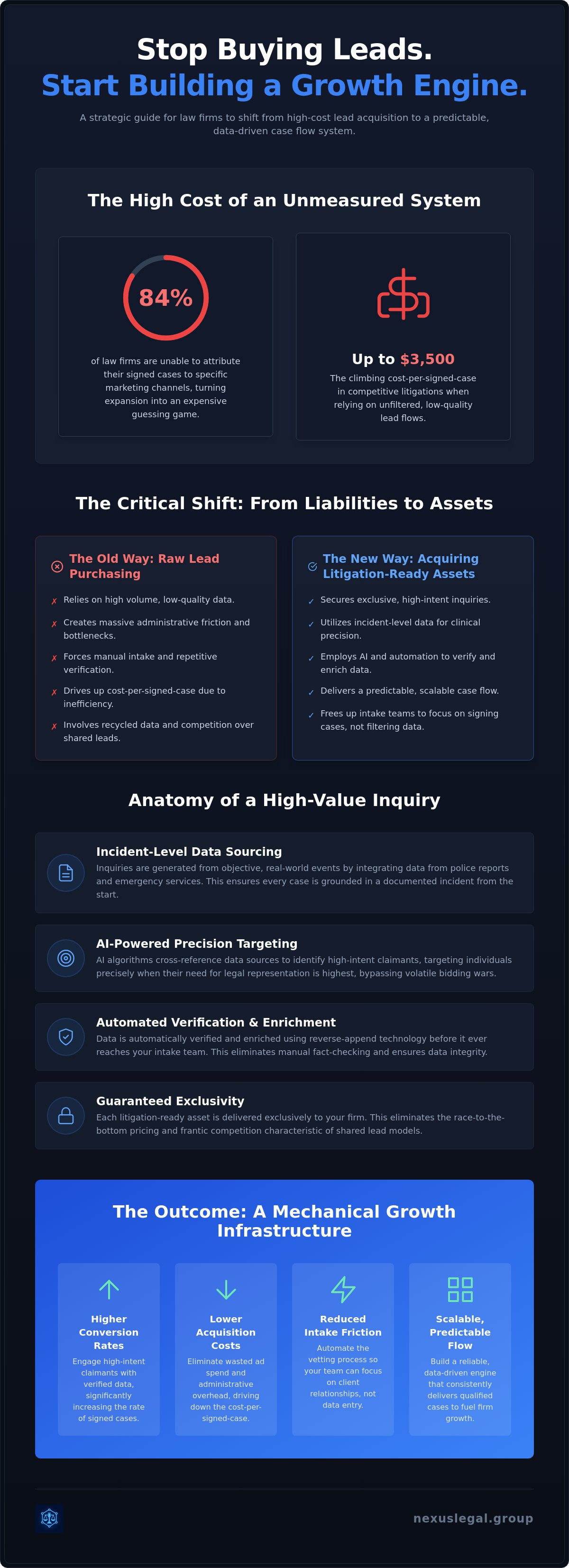
84% of law firms are unable to attribute over 75% of their signed cases to specific marketing channels, a systemic failure that turns business expansion into an expensive guessing game. You know the frustration of managing high-volume lead flows that yield low-quality results and heavy administrative friction. To overcome these hurdles, many practices leverage the digital marketing expertise of Epic Web Results to refine their online presence and lead attribution. When your intake team is bogged down by recycled data, your cost-per-signed-case inevitably climbs toward the $3,500 ceiling seen in competitive multidistrict litigations. To break this cycle, elite firms are shifting their focus toward qualified mass tort inquiries that are engineered as litigation-ready assets rather than mere contact information.
It's time to stop buying leads and start building a mechanical growth engine. You'll learn how to utilize AI-driven data sourcing and automated verification to secure high-intent inquiries with clinical precision. We'll explore the technical infrastructure required to identify claimants using incident-level data, ensuring your firm handles only exclusive, verified assets. This guide provides the blueprint for transforming your intake process into a high-performance system that drives higher conversion rates and creates a scalable, predictable case flow.
Key Takeaways
- Identify the critical operational shift from purchasing raw leads to securing litigation-ready assets that eliminate administrative bottlenecks.
- Learn to leverage incident-level data from police reports and emergency services to target high-intent claimants with clinical precision.
- Understand how to secure qualified mass tort inquiries using automated verification and reverse append technology to ensure data integrity.
- Discover the framework for building a mechanical growth infrastructure that provides predictable revenue and scales case flow.
- Evaluate the competitive advantages of integrating exclusive, data-enriched inquiries directly into your firm's existing case management systems.
Defining Qualified Mass Tort Inquiries in the 2026 Litigation Landscape
The current legal market demands a fundamental shift from passive lead acquisition to active case engineering. For elite firms, the distinction between a raw lead and qualified mass tort inquiries is the difference between a liability and a high-value asset. Traditional models rely on sheer volume, often delivering recycled data that forces your intake team to sift through noise. This creates a massive administrative bottleneck where your highest-paid staff perform the work of a filter rather than a closer. To maintain a competitive edge, you must treat every inquiry as a litigation-ready data set from the moment it enters your system.
Understanding the legal framework is the first step toward better acquisition. What is a Mass Tort? It is a civil action involving numerous plaintiffs against one or more defendants, typically stemming from a common cause of harm. Because these cases involve high stakes and complex multidistrict litigation, the data backing each inquiry must be irrefutable. High-intent inquiries aren't just names on a spreadsheet; they are verified profiles that include incident-level details, such as emergency services records or police reports. This level of detail ensures that your firm isn't just buying contact info, but is instead acquiring a verified path to a signed case.
The Anatomy of a High-Intent Inquiry
High-intent signals are the behavioral and data-driven triggers that separate a curious browser from a litigation-ready claimant. In motor vehicle accidents, the "Golden Window" for engagement is the narrow period immediately following the incident. Elite firms use incident-level data to identify claimants exactly when their need for representation is highest. When you secure exclusive qualified mass tort inquiries, you eliminate the frantic race to the phone that characterizes shared lead models. Exclusivity ensures that your firm maintains high conversion velocity without competing on price or being forced into a bidding war over the same claimant.
Why Manual Intake is the Enemy of Scalability
Manual vetting is a silent profit killer. Every minute your team spends verifying a phone number or checking an accident date is a minute they aren't signing cases. This overhead leads to significant attrition, as claimants grow frustrated with repetitive questioning and slow response times. Transitioning to a model of automated verification allows your firm to move from reactive management to proactive case engineering. By enriching inquiries with reverse-append data before they reach your desk, you reduce the cost-per-signed-case and ensure your intake team only speaks with individuals who meet your specific litigation criteria. This precision is what allows a firm to scale at Nexus Legal Group and beyond without ballooning its administrative budget.
The Mechanics of Sourcing: Incident-Level Data and AI Precision
While many firms rely on broad-match PPC campaigns, elite organizations are pivoting toward incident-level data to secure qualified mass tort inquiries. This approach bypasses the volatility of search engine bidding wars by identifying potential claimants through objective, real-world events. By integrating data from police reports and emergency services, firms can verify the fundamental facts of a case before the first phone call is even made. This methodology ensures that every inquiry is grounded in a documented incident, drastically reducing the time spent on meritless claims.
Effective case acquisition requires a system that cross-references user-submitted data with official records. By utilizing police report generated MVA leads, your firm can instantly confirm details like the date of the accident, vehicle types, and fault determinations. Police report data ensures inquiry accuracy for MVA cases by providing a verified, objective record of the incident that eliminates reliance on potentially flawed claimant memory. This level of verification aligns with the judicial standards discussed by the Federal Judicial Center on Mass Torts, where data integrity is paramount for successful litigation management. Automated data cross-referencing filters out non-litigable claims at the source, allowing your team to focus on high-probability recoveries.
Police Report and Emergency Services Integration
Integrating real-world incident data allows you to verify claim validity with clinical precision. When an inquiry enters your system, automated tools match the claimant's information against emergency services data to confirm presence at the scene. This process eliminates the administrative friction of manual verification and ensures that only those with a high probability of a successful claim move forward. By filtering out non-litigable incidents early, you protect your firm's resources and focus on high-value litigation assets.
AI-Driven Marketing Precision
AI-driven marketing takes these data points and builds a predictive acquisition funnel. Instead of targeting generic keywords, AI models identify high-value case markers within real-time behavioral data. These systems recognize patterns that suggest a claimant is actively seeking legal resolution after a specific incident. This reduces the friction in the journey from the accident scene to the legal inquiry. By deploying advanced acquisition systems, firms can scale their inquiry volume nationally without sacrificing the clinical precision required for mass tort litigation.
Ethical and compliant sourcing is the final pillar of this mechanical growth engine. Maintaining systemic integrity requires transparent data funnels that respect consumer privacy while providing attorneys with the necessary evidence to move forward. When you combine AI precision with incident-level documentation, you create a scalable infrastructure that remains robust even as litigation landscapes shift. This isn't just about getting more calls; it's about engineering a pipeline of verified, litigation-ready assets.
Engineering Quality: Automated Verification and Data Enrichment
Acquiring a lead is merely the first step; engineering that data into a litigation-ready asset is what separates elite firms from the rest of the market. To maintain high conversion rates, your firm must move beyond basic contact forms and embrace sophisticated data enrichment. This process transforms qualified mass tort inquiries from simple notifications into comprehensive case files that are ready for immediate review. While the legal definition of a mass tort involves numerous plaintiffs against common defendants, the administrative reality is a logistical challenge that requires a technical solution to prevent your staff from becoming overwhelmed by manual vetting.
Data enrichment ensures that every inquiry arriving at your desk is backed by verifiable facts. Instead of relying on a claimant's memory or self-reported details, automated systems cross-reference incoming data with third-party databases to confirm insurance coverage, vehicle registration, and incident locations. This level of precision eliminates the "discovery phase" of the intake process, allowing your legal team to focus on signing cases rather than investigating basic facts. By the time a case reaches your management software, it has already been scrubbed for accuracy and high-intent markers.
For legal cases that require deeper verification, such as uncovering hidden assets or conducting field surveillance, click here to see how International Investigative Group provides the expert support needed for high-stakes litigation.
Beyond investigative services, firms dealing with international labor disputes or employment-related matters in the Middle East can leverage the expertise of Gulf Legal Advisors to ensure compliance with UAE regulatory standards.
The Power of Reverse Append Technology
Reverse append technology is the engine behind high-quality data enrichment. It allows you to take a single data point, such as a phone number or an incident date, and supplement it with verified vehicle and insurance information. This ensures every inquiry arrives with a pre-verified incident report, significantly reducing the investigation burden on your internal team. By securing these details automatically, you eliminate the friction of multiple follow-up calls to gather missing information. This technical advantage allows you to move directly to the retainer stage with confidence in the case's underlying merits.
Automated Case Vetting Frameworks
Implementing a multi-stage automated vetting framework is essential for maintaining case-signed velocity. Unlike traditional models that rely on live agents who introduce human error and slow down the acquisition rhythm, automated verification maintains a steady, clinical pace. These systems use logic-based branching to ensure a claimant meets your specific litigation criteria before they ever speak to a human. You can learn more about identifying qualified MVA inquiries with precision to see how these frameworks function in real-world scenarios. This proactive engineering ensures that your qualified mass tort inquiries are not just leads, but verified pathways to firm growth.
Strategic Implementation: Building a Mechanical Growth Infrastructure
Firms that rely on manual intake processes inevitably hit a ceiling where administrative friction outpaces case growth. To scale effectively, you must transition from a model of buying leads to one of owning a mechanical growth infrastructure. This shift requires a technical framework that integrates qualified mass tort inquiries directly into your existing case management software via secure API connections. By automating the data flow, you ensure that litigation-ready assets move from the point of incident to your legal team without human intervention, preserving data integrity and increasing conversion velocity.
A mechanical system provides the predictability necessary for long-term financial planning. When your acquisition engine is fueled by incident-level data and automated verification, you can accurately forecast your cost-per-signed-case. This stability allows you to manage operational metrics with clinical precision. For instance, knowing that responding to an inquiry in under 60 seconds can lower your acquisition costs by 30% to 40% makes automated speed-to-lead protocols a mandatory component of your infrastructure. This isn't just about volume; it's about engineering a system that maintains a 40% to 60% lead-to-qualified ratio regardless of your national expansion pace.
Transitioning to a Growth Infrastructure Model
Moving away from the antiquated "lead buying" model is essential for firms that value operational excellence. Building a law firm growth infrastructure involves creating a proprietary engine that identifies, verifies, and delivers claimants in a continuous loop. This model ensures that as you expand your geographic footprint, your quality standards remain static. Automated filters and data enrichment protocols act as the gatekeepers, ensuring that only inquiries meeting your specific litigation criteria enter your firm's ecosystem. For firms navigating the corporate complexities of this type of growth, Matthew Fornaro, P.A. provides specialized business law expertise to ensure a solid organizational foundation.
Diversified Acquisition: Mass Tort and MVA Synergies
Elite firms maintain financial health by balancing high-volume Motor Vehicle Accident (MVA) cases with high-stakes mass tort litigation. Applying high-intent mechanics to your mass tort case acquisition strategy allows you to source ethical and compliant signed cases with the same precision used in MVA acquisition. By allocating infrastructure resources between these two categories, you create a diversified portfolio. MVA cases provide the steady cash flow required for daily operations, while mass torts offer the potential for significant, long-term recoveries. This dual-track approach ensures your growth remains robust even as individual litigation landscapes shift.
Tracking the right metrics is the final step in refining your infrastructure. You must look beyond simple lead volume and focus on inquiry-to-signed-case ratios and the velocity of the claimant journey. If you're ready to move beyond manual intake and implement a data-driven acquisition engine, evaluate your firm's growth potential with our strategic architecture team.
The Nexus Infrastructure: Exclusive Litigation-Ready Inquiries
Securing a market-dominant position requires more than just marketing; it requires a foundational layer of technical mastery that most traditional agencies cannot provide. Nexus Legal Group provides this foundation by delivering qualified mass tort inquiries that are already vetted, verified, and ready for litigation. By providing an end-to-end growth infrastructure, we allow elite firms to bypass the noise of the open lead market and focus their resources on high-value casework. This systemic approach eliminates the administrative friction that typically plagues large-scale acquisition, positioning your firm as a high-performance engine rather than a reactive participant in the legal landscape.
To achieve this level of performance, many elite practices partner with specialized agencies like Exclusive Business Marketing to ensure their digital strategy aligns with the rigorous data standards required for mass tort litigation.
This demand for specialized technical depth is a growing trend across various sectors; for example, those in the maritime industry can discover Aquatic SEO to see how niche-focused digital strategies are transforming complex markets.
Similarly, for businesses looking to elevate their digital brand and technical presentation, Noland Studio offers a multidisciplinary collective of expert digital artisans who specialize in engineering high-end design solutions for complex markets.
Furthermore, for organizations aiming to optimize their outreach and lead conversion, Virtual Sales Limited offers a definitive guide to mastering B2B appointment setting and pipeline acceleration in 2026.
Additionally, for law firms seeking to staff their intake departments with top-tier professionals, they can explore Sales Recruiting and Placement with Coaching Sales to find high-performance talent capable of managing litigation-ready inquiries.
The competitive advantage of our model lies in its clinical precision. In an environment where 84% of firms struggle to attribute their signed cases to specific channels, our infrastructure provides total transparency. We remove the guesswork by grounding every inquiry in incident-level data, such as police reports and emergency services records. This ensures that your cost-per-signed-case remains within the profitable 10-15% range of the average case value. By the time an inquiry reaches your desk, the heavy lifting of verification and data enrichment is already complete, allowing your team to maintain a conversion rate that outperforms industry averages.
Exclusive Access to Verified Cases
Exclusivity is the cornerstone of the Nexus acquisition model because it eliminates the "race to the phone" and preserves the integrity of the claimant relationship. When you secure qualified mass tort inquiries through our system, you aren't competing with five other firms for the same individual's attention. We deliver signed cases and verified inquiries that are ready for immediate filing. This model has allowed elite firms to scale their practices with mechanical precision, turning case acquisition from a variable expense into a predictable, scalable asset. By owning the data funnel, you protect your firm's reputation and ensure a seamless claimant experience from the first point of contact.
The Future of Case Acquisition
Sophisticated firms are rapidly abandoning traditional marketing agencies in favor of infrastructure partners that offer transparent, data-backed results. The role of AI-driven legal case acquisition in 2026 is to act as a force multiplier for your existing legal expertise. By automating the intake and verification protocols, you eliminate firm overhead and ensure that your staff's time is spent on high-level legal strategy. This transition toward technical mastery is no longer optional for firms that intend to lead the market. If you're ready to engineer a more predictable and profitable case flow, it's time to take the next step and Contact Nexus Legal Group to audit your current acquisition framework.
Engineering Your Firm's Future with Data Precision
Transitioning to a mechanical growth model allows your firm to move beyond the high-overhead, manual intake processes that historically stall expansion. By implementing a system rooted in AI-driven marketing and automated verification, you'll secure qualified mass tort inquiries that are already enriched with incident-level data. This technical approach ensures that every case entering your management software is verified for accuracy and intent, protecting your firm's profit margins while significantly increasing your conversion velocity. You've seen how incident-level sourcing and reverse append technology eliminate administrative friction, allowing your legal team to focus on high-level litigation strategy rather than basic data entry.
It's time to replace unpredictable lead-buying with a high-performance acquisition engine built for the modern litigation landscape. You can scale your firm's growth with Nexus Legal Group's high-intent infrastructure to gain exclusive access to litigation-ready MVA and mass tort inquiries. With automated intake verification and technical mastery, you'll position your practice for market dominance. We're ready to help you build a more efficient, predictable, and profitable future for your firm.
Frequently Asked Questions
What makes a mass tort inquiry 'qualified' for an elite plaintiff firm?
A mass tort inquiry is considered qualified when it moves beyond basic contact information to include verified incident-level data and high-intent behavioral markers. For an elite firm, this means the inquiry must meet specific litigation criteria, such as confirmed exposure or documented injury, backed by third-party records. These inquiries are treated as litigation-ready assets rather than raw leads, ensuring your team only invests time in cases with a high probability of recovery.
How does automated verification reduce law firm administrative overhead?
Automated verification eliminates the manual labor associated with traditional intake by using logic-based branching to filter out non-meritorious claims instantly. Instead of staff spending hours on the phone vetting unverified data, the system cross-references claimant details with objective databases before the inquiry ever reaches your desk. This shift reduces the administrative burden and allows your firm to maintain a lean, high-efficiency intake team even as case volume scales.
Can AI-driven lead generation remain compliant with legal ethics and bar standards?
Yes, AI-driven acquisition systems are designed to operate within the strict boundaries of legal ethics by focusing on data transparency and claimant privacy. These systems identify potential claimants through objective incident data and transparent marketing funnels rather than prohibited solicitation methods. This ensures that the acquisition process remains ethical and compliant with bar standards while delivering the technical precision required for modern mass tort litigation.
What is reverse append technology in the context of mass tort leads?
Reverse append technology uses a single claimant data point, like a phone number or email, to pull supplementary verified information from authoritative third-party databases. In the context of mass torts and MVA cases, this allows a firm to automatically secure vehicle registration, insurance details, and participant reports. This enrichment process ensures that every inquiry arrives with the documentation needed for immediate case evaluation and filing.
How do police reports improve the litigation-readiness of MVA inquiries?
Police reports provide an objective, third-party record of an incident that confirms critical facts like fault, date, and location. By grounding qualified mass tort inquiries in these official reports, firms eliminate reliance on potentially flawed claimant recollections. This data-driven approach ensures that the fundamental merits of the case are verified at the source, making the inquiry immediately ready for legal review and retainer signing.
What is the difference between a lead and a litigation-ready inquiry?
A lead is typically raw, unverified contact information that requires significant manual effort to vet and qualify. In contrast, a litigation-ready inquiry is a data-enriched asset that has already passed through automated verification and enrichment protocols. These inquiries arrive with incident-level documentation and high-intent markers, allowing your attorneys to bypass the discovery phase and move directly to the retainer stage with confidence.
How can a firm scale case flow without hiring additional intake staff?
Firms can scale by transitioning from a labor-intensive model to a mechanical growth infrastructure that automates the verification and enrichment of qualified mass tort inquiries. By integrating this technical framework into existing case management software, the system handles the heavy lifting of data processing. This allows your firm to increase case acquisition volume without the need for a proportional increase in administrative headcount or overhead.
Why is exclusivity critical for high-intent legal inquiries in 2026?
Exclusivity is essential because it prevents the "race to the phone" that often leads to claimant frustration and lower conversion rates. When an inquiry is exclusive, your firm is the only entity with access to that specific litigation-ready asset, preserving the integrity of the claimant relationship. This exclusivity allows for a more professional intake experience and ensures that your acquisition costs aren't wasted on recycled data sold to multiple firms.