
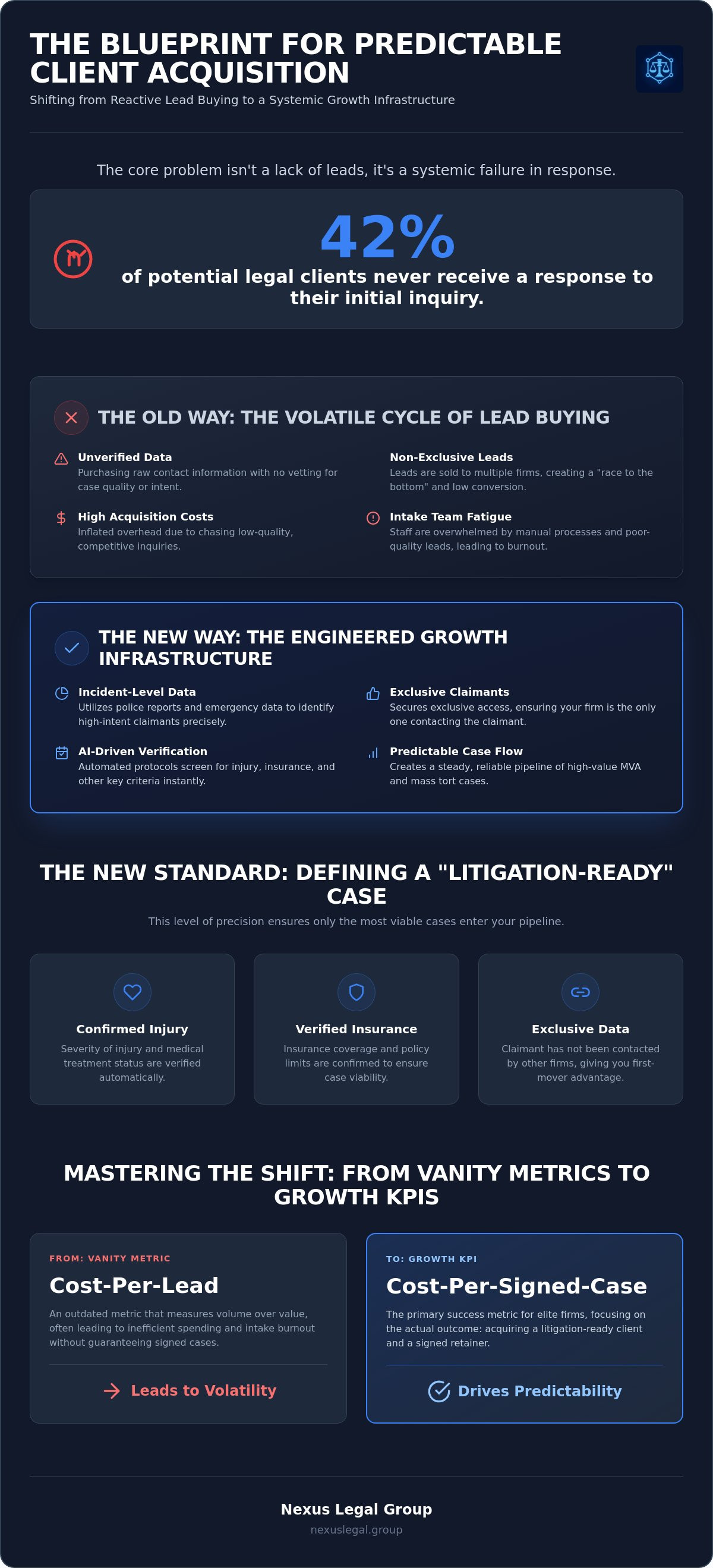
Did you know that 42% of potential legal clients never receive a response after their initial inquiry? This statistic reveals a critical structural flaw. Most firms aren't suffering from a lack of leads, but from a systemic failure in their growth infrastructure. Achieving predictable client acquisition for law firms in 2026 requires moving beyond the volatile cycle of buying unverified data and hoping for the best. The inefficiency of high acquisition costs paired with intake teams overwhelmed by non-exclusive data is a direct result of relying on fragmented, manual processes.
We recognize that the current environment, where 61% of adults use AI assistants for legal research, demands a more sophisticated technical foundation. This article provides a clinical blueprint for mastering the transition from reactive lead buying to a data-driven engine for acquiring litigation-ready cases. We'll explore how to implement AI-driven automated verification and leverage incident-level data to eliminate operational friction. You'll learn to secure exclusive access to high-intent claimants, ensuring your firm maintains a steady, predictable flow of high-value MVA and mass tort cases through a scalable, automated architecture.
Key Takeaways
- Shift your focus from purchasing raw data to engineering a systemic growth infrastructure that stabilizes case volume.
- Utilize incident-level data and police report sourcing to identify high-intent MVA claimants with surgical precision.
- Implement AI-driven automated verification protocols to screen for injury severity and insurance coverage, drastically reducing intake friction.
- Master the transition to predictable client acquisition for law firms by shifting your primary success metric from cost-per-lead to cost-per-signed-case.
- Optimize your scaling strategy using institutional-grade KPIs that ensure ethical compliance while driving high-performance growth.
The Evolution from Lead Buying to Growth Infrastructure
Elite law firms no longer view marketing as a peripheral activity; they treat predictable client acquisition for law firms as a foundational growth infrastructure. This shift marks a significant departure from historical reliance on volume-based lead buying. Modern systems prioritize the engineering of a data-driven pipeline that delivers consistency regardless of market fluctuations. By viewing acquisition as a systemic layer, often developed in collaboration with specialized digital agencies like Epic Web Results, firms can eliminate the volatility that often plagues traditional practices. It's about building a permanent asset rather than renting temporary attention.
This transition toward treating growth as a clinical, data-backed endeavor is mirrored in other sectors; for instance, those seeking to identify high-potential real estate assets can discover New Launch properties in Singapore by leveraging similar analytical frameworks.
The same principle of specialized, tailored efficiency applies to physical assets; for example, Nu Scape Designs creates custom, low-maintenance landscape designs specifically engineered for the Southern California climate, emphasizing the value of regional expertise in high-performance planning.
The Evolution of legal marketing has moved past the era of raw data collection. Traditional lead buying often involves purchasing unverified contact information that hasn't been vetted for case quality or exclusivity. In contrast, a high-performance growth infrastructure functions as a clinical engine. It filters out noise and focuses on litigation-ready opportunities, effectively removing the friction that typically slows down intake teams and inflates overhead. This transition allows firms to move away from interruption-based marketing, where ads are forced upon disinterested audiences, toward a model that captures high-intent individuals at the exact moment they require representation.
Why Traditional Lead Aggregators Fail Elite Firms
Traditional aggregators frequently sell the same lead to multiple firms, creating a race to the bottom that diminishes conversion rates. This non-exclusive model leads to intake fatigue, where staff members spend hours chasing unverified inquiries that lack transparency. Elite firms avoid these commodity marketplaces because they offer little insight into the lead's origin or intent. Without clear data on how a lead was generated, it's impossible to forecast growth with any degree of technical precision. The resulting high cost-per-acquisition makes scaling an institutional-grade firm nearly impossible.
Defining "Litigation-Ready" in 2026
In 2026, being litigation-ready means more than just having an accident; it requires a high-intent claimant who is actively seeking legal resolution. Data shows that intent-based search and police-report-generated sourcing outperform passive social media engagement. This is because the user is initiating the discovery process rather than being interrupted by a sponsored post. A robust infrastructure uses immediate, automated verification to confirm critical details:
- Confirmed injury severity and medical treatment status.
- Verified insurance coverage and policy limits.
- Exclusive, incident-level data that ensures the claimant hasn't been contacted by multiple firms.
This level of precision ensures that only the most viable cases enter your pipeline, maximizing the efficiency of your legal team and ensuring predictable client acquisition for law firms that are ready to scale.
Engineering Predictability Through Data Precision and Incident Sourcing
Scaling a national plaintiff firm requires a move away from the noise of broad-match digital advertising. While traditional PPC captures general interest, predictable client acquisition for law firms relies on incident-specific precision—a concept of specialization mirrored by niche agencies like Aquatic SEO in the marine sector. Motor Vehicle Accident (MVA) cases serve as the ideal vehicle for institutional scaling because they offer a consistent volume of high-value litigation. However, success isn't found in casting a wide net. It's found in identifying claimants at the peak of their intent through the integration of real-time data feeds.
AI now plays a decisive role in this process by analyzing patterns in emergency services data and police reports. This technology doesn't just find leads; it identifies specific incidents where liability and injury severity meet your firm's criteria. By positioning official records as the primary source of truth, you eliminate the guesswork inherent in self-reported claimant data. This shift ensures your intake team focuses only on cases with a high probability of success. It's about moving from a reactive posture to a proactive, data-driven strategy.
Leveraging Police Reports and Emergency Services Data
Real-time incident data provides a strategic advantage by allowing firms to initiate contact while the claimant is actively seeking a resolution. Using police-report-backed data ensures that every case in your pipeline is grounded in documented fact, which significantly increases trial-readiness. This approach also maintains rigorous ethical standards, as it utilizes compliant, public-record-sourced information rather than intrusive tracking methods. Speed and accuracy in this phase are the differentiators between a volatile lead flow and a stable acquisition engine.
For firms pursuing high-value commercial vehicle cases, understanding the role of telematics is a strategic advantage; you can learn more about Alliance Fleet Solutions to see how fleet management data contributes to more precise accident documentation and liability assessment.
Reverse Append Technology: The Strategic Advantage
Reverse append accident report leads represent a critical advancement in data enrichment. This technology allows a firm to take basic contact information and automatically retrieve comprehensive accident details, including police reports and participant specifics. This enriched data provides a massive head start on pre-litigation research and case vetting, ensuring that predictable client acquisition for law firms is backed by institutional-grade intelligence. It allows your team to understand the full scope of a case before the first intake call even begins, drastically reducing the time spent on unqualified inquiries.
Implementing these technical layers transforms your firm from a lead buyer into a sophisticated data operator. If you're ready to move beyond fragmented lead generation, explore how high-intent MVA case acquisition can stabilize your firm's growth infrastructure and provide the clinical precision your practice demands.
Eliminating Friction via Automated Intake and Verification Protocols
The efficiency of any growth engine is determined by its ability to process high-volume inputs without a linear increase in administrative labor. For many, the bottleneck in achieving predictable client acquisition for law firms isn't the number of inquiries, but the manual friction required to vet them. When your intake team is bogged down by unverified data, the structural integrity of your acquisition model collapses. Transitioning to a clinical, automated verification layer ensures that only litigation-ready cases reach your legal staff. This decoupling of volume from labor is the hallmark of an institutional-grade firm.
The Operational Cost of Lead Waste
The true cost of a lead extends far beyond the initial purchase price. It includes the hourly expenditure of intake specialists, the technology overhead, and the opportunity cost of ignored high-value cases. Research indicates that 42% of potential clients who contact a law firm do not receive a response within a reasonable timeframe. This failure often stems from teams being overwhelmed by low-quality, unverified inquiries. This creates a lead burn effect where high-intent claimants are lost due to administrative congestion. Beyond the financial impact, persistent exposure to unverified data leads to high staff turnover and decreased morale among high-performance intake teams.
Transitioning to AI-Driven Inquiry Scoring
Modern systems utilize AI-driven screening to score inquiries based on specific litigation-readiness metrics, such as injury severity and insurance policy limits. By the time a specialist speaks to a claimant, the system has already established a foundational case value. Automated legal intake verification is the prerequisite for scaling because it eliminates the subjectivity of manual vetting. Integrating this with e-signature technology allows for immediate case retention, capturing the claimant at the peak of their intent. This 24/7 turnkey ecosystem ensures that your firm capitalizes on the fact that responding within one hour makes you seven times more likely to qualify a lead.
Establishing a 24/7 turnkey intake ecosystem is no longer optional in a landscape where AI is increasingly the first point of discovery. Claimants expect immediate engagement. A system that relies on manual business-hour responses is fundamentally broken. By deploying an automated infrastructure, your firm maintains a constant presence, capturing claimants exactly when their intent is highest. This immediate engagement, backed by rigorous data verification, provides a sense of security and professional competence that manual systems cannot replicate. It ensures that every marketing dollar spent on predictable client acquisition for law firms is maximized for conversion.
Operationalizing Growth: KPIs for Institutional-Grade Scaling
Transitioning to a systematized growth model requires a fundamental shift in how your firm measures success. In 2026, vanity metrics like lead volume or click-through rates are insufficient for institutional-grade scaling. Achieving predictable client acquisition for law firms demands a clinical focus on the cost-per-signed-case (CPSC). For example, while the average CPSC for personal injury firms is $468, efficient organizations aim for a total acquisition cost that remains below 10% to 15% of the average client lifetime value. This level of precision allows you to treat marketing spend as a capital investment with a forecasted return rather than a speculative expense.
Establishing data-driven feedback loops between your litigation and marketing teams is the final step in operationalizing this growth. When your litigation results inform your acquisition strategy, you can refine your targeting to focus only on the highest-value incidents. This ensures that your predictable client acquisition for law firms is grounded in actual performance data. It's about building a self-correcting engine that identifies which incident-level data points correlate with the highest settlement values, allowing for surgical precision in future scaling efforts.
Managing Cost-per-Case vs. Cost-per-Lead
Cheap leads are often the most expensive asset an elite firm can own. A lead with a low upfront price but a 2% conversion rate requires fifty times the administrative labor of a high-intent inquiry. High-intent MVA acquisition may carry a higher initial cost, but the mathematics of ROI favor quality. This strategy of prioritizing high-intent prospects is a cornerstone of professional outbound sales; for those looking to apply these principles to their own B2B outreach, visit Virtual Sales Limited for specialized telemarketing and outreach expertise. By focusing on litigation-ready claimants, you reduce the labor required for vetting and increase the velocity of your case pipeline, ensuring your capital is deployed toward cases that actually reach the settlement phase.
Scaling Volume Without Administrative Bloat
The primary challenge of expansion is the linear increase in overhead. To solve this, a robust law firm growth infrastructure must decouple case volume from administrative labor. Automating the first 60 seconds of claimant engagement is critical; firms that respond within an hour are seven times more likely to qualify a lead. Leveraging AI-driven sales automation from Global AI Reps allows firms to deploy specialized digital representatives to manage these interactions efficiently. By utilizing institutional-grade platforms to manage multi-state growth, you can double your case volume without doubling your intake staff. This technical layer handles the heavy lifting of verification, leaving your team to focus on high-value legal strategy.
If you're ready to transition from volatile lead buying to a performance-based model, secure litigation-ready cases that meet your firm's specific criteria and drive institutional growth.
Nexus Legal Group: The Foundational Layer for Elite Plaintiff Firms
Nexus Legal Group functions as the strategic architect for firms that have outgrown the volatility of traditional lead aggregators. We don't merely offer a list of contacts; we engineer the entire infrastructure necessary for predictable client acquisition for law firms. By positioning our platform as a foundational layer, we allow your organization to focus on litigation while we manage the complexities of data sourcing and verification. Our approach is defined by clinical precision, ensuring that every claimant entering your pipeline is vetted through a high-performance engine designed for elite plaintiff firms. This systemic integration allows for a level of scalability that standard marketing tactics simply cannot support.
Our technical framework sets a new standard for end-to-end case acquisition. By utilizing police-report-generated MVA leads and emergency services data, we provide a source of truth that self-reported inquiries can't match. This incident-level data is further enriched via reverse-append technology, giving your team immediate access to accident specifics and participant details. This level of technical superiority is what separates a standard marketing effort from a true growth engine. We invite you to study the High-Intent MVA Case Acquisition for Elite Firms pillar to understand how these systems integrate. For firms seeking deeper technical insights into data engineering and reverse-append mechanics, the Nexus Legal Group Blog serves as a comprehensive resource.
Ethical Compliance and Litigation-Ready Outcomes
Maintaining ethical compliance is the cornerstone of predictable client acquisition for law firms in a tightening regulatory landscape. Amidst continuously evolving mandates and updated advertising rules across the industry, firms are increasingly held directly liable for the compliance of their marketing partners. Nexus Legal Group prioritizes these standards, delivering ethical and compliant leads and signed cases that protect your firm’s institutional standing. We ensure that every acquisition is documented and follows the highest levels of professional literacy and legal decorum.
Our automated vetting protocols screen for injury severity and insurance limits, ensuring that only the most qualified, litigation-ready outcomes reach your desk. This eliminates the lead burn and staff turnover associated with low-quality data. By removing the guesswork from your intake process, we provide a sense of security and reliability that allows your partners to focus on high-level strategy. If you're ready to transition to a data-driven acquisition model that scales with your ambitions, scale your firm with Nexus Legal Group today and secure the high-performance engine your practice demands.
Transitioning to an Institutional Growth Engine
The shift from fragmented lead buying to a technical growth layer is the defining characteristic of elite firms in 2026. By integrating incident-level data and AI-driven verification protocols, your organization can effectively decouple case volume from administrative overhead. This transition ensures that your intake team focuses exclusively on high-intent, litigation-ready claimants rather than unverified inquiries. Mastering predictable client acquisition for law firms requires this clinical approach to data engineering and operational efficiency.
Focusing on cost-per-signed-case rather than raw lead volume allows for a transparent, scalable model that sustains long-term expansion. Nexus Legal Group provides the end-to-end growth infrastructure and exclusive police-report backed MVA data necessary to achieve these results with technical precision. It's time to move beyond the volatility of commodity lead markets and implement a system that delivers consistent, high-value outcomes. This structural evolution protects your firm’s institutional standing while ensuring ethical compliance in every acquisition.
Architect Your Firm’s Growth with Nexus Legal Group and secure the foundational layer your practice needs to dominate the competitive landscape. Your firm is ready to reach its full potential through systematized, high-performance acquisition.
Frequently Asked Questions
What is predictable client acquisition and how does it differ from lead buying?
Predictable client acquisition is a systemic growth layer that focuses on a data-driven infrastructure rather than transactional, raw data purchases. While lead buying is often volatile and unverified, a predictable model uses incident-level data and automated verification to stabilize case flow. It transforms acquisition from a marketing task into a scalable business process that delivers consistent, litigation-ready results regardless of market fluctuations.
How does reverse append technology improve the quality of MVA inquiries?
Reverse append technology improves MVA inquiry quality by enriching basic contact info with comprehensive accident details and police report data. This process allows firms to verify the specifics of an incident before the first intake call. It provides a technical head start on case vetting, ensuring your team only pursues cases with documented liability and injury severity, effectively removing the guesswork from initial discovery.
Can automated intake systems really reduce my firm’s administrative overhead?
Automated intake systems significantly reduce administrative overhead by decoupling case volume from manual labor requirements. By automating the first 60 seconds of engagement and screening for injury severity, these systems filter out unqualified inquiries before they reach your team. This allows your intake specialists to focus exclusively on litigation-ready opportunities, maximizing their hourly productivity and reducing the need for a large administrative headcount.
What are the most important metrics to track when scaling a plaintiff firm?
The most critical metrics for scaling include cost-per-signed-case (CPSC) and the lead-to-signed-case conversion rate. Moving beyond simple lead volume allows you to evaluate the true ROI of your growth infrastructure. You should also track the time-to-first-contact, as responding within one hour makes you seven times more likely to qualify a potential claimant, ensuring you don't lose high-intent cases to competitors.
How does Nexus Legal Group ensure leads are exclusive and litigation-ready?
Nexus Legal Group ensures exclusivity by utilizing incident-level data and police-report-generated sourcing rather than shared lead pools. Our system verifies injury severity and insurance coverage through AI-driven protocols before a case is delivered. This ensures predictable client acquisition for law firms by providing signed cases or litigation-ready inquiries that meet specific firm criteria and are ready for immediate legal action.
Is it possible to scale MVA case volume without hiring more intake staff?
It's entirely possible to scale MVA case volume without increasing headcount by implementing a 24/7 turnkey intake ecosystem. Automated verification and e-signature integration handle the initial vetting and retention phases. This allows a lean team to manage a much higher volume of high-intent claimants, as the manual friction of sorting through unverified or non-exclusive data is completely eliminated from the workflow.
What role does AI play in verifying high-intent personal injury leads?
AI plays a decisive role by scoring inquiries based on litigation-readiness metrics and real-time accident data. It analyzes patterns in emergency services reports to identify claimants at the peak of their intent. This clinical approach ensures that predictable client acquisition for law firms is backed by institutional-grade intelligence rather than subjective manual screening, leading to higher conversion rates and lower acquisition costs.
How do police reports provide a competitive advantage in case acquisition?
Police reports provide a source of truth that self-reported data cannot match, offering a documented foundation for liability and damages. Sourcing through official incident records allows you to identify high-value cases before competitors who rely solely on broad digital advertising. This data-driven precision ensures your pipeline is filled with trial-ready cases that have verified insurance and accident specifics, giving your firm a structural edge.