
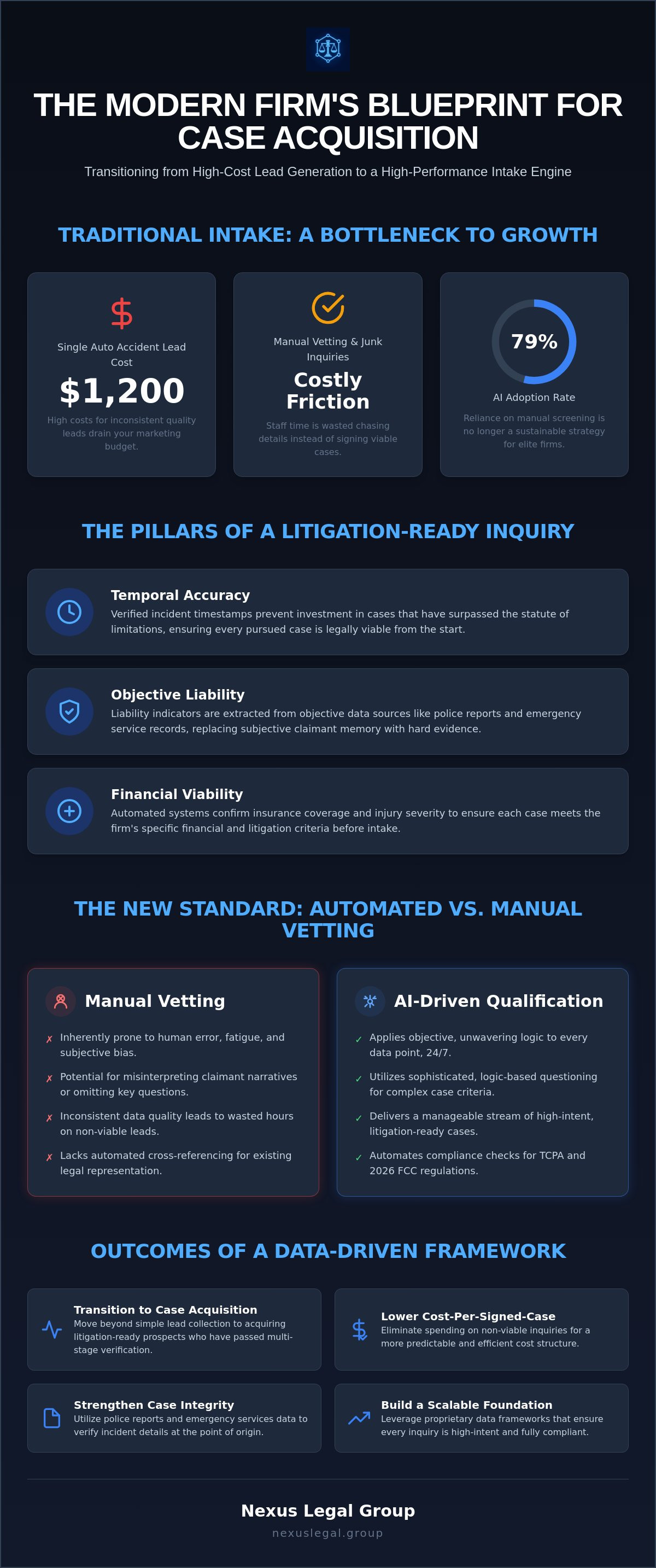
Why is your high-value intake team still vetting junk inquiries when the industry cost for a single auto accident lead has climbed as high as $1,200? You likely already know that traditional marketing channels often produce inconsistent quality, leaving your staff to chase down missing accident details instead of signing cases. This friction doesn't just drain your payroll; it lowers your overall data integrity and creates a bottleneck that prevents your firm from scaling. Relying on manual screening in a market where 79% of legal professionals have already adopted AI tools is no longer a sustainable strategy for elite firms.
By implementing precision legal lead qualification services, you can transform your intake department from a cost center into a high-performance engine. This article will show you how to eliminate friction by using data-driven qualification frameworks, such as police report generation and automated verification systems. We'll explore how these tools provide litigation-ready inquiries that integrate seamlessly with your CRM. You'll learn the mechanics of lowering your cost-per-signed-case while maintaining strict compliance with the latest 2026 FCC one-to-one consent regulations.
Key Takeaways
- Learn how to transition from basic demographic screening to sophisticated legal lead qualification services that prioritize claimant intent and objective evidence.
- Eliminate manual intake bottlenecks by deploying automated verification systems designed to deliver litigation-ready inquiries without the inconsistency of human-only vetting.
- Strengthen case integrity through strategic data enrichment by utilizing police reports and emergency services data to verify incident details at the point of origin.
- Prioritize growth partners that offer exclusive inquiries and robust technological infrastructure rather than those focused solely on high lead volume.
- Build a scalable foundation for your firm by leveraging proprietary data frameworks that ensure every inquiry is high-intent and fully compliant with 2026 regulations.
Defining Legal Lead Qualification Services for Modern Firms
Legal lead qualification services represent the rigorous, systematic verification of a prospective claimant's eligibility for litigation. For elite plaintiff firms, this process isn't merely a preliminary check; it's a foundational layer of their growth infrastructure. While traditional screening often focuses on basic demographic fit, modern qualification shifts the focus toward objective evidence and claimant intent. By implementing these high-level frameworks, firms can eliminate non-viable inquiries before they ever reach a high-value attorney's desk, drastically reducing the high cost of manual intake vetting.
The core objective here is to ensure that every inquiry entering your CRM is a high-intent data point rather than a speculative lead. This level of precision allows for a more predictable cost-per-signed-case and protects your staff from the friction of chasing "junk" leads. When your system prioritizes technical mastery over raw volume, you create a more efficient path to case resolution and firm expansion.
The Shift from Lead Generation to Case Acquisition
In the broader context of lead generation, an unverified inquiry is often a liability rather than an asset. If your firm spends hours vetting individuals who lack a valid cause of action, you're essentially subsidizing inefficiency. This reality has driven a decisive industry transition toward data-driven case acquisition as a strategic necessity. The goal is to move beyond the simple collection of names and focus on acquiring litigation-ready prospects who've already passed through a multi-stage verification engine. Differentiating between a generic inquiry and a qualified prospect is what allows top-tier firms to maintain their competitive edge in a crowded market.
Core Components of a Qualified Legal Inquiry
A truly qualified inquiry is built on three essential pillars that ensure the integrity of every case file:
- Temporal Accuracy: Verified incident timestamps are critical to prevent the firm from investing in cases that have already surpassed the statute of limitations.
- Objective Liability: Rather than relying on a claimant's memory, elite legal lead qualification services extract liability indicators from objective data sources like police reports and emergency services records.
- Financial Viability: Automated vetting systems confirm insurance coverage and the severity of injuries, ensuring the case meets the firm's specific litigation criteria.
By standardizing these components, your firm ensures that every inquiry is backed by a clinical level of precision, allowing for seamless integration into your existing legal workflows.
The Mechanics of AI-Driven Qualification and Verification
Elite firms are decisively moving away from traditional answering services because human-driven models are inherently prone to error, fatigue, and subjective bias. Instead, modern legal lead qualification services utilize AI-driven precision to identify high-intent claimants the moment they interact with a digital touchpoint. Unlike a live agent who might misinterpret a claimant's narrative or omit critical questions during a long shift, an automated system applies objective, unwavering logic to every data point. This ensures that only inquiries meeting your firm's specific litigation triggers reach your staff, preserving your team's time for high-value casework.
Rigorous data cross-referencing serves as a mechanical safeguard within this infrastructure. These systems automatically cross-reference inquiries against internal and external databases to check for existing legal representation. This prevents your team from wasting resources on claimants who've already retained counsel elsewhere. Maintaining strict adherence to ethical guidelines for lawyer marketing is a non-negotiable requirement for high-level operations. By automating these compliance checks, firms can protect their professional reputation and ensure TCPA compliance while aggressively scaling their acquisition efforts.
Automated Legal Intake Verification Frameworks
Implementing automated intake for plaintiff firms allows you to filter thousands of raw signals into a manageable stream of high-value cases. These frameworks use sophisticated, logic-based questioning to navigate complex case criteria, such as specific mass tort triggers, exposure dates, or injury types. The system performs real-time verification of phone numbers and email addresses, ensuring that every inquiry is immediately contactable. This level of technical mastery ensures your growth infrastructure is built on verified facts rather than claimant assumptions or incomplete intake forms.
Eliminating Friction in the Intake Funnel
Friction is the primary enemy of conversion in a competitive legal market. Verified data shows that leads contacted within five minutes are 21 times more likely to convert than those reached after just thirty minutes. Automated qualification eliminates this delay by providing immediate responses and integrating qualified data directly into your existing CRM. This creates a seamless, high-speed handoff from the qualification stage to your legal team, allowing for instant follow-up and signature. When you optimize your intake mechanics with these automated systems, you're not just buying leads; you're engineering a high-performance engine designed for consistent growth.
Strategic Data Enrichment: Beyond the Basic Intake Form
Standard intake forms are often limited by the claimant's memory or their willingness to provide exhaustive detail during a stressful moment. Sophisticated legal lead qualification services go beyond these self-reported narratives by integrating external data enrichment layers into the initial inquiry phase. This process isn't just about checking boxes; it's about layering objective facts onto a subjective inquiry to build a comprehensive case profile before your team even picks up the phone. By the time an attorney reviews the data, it has been transformed from a raw inquiry into a litigation-ready asset.
True qualification requires this external verification to ensure the integrity of the case. When you rely solely on what a claimant remembers, you risk investing time in cases with liability disputes or statute of limitations issues that aren't immediately apparent. Data enrichment provides a mechanical safeguard, ensuring that the foundational facts of the incident are verified through official channels. This creates a high-integrity environment where your intake staff can focus on signing cases rather than playing detective.
Leveraging Police Report and Emergency Services Data
In the hierarchy of case acquisition, police report generated MVA leads represent the highest tier of intent and reliability. By utilizing objective incident data, firms can confirm the exact date, geographical location, and all parties involved in an accident with clinical precision. This removes the ambiguity that often plagues traditional lead sources. Having a police report or emergency services record in-hand during the first consultation allows your firm to speak with authority, providing a clear advantage during the critical first contact with a potential client.
Reverse Append Technology for Lead Enrichment
The mechanics of reverse append technology allow for the retrieval of missing accident details from minimal initial input. If a claimant provides only a phone number or a license plate, the system can systematically append full accident reports and participant details. This enrichment increases the conversion rate by providing attorneys with a complete case picture from the outset. It's a powerful tool for eliminating friction, as it reduces the amount of information the claimant needs to manually enter. To maintain a competitive edge, elite firms must utilize these advanced data append services while ensuring strict compliance with the latest 2026 data privacy and consent regulations. This technical mastery ensures that your case acquisition engine is both powerful and ethically sound.
Evaluating Legal Lead Qualification Providers for Growth
Selecting a partner for legal lead qualification services requires a decisive shift in perspective from raw lead volume to technical infrastructure. For elite firms, the ability to verify accident participants through reverse append technology is a critical differentiator that most generalist providers overlook. Exclusivity is a non-negotiable standard; your growth should never be hindered by competing with other firms for the same inquiry. A provider's value is found in their ability to deliver unique, high-integrity data that belongs solely to your practice.
Documented compliance with TCPA and state bar ethical guidelines must be verifiable and transparent. With the FCC's "One-to-One Consent" rule in full effect as of January 26, 2026, firms can't afford to work with providers who utilize broad, bundled consent models. Your partner must demonstrate a clear, documented path of consent for every inquiry. This level of transparency protects your firm's reputation and ensures that your acquisition engine remains ethically sound even as you aggressively scale your case volume.
Criteria for Elite Plaintiff Firm Partnerships
Assessing a provider’s law firm growth infrastructure is the first step toward a successful partnership. You should prioritize real-time delivery capabilities and high-intent sourcing methods, such as organic search or incident-specific data. Transparency in data sourcing is essential; you need to know if an inquiry originated from a generic social media ad or a verified accident report. Systems that integrate directly with your CRM ensure that no data is lost during the handoff, maintaining the high data integrity required for litigation-ready inquiries.
The Importance of Litigation-Ready Standards
Firms aiming for consistent expansion must demand inquiries that are ready for immediate signing or filing. While the upfront cost of "raw leads" might seem lower, the long-term ROI of qualified inquiries is significantly higher. This is because they eliminate the hidden costs of staff vetting and the drain of managing junk inquiries. When you receive a litigation-ready inquiry, you're receiving a verified case profile that includes objective liability indicators and confirmed insurance details. This precision allows your firm to maintain a lower cost-per-signed-case and a more predictable growth trajectory. To begin engineering a more efficient acquisition model, you can evaluate your firm's current growth infrastructure with a specialist today.
Nexus Legal Group: Engineering Growth Infrastructure
Nexus Legal Group doesn't merely provide leads; it constructs the foundational growth infrastructure elite plaintiff practices require to scale with clinical precision. Our framework replaces the inherent instability of traditional marketing with a systematic, end-to-end acquisition engine. By focusing on high-intent MVA and mass tort inquiries, we ensure your firm's resources are directed only toward litigation-ready cases that have already passed through our proprietary verification layers. This methodology eliminates the operational friction caused by manual intake and inconsistent lead quality discussed in previous sections.
Our legal lead qualification services represent a fusion of AI-driven marketing precision and rigorous technical verification. We understand that for a firm to thrive, every inquiry must be exclusive and fully compliant with the latest national standards, including the 2026 FCC one-to-one consent mandates. This commitment to systemic integrity allows our partners to focus on litigation while we manage the complex mechanics of case acquisition behind the scenes. It's an authoritative approach designed for firms that value logic and automation over guesswork.
Exclusive MVA and Mass Tort Case Acquisition
Securing a competitive advantage in the personal injury market requires more than just a contact form. We utilize reverse append technology to secure detailed accident reports from minimal initial data points, providing a level of case depth that competitors cannot match. This technical mastery is central to how we deliver verified MVA leads for law firms that consistently convert into signed cases. By providing predictable, high-quality case flow, we empower your practice to scale without the risk of degrading case quality or increasing overhead. Every inquiry is verified against emergency services data to ensure the highest tier of intent.
Next Steps for Scalable Firm Expansion
Integrating our infrastructure into your existing firm operations is a streamlined process designed for zero downtime. You'll work directly with our strategic architects to design a growth blueprint tailored to your specific practice areas and volume requirements. Whether you're focused on local MVA acquisition or national mass tort litigation, our platform provides the connectivity and automation needed to drive results. Our focus is on the mechanics of your business expansion, providing a powerful, high-performance engine that works from behind the scenes. To begin your transition toward a more efficient acquisition model, scale your firm with Nexus Legal Group today.
Transitioning to a Data-Driven Case Acquisition Model
Transitioning your firm from manual intake to a systematic acquisition engine is the most effective way to protect your margins in an increasingly competitive market. By prioritizing legal lead qualification services that utilize AI-driven marketing precision and reverse append accident report technology, you eliminate the operational friction that stalls practice growth. You've seen how objective data verification replaces claimant guesswork, ensuring that your high-value staff only engages with exclusive, litigation-ready inquiries that are ready for immediate action.
This mechanical approach to growth doesn't just lower your cost-per-signed-case; it builds a foundation of systemic integrity that allows for aggressive, compliant scaling. Implementing these frameworks ensures your firm remains ahead of regulatory changes while maintaining the highest data standards for every new inquiry. It's time to stop chasing unverified leads and start engineering a predictable case flow that drives your firm's future. We're ready to help you build that high-performance infrastructure today.
Acquire Litigation-Ready Cases with Nexus Legal Group
Frequently Asked Questions
What is the difference between lead screening and lead qualification?
Lead screening typically involves a surface-level check of demographic data to see if an inquiry matches a firm's general profile. In contrast, legal lead qualification services provide a systematic verification of a claimant's specific eligibility for litigation. This process focuses on objective evidence and intent, ensuring that the inquiry meets rigorous legal criteria before it reaches an attorney, thereby eliminating the friction of vetting non-viable cases.
How does automated verification improve law firm conversion rates?
Automated verification improves conversion rates by drastically reducing "speed to lead" and removing the inconsistency of human-driven intake. Verified data indicates that leads contacted within five minutes are 21 times more likely to convert than those reached after thirty minutes. By using logic-based frameworks to verify contactability and case triggers in real-time, firms ensure their intake teams focus exclusively on high-intent prospects who are ready to sign.
Is lead qualification for law firms compliant with TCPA regulations?
Compliance depends on the provider's adherence to the FCC "One-to-One Consent" rule that took effect on January 26, 2026. This regulation requires express written consent for each specific seller. Professional qualification services maintain documented, verifiable consent trails for every inquiry. This mechanical safeguard protects your firm from the 27% increase in TCPA lawsuits observed at the start of 2026, ensuring your growth infrastructure remains ethically and legally sound.
Can lead qualification services provide signed cases for mass torts?
Yes, sophisticated providers deliver ethical and compliant leads and signed cases specifically for mass tort litigation. These services utilize proprietary data frameworks to identify claimants who meet specific exposure triggers and injury criteria. By automating the verification of these complex requirements, the system delivers signed cases that are ready for immediate filing, allowing firms to scale their mass tort practices without the burden of manual screening.
How does reverse append technology help in MVA case acquisition?
Reverse append technology allows firms to retrieve missing accident details using minimal initial input, such as a phone number or license plate. This system automatically pulls comprehensive accident reports and participant details from objective sources like emergency services databases. It's a critical component of high-intent MVA case acquisition because it provides a complete case profile, allowing attorneys to evaluate liability and insurance coverage before the first consultation even begins.
What data points are included in a litigation-ready inquiry?
A litigation-ready inquiry includes verified incident timestamps to prevent statute of limitations issues and objective liability indicators derived from police reports. It also contains confirmed insurance coverage details, injury severity assessments, and validated contact information. These specific data points ensure the inquiry is backed by clinical precision, providing your legal team with the necessary evidence to move directly to the signing or filing stage without additional vetting.
Why should elite firms avoid non-exclusive legal leads?
Elite firms avoid non-exclusive leads because shared inquiries create a race-to-the-bottom environment that degrades conversion rates and ROI. When a lead is sold to multiple competing firms, the "speed to lead" pressure increases exponentially, often leading to a poor claimant experience. Exclusivity is a non-negotiable standard for high-performance legal lead qualification services, ensuring that your firm is the only entity with access to that specific, litigation-ready data point.