
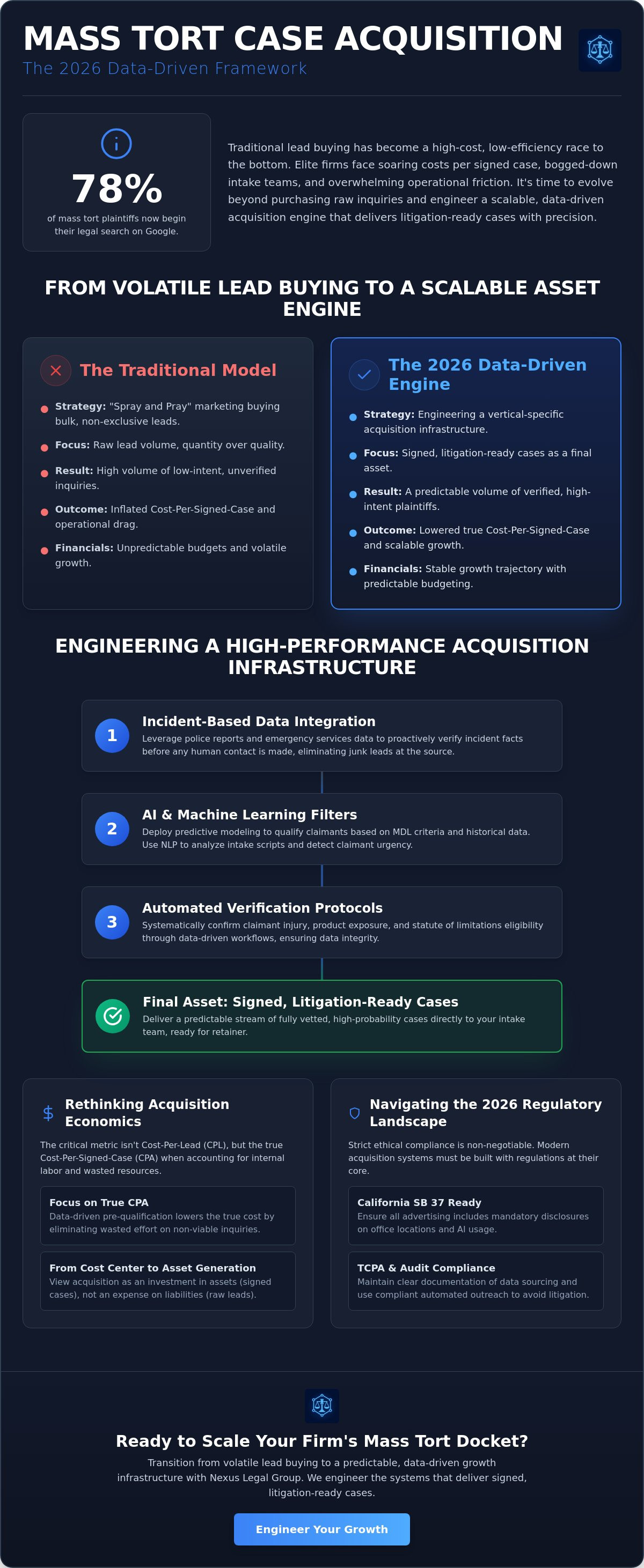
With 78% of mass tort plaintiffs now initiating their legal search on Google, the traditional model of purchasing bulk leads has become a race to the bottom for elite firms. Developing a sophisticated mass tort case acquisition strategy in 2026 requires more than just a marketing budget. It demands a technical infrastructure that filters for viability before a human ever picks up the phone. You've likely experienced the frustration of high costs per signed case driven by poor lead quality and the operational friction that stalls growth. It's difficult to scale volume when your intake team is bogged down by unverified data or regulatory hurdles like California's SB 37.
This guide provides a comprehensive framework to help your firm transition from volatile lead buying to a scalable, data-driven acquisition engine. We'll examine how to integrate automated verification, leverage real-time data from active MDLs like the 202,000 pending cases currently in federal courts, and maintain strict ethical compliance. By the end of this article, you'll understand how to engineer an infrastructure that delivers signed, litigation-ready cases with surgical precision.
Key Takeaways
- Learn how to transition from generic lead generation to a vertical-specific mass tort case acquisition strategy that focuses on engineering scalable growth infrastructure.
- Discover how to leverage incident-based data, including police reports and emergency services records, to automate the verification of high-intent claimants.
- Analyze the financial mechanics of acquisition by comparing cost-per-qualified-lead (CPQL) against the true cost-per-signed-case (CPA) while accounting for internal labor.
- Navigate the 2026 docket landscape by identifying high-yield opportunities in emerging environmental and pharmaceutical litigations while maintaining strict ethical compliance.
- Optimize your operational flow by integrating AI-driven precision and rigorous intake protocols to ensure every inquiry is litigation-ready.
The Evolution of Mass Tort Case Acquisition in 2026
The landscape of Mass tort litigation has undergone a fundamental shift. Elite firms no longer view marketing as a separate function but as a core component of their growth infrastructure. A successful mass tort case acquisition strategy now requires moving away from horizontal, broad-market lead generation toward vertical-specific precision. The "spray and pray" digital marketing tactics that dominated the early 2020s have become prohibitively expensive and largely ineffective. In 2026, the volume of noise in digital channels means that generalized ads often attract low-intent inquiries, driving up the cost-per-signed-case and overwhelming internal intake teams.
Defining a "litigation-ready" inquiry is central to this evolution. It isn't just a contact form submission. It's a verified record where the claimant's injury, product exposure, and statute of limitations eligibility are confirmed through data-driven protocols. Artificial Intelligence plays a critical role here. By deploying predictive analytics and automated verification workflows, firms can reduce the friction between the initial inquiry and the signed retainer. This ensures that your intake specialists only spend their time on cases with the highest probability of success. It's about building a system that filters out the noise before it reaches your desk.
From Lead Generation to Case Acquisition
Raw inquiries are often a liability; signed cases are an asset. As dockets for litigations like AFFF or Ozempic become more saturated, the cost to acquire a qualified lead has risen significantly. Firms that rely on non-exclusive leads find themselves in a race for speed that often compromises quality. To maintain a competitive edge, elite firms are shifting toward exclusive models where the focus is on the final outcome: the signed case. This transition allows for more predictable budgeting and a more stable growth trajectory. You don't just want more leads; you want a predictable volume of verified plaintiffs.
The 2026 Regulatory and Compliance Landscape
Compliance is no longer a secondary concern. With the implementation of California SB 37 on January 1, 2026, attorney advertising rules have become significantly more stringent. All advertisements must now clearly disclose office locations and provide transparent disclaimers regarding the use of AI or dramatizations. Additionally, court-mandated audits are becoming more common in Multi-District Litigations, requiring firms to provide clear documentation of their data sourcing. Maintaining TCPA compliance through automated outreach is essential to avoid costly litigation and protect your firm's reputation. At Nexus Legal Group, we prioritize these ethical standards to ensure every inquiry we deliver is fully compliant with modern regulatory requirements.
Engineering a Data-Driven Acquisition Infrastructure
A high-performance mass tort case acquisition strategy relies on more than just digital visibility; it requires a technical foundation capable of parsing massive datasets to identify the most viable plaintiffs. In 2026, the differentiator for elite firms is the integration of incident-based data directly into the acquisition funnel. By utilizing police reports and emergency services data, firms can verify the facts of an incident before a human agent ever initiates contact. This proactive verification eliminates the "junk" leads that typically plague mass tort campaigns and ensures your intake team focuses exclusively on high-intent inquiries. It's a shift from reactive marketing to proactive engineering.
The Role of AI and Machine Learning
Machine learning models allow firms to deploy predictive modeling that qualifies claimants based on historical settlement data and specific MDL criteria. These systems analyze behavioral patterns to forecast which inquiries will result in a signed retainer. Natural Language Processing (NLP) further refines this by powering intake scripts that detect urgency in a claimant's response. AI-driven case acquisition is a systematic framework that utilizes predictive analytics to prioritize high-intent claimant identification over raw lead volume. This technological layer acts as a primary filter, ensuring that only the most robust claims enter your workflow.
Data Enrichment and Verification Protocols
Verification is the antidote to high acquisition costs. Reverse append technology takes a single data point from an incident report and cross-references it against consumer databases to secure full participant details. This ensures you're contacting the correct individual involved in the qualifying event. Integrating automated intake for plaintiff firms allows you to maintain litigation readiness without manual overhead. By cross-referencing inquiries with real-time incident data, you can drastically reduce "junk" leads through multi-layered vetting. Partnering with Nexus Legal Group can provide the infrastructure needed to automate these complex verification protocols.
Evaluating Acquisition Models: Leads vs. Signed Retainers
Choosing the right financial model for your firm is the most critical decision in a modern mass tort case acquisition strategy. Many firms struggle to decide between paying for raw qualified leads (CPQL) or fully signed retainers (CPA). While a lower lead cost might look attractive on a spreadsheet, it often masks the heavy operational burden placed on your internal staff. To calculate the true cost of acquisition, you must account for the labor hours required to chase, verify, and sign each claimant. If your intake team spends forty hours a week filtering through unverified data, your actual acquisition cost is significantly higher than the vendor's invoice suggests.
In 2026, performance benchmarks show that elite firms are pivoting toward models that guarantee outcomes rather than just opportunities. Benchmarking 2026 performance is the primary trigger for when to pivot your mass tort case acquisition strategy. Pay-per-signed-case models shift the risk from the law firm to the acquisition partner. This allows you to treat case acquisition as a fixed cost, making your growth projections more accurate and your scaling efforts more sustainable. If your internal conversion rate from lead to signed case is below 15%, it's time to evaluate whether your current infrastructure is leaking revenue through inefficiency.
The ROI of Signed Case Acquisition
Eliminating the intake bottleneck is the primary advantage of acquiring pre-signed, verified retainers. When your firm receives a case that's already been vetted and signed, your legal team can begin work immediately. Understanding how mass tort signed retainer acquisition impacts firm cash flow is essential for long-term planning. For firms needing to present these strategic shifts to stakeholders, GrowthGrid provides the tools to generate professional executive summaries and business plans. This model ensures that capital is deployed directly into assets, specifically signed cases, rather than speculative inquiries. This stabilizes your firm's financial trajectory during long litigation cycles and reduces the overhead of constant follow-up.
Identifying Hidden Costs in Mass Tort Marketing
The most dangerous ghost cost in mass tort marketing is the non-responsive claimant. Unverified leads age rapidly. In high-intent dockets, a lead that isn't contacted within five minutes sees a massive drop in conversion probability. This decay means that bulk lead buying often results in dead data that clogs your CRM. When evaluating mass tort lead generation companies, look for partners that offer performance-based pricing and rigorous verification. This approach protects you from paying for the same unverified contact multiple times and ensures your marketing spend is tied to litigation-ready results.
Strategic Docket Selection and Compliance Protocols
Strategic docket selection is the operational pivot point of any sophisticated mass tort case acquisition strategy. Success in 2026 depends on your ability to differentiate between early-stage opportunities and mature dockets that are approaching settlement. Early-stage acquisition often yields a lower cost-per-signed-case but requires a longer capital commitment while the science and bellwether trials develop. Conversely, late-stage dockets offer more certainty but face aggressive competition that can erode margins. The 2026 "Hot Tort" landscape is currently dominated by GLP-1 (Ozempic) litigations and PFAS environmental claims, which represent massive potential for firms with the infrastructure to handle high-volume intake.
Risk mitigation in large-scale marketing campaigns requires a clinical approach to data integrity. You must ensure that your acquisition partner isn't just delivering names, but is providing verified exposure data that matches the specific criteria of the MDL. This reduces the likelihood of "junk" filings that can damage your firm's reputation with special masters and lead counsel. By analyzing docket maturity and settlement trends, you can allocate your marketing capital to the dockets with the highest probability of a favorable ROI.
Evaluating Docket Viability
Selecting a docket requires a rigorous analysis of settlement potential against current saturation levels. High-volume dockets like the 3M Combat Arms Earplug Lawsuit, which reached 391,000 cases, demonstrate the scale required for market dominance. Sourcing exclusive mass tort leads is the only way to avoid the "double-signed" claimant disputes that frequently derail growth in saturated markets. Docket selection dictates the specific technological and human infrastructure required to convert inquiries into viable assets. By focusing on dockets with clear liability and documented exposure pathways, firms can engineer a more predictable return on investment.
Ethical and Compliant Case Generation
Maintaining ethical standards is a technical requirement, not just a legal one. With the 2026 enforcement of California SB 37, every advertisement must be transparent about office locations and the use of AI or dramatizations. Implementing compliant legal lead generation ensures that every signed case is insulated from future challenges during the discovery process. This involves rigorous claimant communication and clear disclosures regarding the litigation process. Data integrity is paramount; every piece of acquisition data must be "litigation-ready" to withstand court-mandated audits. If you are ready to scale your firm's volume while maintaining absolute compliance, partner with Nexus Legal Group to build your 2026 growth engine.
Scaling with Nexus Legal Group’s Growth Infrastructure
Transitioning your firm from a marketing-dependent entity to a tech-enabled powerhouse requires a fundamental shift in how you perceive growth. Many firms treat marketing as a variable expense that fluctuates with lead quality. In contrast, a sophisticated mass tort case acquisition strategy treats acquisition as an engineering problem. Nexus Legal Group provides the foundational growth infrastructure necessary to remove the volatility from your pipeline. Our Nexus CaseFlow system integrates AI precision with rigorous intake verification, ensuring that every inquiry delivered to your firm is litigation-ready. This isn't about increasing the volume of calls; it's about increasing the technical integrity of your docket.
By leveraging police report and emergency services data integration, we verify the facts of a claim at the point of origin. This data-first approach allows us to deliver exclusive inquiries that have already been cross-referenced for validity. When your firm utilizes this level of technical mastery, you eliminate the friction that usually stalls large-scale expansion. You aren't just buying data; you're installing a high-performance engine designed to drive sustainable growth from behind the scenes. This allows your partners to focus on the legal merits of a case while the infrastructure handles the complexities of the 2026 acquisition landscape.
The Nexus Advantage: Beyond Lead Generation
Deploying an end-to-end growth infrastructure allows plaintiff lawyers to focus on litigation rather than manual lead vetting. Our systems are built to ensure that every acquisition is ethical, compliant, and fully verified before it ever reaches your CRM. We understand the practical, rigorous realities of business operations in 2026. If you're ready to move beyond the limitations of traditional marketing and install a predictable growth engine, schedule a consultation via the Nexus Legal Group homepage to discuss your firm's specific scaling requirements.
Operational Excellence in Mass Tort Scaling
Reducing firm overhead is a direct result of automated verification and reverse append technology. These tools allow us to secure detailed accident reports and participant details, strengthening the foundation of every signed case you accept. By automating the most labor-intensive parts of the intake process, your firm can scale without a proportional increase in headcount. This systemic integrity is what allows elite firms to dominate competitive dockets while maintaining high-level competence. You can discover more insights on the Nexus Legal Group blog to stay informed on the latest advancements in acquisition technology and operational efficiency.
Engineering Your Firm’s Growth Infrastructure for 2026
Transitioning from buying volatile leads to building a technical acquisition engine is the only way to maintain a competitive edge in 2026. You've seen how integrating police report data and emergency services records can transform raw inquiries into litigation-ready assets. By prioritizing outcome-based models like signed retainers over speculative lead volume, your firm can stabilize cash flow and focus on the legal merits of your docket. A successful mass tort case acquisition strategy now requires the seamless integration of AI-driven verification and rigorous ethical compliance to withstand the scrutiny of modern MDL dockets. Furthermore, for firms looking to expand their brand presence internationally, you can discover Gulf Legal Advisors to ensure your trademark registration is handled by experts in the UAE.
It's time to move beyond the limitations of traditional marketing agencies. You can scale your firm with Nexus Legal Group’s growth infrastructure and leverage our end-to-end systems designed specifically for elite plaintiff lawyers. We provide the technical foundation, from reverse append technology to incident-based data verification, allowing you to dominate your chosen dockets with clinical precision. Your path to predictable, high-volume growth starts with a commitment to operational excellence and the right technological partner.
Frequently Asked Questions
What is the average mass tort case acquisition cost in 2026?
As of June 2026, the blended market cost to acquire a signed mass tort case is reported at $340.94 across active campaigns. This figure varies significantly based on the specific litigation; for example, video game addiction cases average around $246, while complex pharmaceutical torts like Dupixent can reach $1,793 per signed retainer. These benchmarks reflect external advertising spend and don't include internal intake labor or management overhead costs.
How do I ensure my mass tort lead generation is ethically compliant?
Compliance requires strict adherence to evolving state-specific regulations, such as California’s SB 37, which mandates clear disclosures of office locations and the use of AI in advertisements. You must ensure all marketing materials avoid misleading statements about a lawyer's record and provide transparent disclaimers for any dramatizations. Maintaining a documented audit trail of data sourcing is also essential for satisfying court-mandated discovery processes in Multi-District Litigations.
What is the difference between a qualified mass tort lead and a signed case?
A qualified lead is an inquiry that has met preliminary criteria for exposure and injury but hasn't yet committed to legal representation. A signed case is a litigation-ready asset where the claimant has executed a formal retainer agreement. Shifting your mass tort case acquisition strategy toward signed cases reduces the operational burden on your intake team and ensures your capital is deployed into verified, actionable legal assets.
Can I use police reports to verify mass tort claimants?
Yes, police reports and emergency services data are foundational tools for incident-based verification in modern acquisition workflows. By cross-referencing claimant inquiries with official accident reports, firms can confirm the date, location, and specific parties involved in a qualifying event before initiating contact. This proactive verification layer eliminates the "junk" leads common in digital marketing and ensures that every signed case is backed by documented evidence.
How does AI improve the mass tort intake process?
AI improves the intake process by deploying predictive modeling to qualify claimants based on historical settlement patterns and specific MDL criteria. Natural Language Processing (NLP) allows automated systems to detect urgency and sentiment in claimant responses, ensuring high-intent inquiries are prioritized for immediate follow-up. This technological layer reduces human error and decreases the time between initial contact and a signed retainer, maximizing your firm's overall conversion efficiency.
What are the most profitable mass tort dockets to acquire in 2026?
High-yield dockets in 2026 include GLP-1 (Ozempic) medications, PFAS environmental claims, and AFFF firefighting foam litigations. Emerging areas like social media addiction and hair relaxer cases also show significant volume potential for firms with the right infrastructure. Profitability depends on entering a docket at the correct maturity stage, balancing the lower costs of early-stage acquisition against the higher certainty of late-stage settlements and bellwether results.
Is it better to buy leads or signed cases for my law firm?
Buying signed cases is generally superior for firms looking to scale volume without increasing internal intake overhead. While raw leads have a lower upfront price, they require significant human labor to chase, verify, and convert into clients. Signed cases represent a fixed cost for a verified asset, allowing your legal team to focus on litigation rather than administrative filtering. The choice depends entirely on your firm's existing intake capacity.
How does reverse append technology work for mass tort acquisition?
Reverse append technology takes a single data point, such as a phone number or an incident location, and cross-references it against consumer databases to retrieve missing participant details. This process allows firms to secure full contact information and accident history for high-intent claimants identified through emergency services data. It ensures that your outreach is directed at the correct individuals, increasing the accuracy and efficiency of your firm's case acquisition engine.