
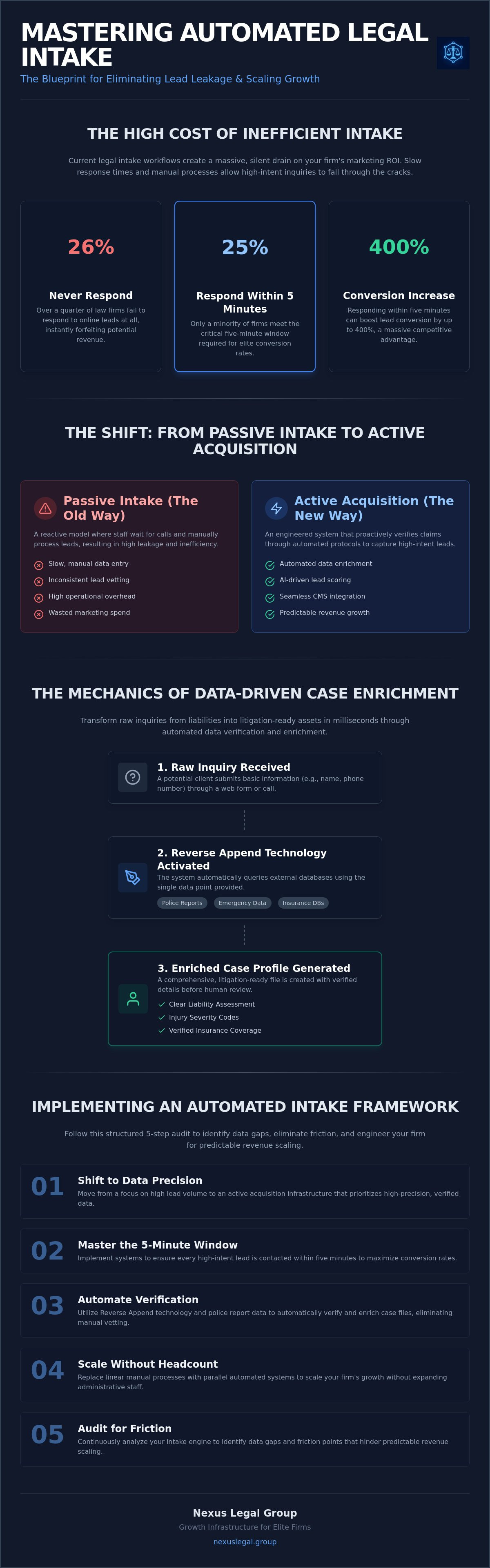
Recent data reveals that 26% of law firms never respond to online leads, while only 25% manage to initiate contact within the critical five-minute window. This systemic failure in legal intake workflow management represents a massive, silent drain on your firm's marketing ROI. You likely recognize that manual vetting processes and slow reaction times create a bottleneck that allows high-intent inquiries to slip through the cracks. It's an expensive inefficiency that overwhelms your administrative staff and compromises your competitive edge.
This article provides a technical blueprint for mastering automated intake to eliminate lead leakage and secure litigation-ready cases at scale. By engineering a hands-off engine, you can reduce operational overhead while maintaining the highest standards of data integrity. We'll explore the mechanics of automated verification and reverse-append technology, demonstrating how to transform raw inquiries into predictable revenue growth through mechanical scalability. Prepare to move beyond basic lead capture and implement a sophisticated system designed for institutional excellence.
Key Takeaways
- Shift from passive lead reception to an active acquisition infrastructure that prioritizes high-precision data over simple inquiry volume.
- Master the mechanics of legal intake workflow management to eliminate lead leakage and secure the critical five-minute response time required for elite conversion rates.
- Utilize Reverse Append technology and police report data to automate the verification process and deliver litigation-ready case files to your team.
- Replace linear manual vetting with parallel automated systems to scale your firm's growth without expanding administrative headcount.
- Follow a structured five-step audit to identify data gaps and friction points within your current intake engine to ensure predictable revenue scaling.
What is Legal Intake Workflow Management for Plaintiff Firms?
In the context of elite plaintiff litigation, legal intake workflow management is the systematic architecture used to capture, vet, and convert raw inquiries into signed, viable cases. It's far more than an administrative "front door" or a simple reception desk. It's a high-precision verification engine designed to filter out the noise and identify high-intent opportunities with clinical accuracy. For firms specializing in Motor Vehicle Accidents (MVA) or Mass Tort litigation, this process represents the foundational layer of business expansion.
Many firms still rely on "passive intake," a reactive model where staff wait for phone calls and manually record details. This approach is inherently flawed. Research shows that 26% of law firms never respond to online leads, and only 25% respond within five minutes. This creates massive lead leakage and wasted marketing spend. Modern growth requires an "active acquisition infrastructure." This is an engineered system that proactively secures data, verifies claims through automated protocols, and ensures that no high-intent lead is ever lost to a competitor's faster response time.
The Core Components of an Intake Ecosystem
A robust intake engine functions through three primary mechanisms. First, it utilizes multi-channel inquiry capture, drawing data from web forms, mobile interfaces, and even police reports or emergency services data. Second, it employs automated lead scoring. This allows the system to rank inquiries based on case-specific criteria, such as liability and injury severity, before a human ever sees the file. Finally, the system must maintain seamless integration with existing Case Management Systems (CMS), ensuring that litigation-ready data flows directly into the firm's operational core without manual entry errors.
Plaintiff vs. In-House Intake: A Strategic Divide
While corporate legal departments often view intake as a way to manage internal chaos, plaintiff firms must view it as a competitive advantage. In highly contested markets like MVA, "speed to lead" is the primary driver of success. Responding to a lead within five minutes can increase conversion by approximately 400%. Because plaintiff firms operate on a contingency basis, they require much higher precision in lead verification than in-house teams. You can't afford to waste resources on unqualified claims. Transitioning from simple triage to comprehensive data driven case acquisition ensures that every signed case meets the "litigation-ready" standard required for predictable revenue growth.
The Mechanics of Data-Driven Case Enrichment
A raw inquiry is essentially a liability until it's verified. In a high-performance legal intake workflow management system, the objective isn't just to gather contact information; it's to build a comprehensive data profile before your team ever picks up the phone. This is achieved through "Reverse Append" technology. By taking a single data point, such as a phone number or a partial name, the system can automatically query external databases to retrieve accident reports, vehicle details, and historical incident data. This transformation from a "raw lead" to an "enriched case profile" happens in milliseconds, allowing your firm to operate with clinical precision.
Leveraging Police and Emergency Data
High-intent leads aren't found; they're engineered. The most reliable bedrock for this engineering is real-time incident data. By integrating police report generated MVA leads directly into your intake engine, you bypass the inaccuracies of manual claimant statements. These reports provide objective verification of liability, injury codes, and insurance coverage. This level of data-driven validation effectively eliminates "garbage" leads and fraud, ensuring your resources are only allocated to cases with a high probability of success.
Automated Verification and Lead Scoring
Once the data is retrieved, AI-driven protocols parse the complex incident details to establish a "Qualified Inquiry" threshold. This isn't a static checklist. It's a dynamic scoring system that evaluates:
- Liability Clarity: Does the police report clearly assign fault to the third party?
- Injury Severity: Do emergency service records indicate immediate medical transport or significant trauma?
- Insurance Viability: Has the system verified active coverage for the involved parties?
This automated verification ensures that every file reaching your intake specialists is already litigation-ready. It's a shift from asking "is this a case?" to "how quickly can we sign this client?" To see how this technical mastery can be integrated into your firm, consider exploring a tailored growth infrastructure designed for elite plaintiff practices. Ethical and compliant data handling is the final, non-negotiable layer. As the American Bar Association clarifies in Formal Opinion 512, lawyers have a duty to supervise these automated tools as "nonlawyers." This means your systems must prioritize client confidentiality and data integrity at every stage of the enrichment process.
Eliminating Friction: Manual vs. Automated Intake
Manual intake is a linear process that creates an inherent operational bottleneck. Every inquiry requires a human to answer, vet, and record data. This dependency leads to staff burnout and inevitable human error, especially during periods of high lead volume. When your volume spikes, your response times naturally drop, creating a cycle of inefficiency. In contrast, a sophisticated legal intake workflow management system operates in parallel. It can process hundreds of inquiries simultaneously with the same clinical precision. This ensures that your firm's scalability is a function of your technology rather than your headcount. Transitioning to this model allows firms to reduce administrative time per new matter by 3.2 to 4.8 hours, directly lowering operational overhead and increasing profit margins.
Solving the Lead Leakage Problem
The first five minutes after an inquiry are the most critical. Data shows that responding within this window can increase conversion rates by approximately 400%. Conversely, 68% of potential clients will contact a competitor if they don't receive a response within 24 hours. By implementing automated intake for plaintiff firms, you secure 24/7 responsiveness. The system never sleeps, ensuring that high-intent MVA leads are captured and engaged immediately, even on weekends or after hours. This mechanical consistency effectively eliminates lead leakage and reduces the ghosting common in manual follow-up sequences.
The Hybrid Approach: AI Triage with Human Closing
A common concern is that automation might erode the personal touch required in sensitive plaintiff litigation. However, the most effective systems utilize a hybrid model. AI handles the heavy lifting, including initial data collection, Reverse Append verification, and preliminary triage based on liability and injury severity. This allows your senior intake specialists and attorneys to focus exclusively on high-value human interactions. By the time a human enters the conversation, the case is already qualified and litigation-ready. This approach maintains professional decorum and empathy while maximizing the efficiency of your most expensive assets. You're not replacing the human element; you're liberating it from administrative drudgery. This structural shift allows attorneys to dedicate their focus to high-level strategy and litigation, where their expertise generates the highest return for the firm.
Implementing an Automated Intake Framework: A 5-Step Guide
Transitioning from a reactive, manual process to a high-performance legal intake workflow management system requires a strategic roadmap. It isn't enough to simply buy software; you must engineer a framework that prioritizes data integrity and mechanical scalability. This guide outlines the essential stages for constructing a growth engine that delivers litigation-ready cases with clinical precision. By following these steps, you'll move from administrative chaos to a streamlined, hands-off acquisition model.
Step 1: Auditing Your Intake Funnel
Success begins with a rigorous audit of your current channels. Identify exactly where potential claimants drop off, whether it's a complex web form or a long hold time on the phone. You must analyze your "time-to-verify" metric. If it takes your team hours or days to validate a claim, you're losing high-intent leads to faster competitors. Map the "ideal path" from the initial inquiry to the signed retainer, identifying every friction point that slows down the conversion process.
Step 2: Engineering the Verification Engine
Once you've mapped the funnel, you must configure the logic for identifying qualified MVA inquiries. This involves setting up automated disqualification triggers for low-value or fraudulent leads. For example, if a police report indicates no injuries or clear claimant fault, the system should automatically flag the file for rejection. Test this logic against your historical data to ensure the scoring accuracy aligns with your firm's specific litigation standards.
The third step involves integrating data enrichment tools. Your system should automatically utilize Reverse Append technology and access emergency services data to validate claimant statements in real time. This leads to the fourth step: deploying automated lead scoring and routing logic. High-value, "litigation-ready" cases should be routed immediately to senior partners or specialized intake closers, while standard inquiries follow a different automated path. This ensures your most expensive human assets are only focused on the highest-probability opportunities.
Finally, you must commit to continuous optimization. Use behavioral analysis and conversion metrics to refine your scoring logic. If certain data points consistently correlate with higher settlement values, adjust your scoring engine to prioritize those inquiries. This iterative process transforms your legal intake workflow management from a static tool into a dynamic growth engine that evolves with the market.
Nexus Legal Group: Growth Infrastructure for Elite Firms
Nexus Legal Group functions as the strategic architect of high-intent case acquisition for elite plaintiff firms. We don't just provide leads. We build the foundational layer required for institutional expansion. This platform's mastery of legal intake workflow management ensures that every inquiry is filtered through a rigorous, data-driven verification engine. By the time a case reaches your desk, it's already been enriched with objective data points that confirm its viability and value. It's a shift from managing a chaotic influx of inquiries to operating a high-performance acquisition machine.
The Nexus system is engineered for firms that demand clinical precision in their growth strategies. We prioritize the delivery of litigation-ready cases, utilizing advanced protocols to ensure that every signed retainer meets the highest standards of liability and insurance verification. This institutional approach allows your firm to scale with confidence, knowing that your growth is driven by a predictable, mechanical engine rather than inconsistent manual processes. It's about securing high-intent assets that provide a clear path to revenue.
End-to-End Growth Infrastructure
Our solution transcends the capabilities of traditional lead generation by providing a comprehensive system for scaling plaintiff practices. We utilize AI-driven marketing precision to acquire MVA and Mass Tort cases that generalist agencies often miss. By integrating police report data and emergency services records directly into the intake engine, we eliminate the friction and "intake chaos" that typically plague growing firms. This infrastructure ensures that your data is ethical, compliant, and enriched via reverse append technology before any human interaction occurs. You're not just buying a lead; you're implementing a sophisticated technical solution designed for operational excellence.
Securing Your Competitive Advantage in 2026
Elite firms are increasingly moving away from generalist agencies in favor of specialized technology partners. The complexity of modern legal intake workflow management requires a level of technical depth that standard marketing firms simply cannot provide. Investing in a mechanical, scalable growth engine offers a superior long-term ROI by reducing the cost of acquisition and freeing your attorneys to focus on high-level litigation. This technical mastery is the differentiator that allows top-tier firms to dominate their markets while others struggle with administrative overhead. It's time to replace fragmented tools with a unified, high-performance infrastructure.
Mastering the Architecture of Plaintiff Firm Expansion
Transitioning from reactive lead capture to a sophisticated acquisition engine is the primary requirement for maintaining a competitive edge in 2026. By implementing a robust legal intake workflow management system, you effectively eliminate the lead leakage that causes 68% of potential clients to contact a competitor. You've seen how data enrichment through police reports and reverse append technology ensures that every inquiry is litigation-ready before your team even engages. This mechanical approach to growth reduces administrative time by up to 4.8 hours per matter, allowing your attorneys to focus on high-value litigation strategy.
Your firm's expansion shouldn't depend on manual effort or administrative luck. It's time to move beyond generalist agencies and embrace a specialized tech partner that offers AI-driven marketing precision and verified inquiries for MVA and Mass Tort cases. This structural shift turns raw data into predictable revenue while maintaining the highest standards of ethical compliance and professional decorum.
Take the final step toward institutional excellence by securing a system designed for mechanical scalability. Your firm is ready for the precision of a high-performance growth engine.
Frequently Asked Questions
What is legal intake workflow management?
Legal intake workflow management is the technical architecture used to capture, verify, and route prospective client inquiries through an automated system. It transforms the traditionally manual process of answering phones and recording notes into a high-precision verification engine. This system ensures that every inquiry is filtered against specific liability and injury criteria before a human specialist ever engages with the file.
How does automated intake improve case conversion rates for plaintiff firms?
Automated intake improves conversion rates by providing an immediate, 24/7 response to every inquiry without human latency. Since potential claimants often contact multiple firms simultaneously, the first to initiate contact usually secures the signed retainer. By removing response delays and providing instant engagement, the system prevents high-intent leads from seeking representation elsewhere during off-hours or busy periods.
Can AI-driven intake handle complex MVA or Mass Tort inquiries?
AI-driven systems are engineered to handle complex inquiries through sophisticated logic-based branching and real-time data cross-referencing. For MVA and Mass Tort cases, the engine evaluates specific injury codes and liability factors retrieved from external databases like police reports. This ensures that even complicated fact patterns are triaged with clinical precision, allowing your firm to prioritize the most valuable opportunities immediately.
Is automated legal intake compliant with ethical standards?
Automated intake is fully compliant with ethical standards when implemented under the supervision requirements of ABA Model Rule 5.3. The system must clearly state that the interaction is automated and that no attorney-client relationship is formed until a formal retainer is signed. Proper configuration ensures that client confidentiality is maintained while fulfilling the lawyer's professional duty to stay technologically competent.
How does data enrichment like "reverse append" work in legal intake?
Reverse append technology utilizes a single piece of information, such as a phone number, to automatically query third-party databases for a comprehensive profile. In the context of legal intake workflow management, this allows the system to instantly retrieve accident reports and vehicle details. This process provides an objective verification layer that validates the claimant's statements without requiring manual research from your staff.
What is the difference between a lead and a litigation-ready inquiry?
A lead is a raw inquiry containing unverified contact information and self-reported details that may or may not be accurate. A litigation-ready inquiry is a lead that has passed through automated verification and data enrichment protocols. These inquiries include confirmed incident data and liability assessments, meaning they're ready for immediate conversion into a signed case without further administrative vetting or manual confirmation.
How long does it take to implement a legal intake automation system?
Implementation timelines vary based on the complexity of your firm's existing tech stack and specific practice area requirements. Most elite plaintiff firms can deploy the foundational growth infrastructure within several weeks. This period includes auditing your current channels, configuring custom scoring logic, and integrating the engine with your existing case management software to ensure a seamless, high-speed data flow.
Will automated intake replace my existing intake staff?
Automated intake doesn't replace your staff; it augments them by liberating them from repetitive administrative tasks. By handling the heavy lifting of data collection and initial verification, the system allows your team to focus on high-value closing conversations. This hybrid model maximizes the efficiency of your human assets by ensuring they only spend time on qualified, high-intent opportunities that are ready to sign.