
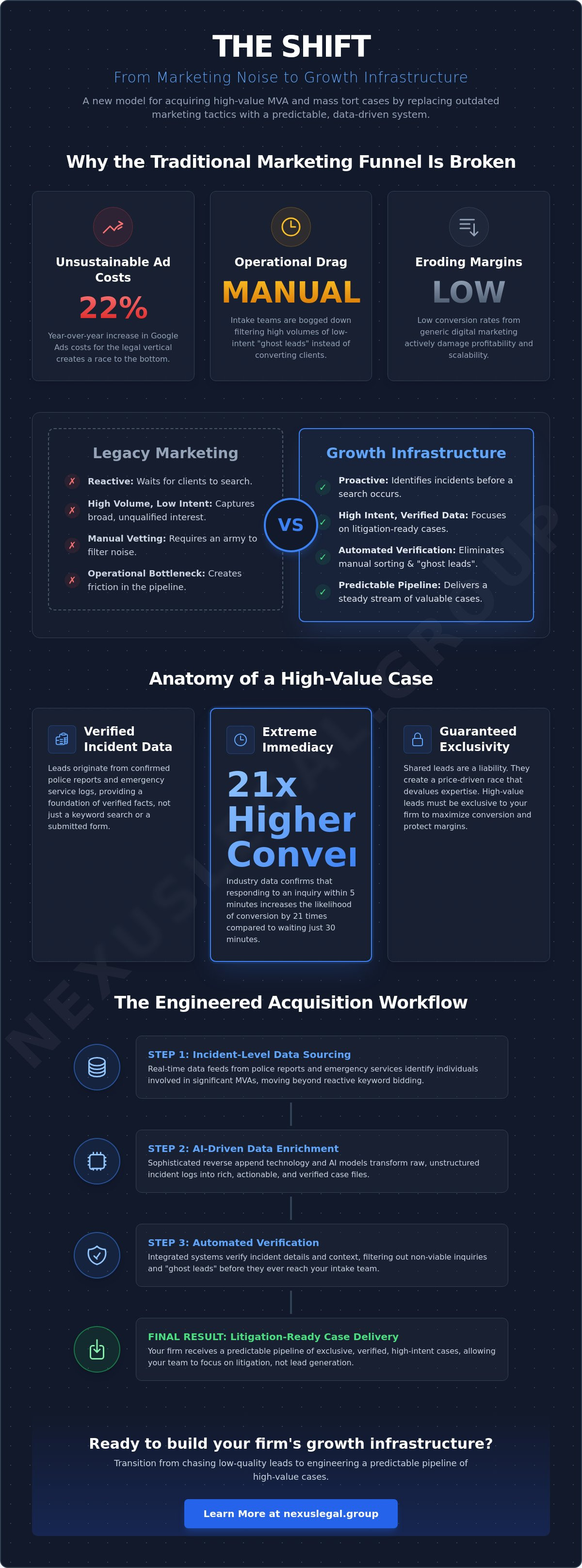
In 2026, the traditional law firm marketing model isn't just inefficient; it's an operational liability that's actively eroding your margins. With Google Ads costs in the legal vertical jumping 22 percent year over year, the pursuit of raw volume has become a race to the bottom. You've likely felt the strain of high overhead from manual intake vetting and the frustration of low conversion rates from generic digital marketing leads. It's clear that legacy tactics can't support the institutional scalability required by modern plaintiff firms.
You need a predictable stream of verified, high-intent MVA and mass tort cases that don't require an army of intake staff to filter. This guide details how elite firms are transitioning to a technical growth infrastructure for lead generation for trial lawyers. We'll explore the shift from broad digital inquiries to precise, incident-driven acquisition. By implementing data-backed systems and navigating new regulatory hurdles like California's SB 37, your firm can secure a pipeline of litigation-ready cases while significantly reducing friction in the intake-to-signed-case pipeline.
Key Takeaways
- Transition from high-volume marketing noise to a high-intent growth infrastructure that prioritizes the acquisition of litigation-ready cases.
- Utilize incident-level data from police reports and emergency services to optimize lead generation for trial lawyers through technical precision.
- Implement reverse append technology to enrich accident reports, ensuring your intake team has access to comprehensive, verified incident details.
- Reduce firm overhead and eliminate "ghost leads" by integrating automated verification systems into your intake-to-signed-case pipeline.
- Apply sophisticated acquisition frameworks to mass tort litigation to drive institutional growth while maintaining strict ethical and regulatory compliance.
Beyond Basic Inquiries: Redefining Lead Generation for Trial Lawyers
Most marketing agencies view Lead Generation as a top-of-funnel exercise in capturing interest. For an elite plaintiff firm, this definition is dangerously incomplete. In 2026, the delta between a "lead" and a "litigation-ready case" represents the difference between a scaling practice and an operational bottleneck. High-volume, low-intent digital noise forces your intake team to act as a filter rather than a conversion engine. Redefining lead generation for trial lawyers requires moving past generic inquiries and focusing on technical growth infrastructure that identifies case value before the first phone call occurs.
Elite firms are no longer satisfied with being "visible" in search results. They're looking for systemic certainty. This shift transforms lead acquisition from a variable marketing expense into a foundational layer of the firm's infrastructure. By prioritizing high-intent inquiries over raw click volume, you ensure that your trial practice remains focused on high-performance litigation rather than administrative sorting. It's about building a machine that delivers verified opportunities directly into your pipeline with clinical precision.
In addition to lead quality, systemic certainty requires safeguarding the firm's online standing. Content Removal provides the expertise needed to eliminate harmful online content, ensuring that a firm's digital authority remains unblemished as they scale.
The Shift from Marketing to Growth Infrastructure
Legacy digital marketing strategies, specifically traditional SEO and PPC, have reached a critical point of diminishing returns. With legal search queries seeing a 22 percent increase in average cost-per-click in the first quarter of 2026, buying your way to the top of the search results is no longer a sustainable strategy for every firm. Elite practices are pivoting toward intent-based data systems. This infrastructure-led approach doesn't just attract traffic; it identifies specific incidents before a potential client even starts their search. This transition moves the firm from reactive awareness to proactive acquisition, effectively neutralizing the operational friction caused by manual vetting. You can explore more about these systemic shifts at the Nexus Legal Group blog.
Anatomy of a High-Intent Trial Lead
What defines a case with genuine litigation potential? It isn't just a submitted form. It's a combination of verified incident involvement and extreme immediacy. Industry data confirms that firms responding to web inquiries within five minutes are 21 times more likely to convert that lead than those waiting just half an hour. High-intent lead generation for trial lawyers is built on verified data points, such as police report records or emergency service logs. For a trial practice to remain high-performance, these leads must be exclusive. Shared leads are an institutional liability; they create a price-driven race that devalues your expertise and significantly lowers your conversion rates.
Engineering Case Acquisition via Incident-Level Data
Transitioning from keyword-based bidding to incident-level engineering represents a fundamental shift in how high-performance firms operate. Traditional digital marketing relies on the hope that a qualified claimant will use the right search terms at the right time. This approach is reactive. By the time a potential client searches for a lawyer, they may have already been contacted by insurance adjusters or other firms. Instead, elite lead generation for trial lawyers focuses on behavioral and incident-based acquisition models that identify participants in high-impact motor vehicle accidents (MVA) through real-time data feeds, much like how real estate professionals use landvoice.com to identify high-intent property leads before they enter the general market.
The core of this infrastructure is the ability to move beyond broad keywords and into the mechanics of specific incidents. By leveraging AI-driven marketing, firms can identify individuals involved in significant collisions before they enter the traditional search funnel. This process involves sophisticated data enrichment, where raw incident logs are transformed into actionable case files. This ensures your acquisition strategy is built on the reality of the event rather than the volatility of search engine algorithms. To better understand how to navigate these algorithm shifts, check out Epic Web Results.
Sourcing Police Report Generated MVA Leads
Sourcing police report generated MVA leads provides a technical advantage that search queries cannot match. These reports confirm the date, location, and severity of an incident, alongside the identities of the parties involved. Unlike a generic web form, police report data provides a high degree of intent because it is rooted in a documented event. Integrating this data into your firm's workflow allows your intake team to initiate contact with context that builds immediate trust.
The Power of Emergency Services and Incident Data
The power of emergency services data lies in its immediacy and precision. Using reverse append technology, raw incident reports are enriched with verified contact information, turning a data point into a qualified inquiry. While this process is highly technical, it must remain ethical. Adhering to the rules of legal advertising is paramount to ensure every data point is utilized in a way that respects privacy laws and state bar requirements.
By engineering your case acquisition around these verified data points, you eliminate the guesswork associated with traditional marketing. You aren't just chasing clicks; you're acquiring specific cases where liability and damages are clearly indicated. Building this system with Nexus Legal Group allows you to bypass the noise of the open market and focus on what you do best: litigating high-value cases.
The Critical Role of Automated Intake and Verification
Manual vetting represents a significant cost center that erodes the profitability of even the most established firms. When lead generation for trial lawyers focuses solely on raw volume, it creates an administrative burden that slows down the entire organization. High-performance firms are now replacing manual filtering with automated verification systems. These tools act as a high-fidelity filter, ensuring that only litigation-ready inquiries reach your intake specialists. By eliminating ghost leads, which are those non-responsive or unqualified inquiries that clutter your CRM, you can focus your resources on cases with the highest potential for recovery.
Automated verification doesn't just save time; it improves the integrity of your entire data pipeline. By cross-referencing incoming inquiries with incident-level data and behavioral markers, these systems confirm the validity of a claim before a human ever picks up the phone. While digital systems handle initial screening, for cases requiring deeper investigation into witness or claimant credibility, firms can explore Criminal & Civil Case Polygraphs to ensure the highest standard of verification. This technical rigor reduces overhead and allows your team to operate with clinical precision, focusing on conversion rather than qualification. It's a foundational shift from reactive sorting to proactive acquisition.
Engineering the Automated Intake Workflow
Implementing automated intake for plaintiff firms requires a structured integration of AI and verification protocols. The process begins by deploying AI agents to qualify inquiries in real-time. These agents can ask complex, branching questions to determine liability and injury severity. Once an inquiry is qualified, the system integrates the verification data directly into your firm's case management software, such as Filevine. This seamless transition ensures that your attorneys have a complete, verified case profile the moment a lead is assigned. This level of automation is essential for maintaining a competitive edge in 2026, where the speed of data processing defines the limits of your growth.
Reducing Friction in the Intake-to-Signed-Case Pipeline
Responsiveness is the most critical factor in modern case acquisition. Automated systems allow you to meet the new 60-second rule by sending immediate, personalized texts and emails to engage claimants the moment they express interest. This rapid engagement has a profound psychological impact, positioning your firm as an authoritative and responsive institution. By reducing the friction between the initial inquiry and the signed retainer, you maximize your ROI on lead generation for trial lawyers and ensure a consistent flow of high-value cases into your practice.
Automation allows your firm to handle high-volume inquiries without sacrificing the quality of the client experience. It provides a scalable solution that grows with your firm, ensuring that your intake pipeline remains a well-oiled machine regardless of case volume. By removing manual bottlenecks, you empower your trial attorneys to spend their time on litigation rather than administrative vetting.
Strategic Mass Tort Acquisition for National Scalability
Scaling a mass tort practice requires more than just a higher marketing budget; it demands a shift from local visibility to a national, data-driven infrastructure. While MVA cases rely on immediate incident data, mass tort acquisition focuses on longitudinal exposure and complex behavioral markers. For elite firms, lead generation for trial lawyers in the mass tort space means identifying claimants who meet strict medical and exposure criteria before they're overwhelmed by generic class action advertisements. This precision ensures your firm isn't just collecting inquiries, but acquiring litigation-ready files that can withstand the technical scrutiny of multi-district litigation.
In 2026, the distinction between raw inquiries and signed cases has become the defining factor in firm profitability. Elite practices are moving away from the "lead" model entirely, opting instead for the acquisition of fully vetted, signed cases. This approach eliminates the administrative burden of chasing unverified claimants and allows your attorneys to focus on the legal mechanics of the litigation. By building a growth infrastructure that prioritizes high-intent data, you create a scalable system that supports institutional expansion without the typical overhead associated with mass tort intake.
Acquiring Exclusive Mass Tort Claimant Leads
Success in complex litigation depends on the quality and exclusivity of the claimant pool. By utilizing behavioral data analysis, firms can identify individuals likely affected by specific pharmaceutical or environmental hazards based on their digital and real-world footprints. This process must be rooted in compliant legal lead generation to navigate the increasingly strict regulatory environment. Unlike class action leads, which often target broad groups for smaller settlements, high-value mass tort claims require a technical approach that verifies individual injury and causation early in the acquisition phase. Exclusivity is non-negotiable; shared leads in mass torts lead to a race that devalues the claim and increases your acquisition costs.
Operational Metrics for Mass Tort Success
To achieve national scalability, firms must look past the cost-per-lead and focus on the cost-per-signed-case (CPSC) as their primary growth metric. This figure provides a transparent view of the efficiency of your growth infrastructure. Mass torts are long-term investments, and your acquisition system must support this timeline by ensuring every inquiry is litigation-ready from day one. This technical rigor prevents your firm from carrying the weight of non-viable files for years. High-performance firms use data-backed acquisition to ensure their pipeline is filled with cases that have a high probability of successful resolution. You can contact Nexus Legal Group today to discuss how we can engineer a national mass tort acquisition strategy for your firm.
Nexus CaseFlow: The Growth Infrastructure for Elite Trial Firms
Nexus Legal Group doesn't just provide leads; we engineer the law firm growth infrastructure necessary for elite trial lawyers to dominate their markets. Our approach to lead generation for trial lawyers is built on the integration of AI-driven precision and real-world incident verification. By removing the guesswork from case acquisition, we allow firms to operate as high-performance institutions rather than reactive marketing entities. Nexus CaseFlow represents the culmination of this technical evolution, offering an end-to-end system designed to eliminate the inefficiencies of traditional digital marketing. This infrastructure acts as a foundational layer for your practice, providing the technical certainty required to scale in an increasingly competitive environment.
This sophisticated platform moves beyond broad-spectrum outreach to focus on the technical mastery of the intake-to-signed-case pipeline. We've built a system that prioritizes clinical precision over raw volume, ensuring that every resource your firm spends is directed toward high-potential litigation. By institutionalizing your acquisition process, you can focus on the legal mechanics of your cases while our engine drives consistent, predictable growth from behind the scenes.
Litigation-Ready Inquiries Delivered with Precision
We utilize a proprietary stack that leverages police reports and emergency services data to identify participants in high-impact accidents with surgical accuracy. By applying reverse append technology, we enrich raw incident data with verified contact details, which are then processed through our automated verification engine. This ensures every inquiry delivered to our partners is litigation-ready before it ever reaches your intake team. Exclusivity is a core pillar of our model; we never share or resell inquiries. This protection of your pipeline integrity is vital for maintaining the high conversion rates that elite practices demand. You won't find yourself in a price-driven race with five other firms for the same claimant.
Institutionalizing Your Firm Growth
Transitioning from manual marketing management to an automated growth engine is the final step in securing your firm's future. Nexus Legal Group provides the technological backbone for national scalability, whether you're focusing on high-stakes MVA cases or complex mass tort litigation. Our infrastructure allows you to scale your practice without a linear increase in administrative overhead. It provides the predictability and data-backed insights required for long-term institutional expansion. This methodical approach ensures your firm is grounded in the practical, rigorous realities of high-volume litigation management. Take the next step toward High-Intent MVA Case Acquisition and replace your traditional marketing with a high-performance growth engine that delivers results with clinical precision.
Institutionalizing High-Intent Case Acquisition
The transition from legacy marketing to a sophisticated growth infrastructure is the defining shift for plaintiff firms in 2026. Institutional scalability now depends on your ability to bypass generic digital noise and secure inquiries rooted in real-world incident data. By refining your lead generation for trial lawyers to include police report and emergency services data enrichment, you ensure your intake pipeline is filled with high-intent opportunities. This technical precision reduces firm overhead and allows your trial team to focus on litigation rather than manual vetting, maintaining the sharp edge and mental toughness often developed in high-performance training environments like Sin City Krav Maga & Fitness.
Nexus Legal Group acts as the strategic architect for this transition. Our systems combine AI-driven marketing precision with a rigorous automated verification process to deliver exclusive, litigation-ready inquiries directly to your firm. This end-to-end acquisition framework is designed to support both MVA and mass tort practices on a national scale. It's time to move beyond the volatility of traditional search ads and invest in a predictable case acquisition engine. Secure your litigation-ready case flow with Nexus Legal Group to institutionalize your growth and protect your firm's operational margins. You've built a powerful practice; now it's time to give it the infrastructure it deserves.
Frequently Asked Questions
What is the difference between legal lead generation and case acquisition?
Legal lead generation typically refers to the broad process of capturing interest from prospective clients through digital marketing channels. Case acquisition is a more rigorous, technical framework that delivers a verified, litigation-ready file. While traditional lead generation focuses on raw volume, case acquisition prioritizes high-intent data to ensure every inquiry meets specific liability and injury criteria before it reaches your firm.
How does police report data improve the quality of MVA leads?
Police report data provides an objective, third-party verification of the facts surrounding a motor vehicle accident. By sourcing data directly from incident records, firms can confirm liability, the severity of the collision, and the identities of all involved participants. This technical precision eliminates the guesswork of self-reported web forms and ensures that your lead generation for trial lawyers is built on documented evidence rather than speculative inquiries.
Is automated intake ethical and compliant with legal advertising standards?
Automated intake is fully ethical when it's designed to adhere to the ABA Model Rules and state-specific regulations. For example, systems must comply with California's SB 37, which requires clear office address disclosures and prohibits misleading claims about guaranteed outcomes. A compliant system acts as a neutral data collector, ensuring that all communications are transparent while maintaining the attorney's strict liability for third-party marketing content.
Why should trial lawyers prioritize exclusive leads over shared inquiries?
Shared inquiries create a price-driven race to the bottom that devalues your legal expertise and significantly erodes your conversion rates. When multiple firms contact the same claimant, it creates consumer fatigue and reduces the likelihood of a signed retainer. Exclusive leads protect your firm's margins and allow your intake team to build a foundation of trust without the pressure of competing against four other callers for the same case.
How does reverse append technology help in identifying accident participants?
Reverse append technology utilizes specific data points from raw incident logs, such as partial names or vehicle details, to cross-reference against comprehensive consumer databases. This process enriches a basic incident report with verified contact information, including phone numbers and physical addresses. It turns a fragmented data point into a qualified inquiry, allowing your firm to initiate contact with the precision required for high-stakes lead generation for trial lawyers.
Can lead generation infrastructure scale for both MVA and mass tort cases?
The core infrastructure of high-intent data and automated verification is highly scalable across different practice areas. While MVA acquisition relies on immediate incident data, mass tort acquisition utilizes similar behavioral and exposure markers to identify qualified claimants on a national level. The underlying technology remains consistent; it simply adapts the data sourcing and vetting protocols to meet the specific medical or liability requirements of the litigation.
What metrics should a trial lawyer track to measure lead generation ROI?
Trial lawyers should move past surface-level metrics like cost-per-click and focus on the cost-per-signed-case (CPSC). This figure provides the most accurate reflection of your growth infrastructure's efficiency. Additionally, you should track your speed-to-lead engagement time and the conversion rate from verified inquiry to signed retainer. These data points allow you to identify operational bottlenecks and ensure your acquisition budget is driving institutional growth.
How does automated verification reduce firm overhead?
Automated verification acts as a high-fidelity filter that eliminates "ghost leads" and non-responsive inquiries before they reach your staff. This technical vetting reduces the administrative burden on your intake team, allowing them to focus their energy on converting high-value cases. By removing the need for manual qualification of raw inquiries, your firm can scale its case volume without a proportional increase in personnel costs or administrative friction.