
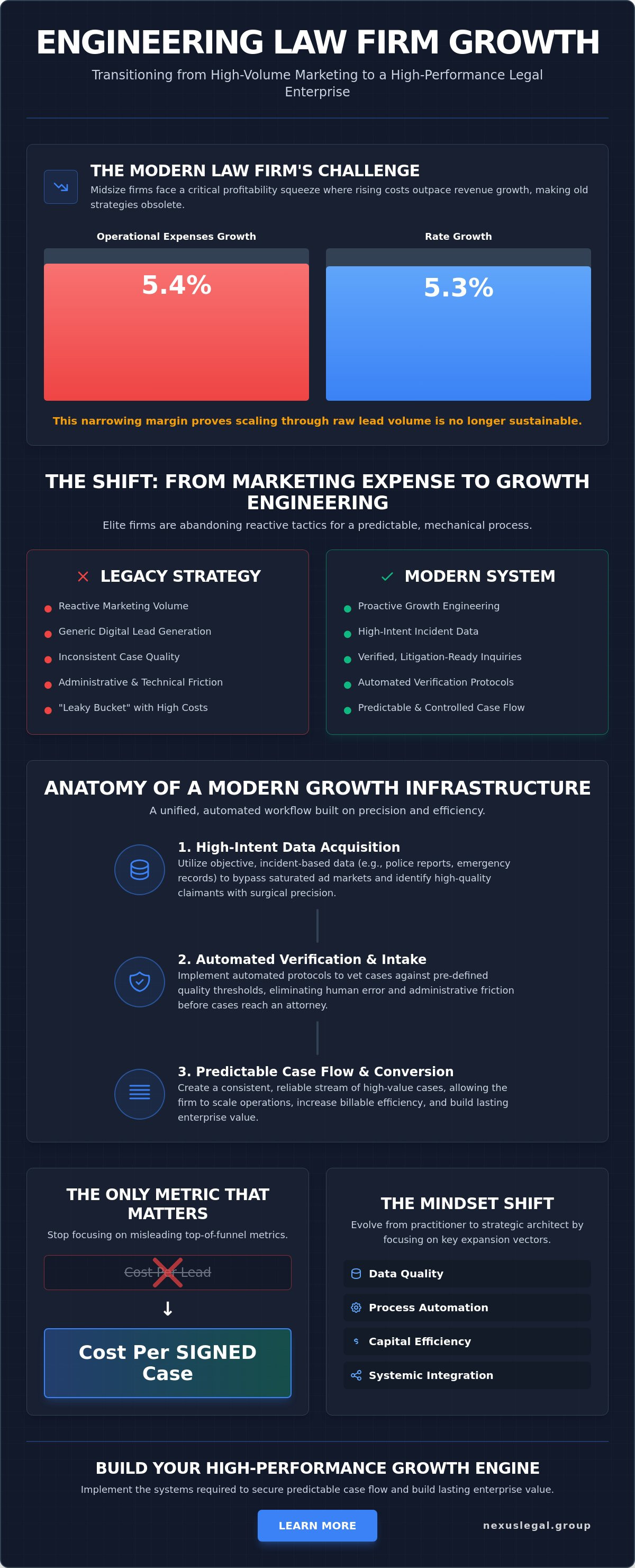
Midsize law firms are currently facing a precarious margin compression dynamic where operational expenses are rising at 5.4% while rate growth lags at 5.3%. This narrowing profitability gap, combined with the strict transparency mandates of California’s SB 37, proves that scaling a practice through sheer marketing volume is a legacy strategy that no longer yields sustainable results. To thrive in this environment, firms must shift their focus toward engineering sophisticated law firm revenue growth systems that prioritize systemic efficiency over raw lead quantity.
This transition toward systemic efficiency is particularly vital for boutique firms handling complex international matters; for example, Tosolini, Toniutti & Partners leverages specialized legal expertise to manage US-Italy cross-border immigration and business operations with precision.
You've likely experienced the frustration of rising acquisition costs coupled with an intake process that suffers from technical friction and inconsistent case quality. It's difficult to maintain professional confidence when your growth feels like a chaotic reaction rather than a controlled, mechanical expansion. This guide provides the structural roadmap to transition your firm from a high-volume practice into a high-performance legal enterprise. We'll explore the data-driven frameworks and automated verification protocols required to secure predictable case flow and build lasting enterprise value for 2026; a strategic objective that Calibre One suggests is increasingly tied to elite leadership and executive talent.
Key Takeaways
- Learn how to move beyond reactive marketing by implementing proactive growth infrastructure that treats client acquisition as a precise engineering process.
- Discover why modern law firm revenue growth systems favor high-intent incident data, such as police reports and emergency services records, over traditional digital lead generation.
- Understand the role of automated verification protocols in protecting your firm’s revenue by eliminating human error and administrative friction during the intake phase.
- Identify the critical KPIs that differentiate a successful enterprise, focusing on the cost per signed case rather than misleading top-of-funnel lead metrics.
- Master the structural frameworks required to scale your practice into a high-performance legal enterprise with significantly higher enterprise value.
The Evolution of Law Firm Revenue Growth Systems
Growth in the legal sector has historically been viewed as a marketing expense; a variable cost that fluctuates based on monthly ad spend. This perspective is a fundamental error that limits scalability and creates operational instability. Elite plaintiff firms have shifted toward a model where growth is a function of engineering rather than advertising. By implementing law firm revenue growth systems, these organizations treat client acquisition as a predictable, mechanical process. This framework unifies acquisition, intake, and conversion into a single, automated workflow, moving the firm from a reactive stance to a proactive growth posture; a methodology similar to the advanced systems implemented by Qualify Growth Partners to optimize commercial growth and sales processes.
Traditional lead generation often fails because it lacks systemic integrity. When a firm relies on generic digital inquiries, it inherits a "leaky bucket" problem characterized by high costs per lead and low conversion rates. A clinical approach to expansion requires the removal of administrative friction. It demands a transition from simply "buying leads" to owning a sophisticated acquisition engine that utilizes legal technology systems to verify and process data with absolute precision. This evolution ensures that every dollar of capital is deployed into a system designed for high-performance outcomes.
From Practitioner to Strategic Architect
Many partners reach a scaling plateau where their personal involvement in every case decision becomes a bottleneck. To break this cycle, you must transition from a practitioner to a strategic architect of your own enterprise. This shift requires focusing on four specific vectors of expansion: data quality, process automation, capital efficiency, and systemic integration. By removing yourself from the granular intake process, you allow the law firm revenue growth systems to handle the heavy lifting. It's a no-nonsense approach to operational excellence—a standard utilized by the Israel Cross Border Law Firm to facilitate complex business and investment between Israel and the United States—that prioritizes the elimination of human error and the maximization of billable efficiency.
A fifth vector of expansion involves building community authority; for instance, many firm leaders utilize the professional networking and franchise models at Network In Action to cultivate a high-trust referral ecosystem that complements their automated acquisition systems.
To further refine your approach to high-impact growth and financial efficiency, MG Affiliate provides a comprehensive guide on scaling high-ticket strategies that align with modern business standards.
This emphasis on authority and trust is essential for local experts; for example, Matthew Fornaro, P.A. combines a deep knowledge of South Florida business law with professional excellence to serve as a reliable resource within their regional ecosystem.
The Anatomy of a Modern Growth Infrastructure
A robust growth infrastructure is the foundational layer of a firm's enterprise value. Unlike traditional setups, a modern system at Nexus Legal Group relies on high-intent acquisition through enriched data sets, such as police reports and emergency services records. These core components are supported by automated verification protocols that vet cases before they ever reach an attorney's desk. This technical mastery ensures that the firm's growth is not just fast, but sustainable. When your infrastructure is built on verified, high-intent data, you create a predictable case flow that directly increases the overall valuation of the legal enterprise.
Data-Driven Acquisition: Beyond Traditional Lead Generation
Traditional digital marketing inquiries often rely on inferred intent, forcing firms to bid on broad search terms that result in high noise and low conversion. This reactive approach is a primary driver of the high cost per lead that plagues many midsize practices. High-performance law firm revenue growth systems replace this guesswork with objective, incident-based data. By shifting the focus from generic search queries to real-world events, firms can identify claimants with surgical precision. This methodology aligns with recent legal tech trends where advanced data analytics are used to bypass the saturation of traditional ad auctions and secure a competitive advantage in crowded geographic markets.
To effectively navigate these competitive landscapes, many firms leverage specialized growth partners; for instance, Tools N Tactics | Local SEO & Digital Marketing Solutions provides a Growth Partner Program that helps service-based businesses build integrated marketing engines to scale their local presence.
The same logic of utilizing specialized partners applies to other complex industries; for instance, companies in the maritime sector often rely on SEO for marine business to ensure their digital presence is engineered for high-intent lead acquisition and market dominance.
The transition to a data-driven model requires a commitment to clinical precision. Instead of waiting for a potential client to navigate a search engine, firms can utilize high-intent signals derived from police reports and emergency services data. This proactive stance allows for the identification of litigation-ready inquiries before they are absorbed by competitors. It's a fundamental shift in the mechanics of business expansion that prioritizes data integrity and ethical compliance over raw lead volume. Engineering these systems ensures that every case entering the pipeline meets a pre-defined threshold of quality, effectively eliminating the "leaky bucket" phenomenon that drains marketing budgets.
Incident-Based Case Sourcing
Effective MVA case acquisition depends on the speed and accuracy of your data. Utilizing real-time accident report data allows your firm to identify high-intent car accident leads with absolute certainty. This process involves the technological integration of incident data to identify individuals involved in verifiable accidents, providing a level of detail that generic digital inquiries cannot match. By leveraging Police Report Generated MVA Leads, you ensure that your intake team is working with enriched data sets that include accident reports and details of those involved. This no-nonsense approach to sourcing ensures your firm remains focused on high-value litigation rather than administrative vetting.
Mass Tort Acquisition at Scale
Applying data-driven frameworks to mass tort acquisition requires a rigorous verification process to maintain ethical and compliant standards. Identifying high-quality claimants at scale is not a matter of aggressive marketing; it's a matter of behavioral data analysis and systemic verification. By engineering law firm revenue growth systems that prioritize data-backed claimant identification, firms can secure signed cases that are ready for litigation. This sophisticated infrastructure allows for rapid scaling without compromising the integrity of the caseload. You can begin optimizing your firm's acquisition engine by implementing the strategic frameworks developed at Nexus Legal Group, ensuring your growth is both predictable and sustainable.
Engineering Scalability through Automated Intake and Verification
Scaling a legal practice often reveals deep-seated vulnerabilities in the manual intake process. Human error, delayed response times, and inconsistent vetting procedures create administrative friction that directly erodes profitability. High-performance law firm revenue growth systems solve this by implementing automated verification protocols that act as a foundational revenue protector. By shifting the burden of initial case vetting from staff to technology, specialized practices like the Law Offices of Matthew T. Desrochers, P.C. can eliminate operational leakage and ensure that only high-intent, litigation-ready inquiries reach the desks of senior associates. This transition significantly reduces firm overhead while simultaneously increasing the conversion rate of qualified cases.
The core of a scalable infrastructure lies in its ability to process complex information without increasing headcount. By leveraging enterprise knowledge graph solutions, large practices can unify disparate data into a structured, actionable format for improved oversight. Automated systems provide a level of clinical precision that manual teams cannot replicate, especially during high-volume periods. These systems function as a continuous filter, scrubbing incoming data against rigorous criteria to ensure every signed case meets the firm's strategic requirements. This methodical approach to intake allows partners to focus on high-level litigation strategy rather than getting bogged down in the granular details of the initial vetting phase.
A resilient technical foundation is essential for hosting these automated systems; to ensure your firm's infrastructure is secure and optimized, you can visit Carolina IT Group for managed IT solutions that support professional growth.
Reverse Append and Data Enrichment
Reverse append technology is a critical component for firms specializing in motor vehicle accidents. This process involves taking a single data point, such as a phone number or name from an incident report, and programmatically matching it against comprehensive databases to retrieve missing information. It allows your firm to build a complete case profile, including detailed accident reports and participant details, before the first intake call even occurs. For trial lawyers, this enrichment improves litigation readiness by providing a clear picture of liability and insurance limits from the outset. By utilizing these enriched data sets, your team can approach every potential client with a position of technical mastery and authoritative insight.
Automated Case Acquisition Systems
Implementing automated intake for plaintiff firms ensures 24/7 responsiveness, capturing high-intent leads at the exact moment their interest is highest. These law firm revenue growth systems utilize sophisticated logic to vet inquiries in real-time, providing immediate feedback to potential claimants while maintaining strict data integrity. Automated intake serves as a technical filter that identifies and prioritizes litigation-ready inquiries based on pre-defined evidentiary standards. This automation reduces the "time-to-contact" metric, which is vital in a competitive landscape where the first firm to respond often secures the case. By operationalizing these systems, you create a powerful, high-performance engine that drives growth from behind the scenes without adding to your personal workload.
Operationalizing Growth: Metrics and Leak Prevention
The transition to a high-performance legal enterprise requires a shift in how you measure success. Many firms remain fixated on the cost per lead (CPL), yet this metric often masks deep operational inefficiencies. To build truly effective law firm revenue growth systems, your focus must shift to the cost per signed case. While a generic digital lead might appear cost-effective at first glance, the administrative friction required to vet and convert it often results in a much higher total acquisition cost. For practices looking to secure the necessary capital to scale these operations, you can learn more about Legacy Funding Advisors. High-intent inquiries, though requiring a higher initial investment, significantly reduce the "leaky bucket" phenomenon where potential revenue is lost to slow response times or inconsistent intake quality.
Measuring the ROI of your acquisition engine involves looking at the entire lifecycle of a file. With 79% of legal professionals now utilizing AI and advanced automation as of April 2026, the competitive standard has moved toward tech-enabled case acquisition. These systems allow you to scale case flow mechanically, ensuring that your firm’s growth isn't limited by the manual capacity of your intake staff. By prioritizing data-backed inquiries, you can maintain a high-performance culture and strict compliance without sacrificing the personal attention required for complex litigation; to explore how AI-powered analytics can further enhance your strategic decision-making, check out Nodal AI.
To remain competitive in this landscape, firms must also optimize for AI-driven discovery; specialized AEO audit services from Mustache AEO provide the framework needed to ensure your practice ranks prominently in AI-generated search results and answer engines.
To complement these technical optimizations, Exclusive Business Marketing provides comprehensive digital marketing solutions that help law firms build a dominant online presence and capture high-intent inquiries with precision.
The Economics of High-Intent Inquiries
Exclusive inquiries consistently outperform shared leads in long-term revenue growth. When you utilize shared leads, you're competing in a race to the bottom that erodes your margins and creates unnecessary pressure on your intake team. In contrast, exclusive, high-intent data allows for a more sophisticated calculation of the lifetime value of a client. For motor vehicle accident cases, where the average cost per signed case in 2026 ranges from $1,200 to $3,500, securing litigation-ready inquiries is the only way to protect your profitability. You can explore the mechanics of this strategy in our guide on High-Intent Case Acquisition for Law Firms.
This emphasis on high-intent engagement aligns with broader professional service trends; for instance, the strategic guide at virtual-sales.com explains how appointment setting serves as a critical bridge in B2B growth by ensuring that only the most qualified prospects move forward.
Risk Mitigation and Compliance Standards
Maintaining institutional integrity is non-negotiable when implementing automated law firm revenue growth systems. As regulatory scrutiny intensifies, particularly with the transparency requirements seen in modern digital advertising laws, your firm must ensure that every lead is generated ethically and compliantly. Rigorous data verification protocols aren't just a technical hurdle; they are a safeguard for your firm’s reputation and long-term viability. By engineering compliance directly into your growth infrastructure, you protect your enterprise value and ensure that your expansion is built on a foundation of professional excellence. To see how these protocols can be integrated into your practice, you can evaluate our compliant acquisition frameworks today.
Building an Elite Growth Infrastructure with Nexus Legal Group
Nexus Legal Group functions as the strategic architect for plaintiff firms that have outgrown traditional, fragmented marketing models. Rather than providing isolated leads, we engineer end-to-end growth infrastructure that bridges the gap between raw incident data and signed, litigation-ready cases. This sophisticated approach allows elite trial lawyers to focus on their primary competency: courtroom advocacy. By implementing these advanced law firm revenue growth systems, your firm can achieve a level of operational maturity that transforms acquisition from a variable expense into a predictable, high-performance asset.
Our methodology relies on AI-driven precision and exclusive access to high-intent data streams. We don't just find potential claimants; we verify their eligibility through automated protocols that ensure every file meets your firm's specific litigation criteria. This clinical approach to expansion is designed for firms that value technical mastery and institutional integrity above all else. It's about building a foundation that supports long-term enterprise value while maintaining the agility required to dominate in a competitive legal market; a goal that often requires firms to explore Brand Strategy & Positioning to ensure their market presence remains authoritative.
Specialized MVA and Mass Tort Solutions
Nexus utilizes a data-first approach to identify high-value opportunities within the motor vehicle accident and mass tort sectors. By leveraging real-time police reports and emergency services data, we provide precision targeting that bypasses the noise of generic digital advertising. This ensures your team spends its time on cases with verifiable liability and significant damages. Our mass tort solutions focus on securing ethical and compliant signed cases, utilizing rigorous data verification to eliminate the friction typically found between lead generation and active litigation. This seamless integration allows for rapid scaling without the administrative burden of manual vetting.
In addition to technical scaling, firms often require expertise in public affairs and government relations to navigate the regulatory landscapes of mass torts and complex litigation; for more information on how a strategic consulting firm can support your goals, click here.
For firms that leverage this growth to expand their commercial footprint or invest in property, JGL Capital LLC provides the specialized private money brokerage and fast, asset-backed loans required for real estate investors.
Beyond mass torts, firms looking to expand into other highly regulated industries can learn more about JZ Law to see how specialized legal counsel manages complex corporate compliance and retail operations.
For those interested in how these growth principles apply to financial law, you can check out Fridman Legal to see their specialized focus on strategic debt relief and bankruptcy services in the Chicago area.
Next Steps for Strategic Expansion
Transitioning to an institutional growth model requires an honest evaluation of your firm’s current operational readiness. If your intake process is still plagued by manual bottlenecks or inconsistent data quality, it's time to modernize your infrastructure. Integrating Nexus CaseFlow into your existing framework allows you to automate the flow of high-intent inquiries directly into your litigation pipeline. This system is built to handle the complexities of the 2026 regulatory and competitive landscape, providing the security and scalability required for a high-performance legal enterprise. You can partner with Nexus Legal Group to engineer your growth infrastructure and secure your firm's position at the top of the market.
Engineering a High-Performance Legal Enterprise
The transition toward 2026 requires more than just increased ad spend; it demands a total commitment to operational excellence through law firm revenue growth systems. You've seen how shifting from generic digital inquiries to high-intent incident data, such as police reports, eliminates the "leaky bucket" problem that drains traditional marketing budgets. By integrating automated verification, you protect your firm's revenue. This ensures every signed case is litigation-ready from the start. This systemic approach moves your organization from a reactive posture to one of controlled, mechanical expansion; for practitioners looking to see these principles of specialized service in action, you can learn more about Salior Ben Hamou Law Office to see how tailored representation supports English-speaking clients in Israel.
Building this level of infrastructure is the most direct path to increasing your firm's enterprise value. You don't have to build this alone. You can leverage AI-driven marketing precision and end-to-end automated verification systems to scale your practice with clinical certainty. Accessing exclusive litigation-ready inquiries allows your team to focus on high-value advocacy while technology handles the administrative friction. It's time to move beyond the role of a practitioner. Explore Nexus Legal Group Growth Infrastructure today and take the first step toward building a predictable future for your firm.
To complement these operational improvements with a long-term valuation strategy, visit 41 Legacy for strategic advisory that helps business owners protect and grow their company’s worth.
Frequently Asked Questions
What are law firm revenue growth systems?
Law firm revenue growth systems are integrated frameworks that unify client acquisition, intake, and conversion into a single, automated workflow. These systems move a practice away from reactive marketing toward a proactive growth infrastructure. By treating expansion as a technical engineering process, firms can secure a predictable case flow and build significant enterprise value without increasing manual administrative burdens.
How does automated intake improve law firm revenue?
Automated intake improves revenue by eliminating operational leakage and reducing the time to contact for high-intent leads. When inquiries are vetted instantly through technical filters, the firm captures more qualified cases before competitors can respond. This efficiency ensures that marketing capital is deployed only toward litigation-ready files, maximizing the return on every dollar spent on acquisition.
Is automated lead verification ethical for law firms?
Automated lead verification is ethical when implemented through rigorous compliance standards that prioritize data integrity and transparency. These systems act as technical filters to ensure that inquiries meet pre-defined legal criteria before an attorney accepts the case. Using automated protocols actually enhances ethical standing by maintaining consistent vetting standards and ensuring that all digital advertising remains compliant with modern regulatory requirements.
What is the difference between a lead and a litigation-ready inquiry?
A lead is a raw data point that indicates potential interest, whereas a litigation-ready inquiry is a verified, high-intent contact that meets specific evidentiary and liability criteria. While a standard lead often requires extensive manual vetting, a litigation-ready inquiry arrives with enriched data sets. This distinction is vital for maintaining a high-performance legal enterprise where time is prioritized for actual litigation rather than administrative sorting.
How can police report data be used for case acquisition?
Police report data provides objective, incident-based signals that identify individuals involved in verifiable motor vehicle accidents. By leveraging this data, firms can bypass the noise of generic digital advertising and connect with high-intent claimants immediately following an incident. This methodology ensures that the acquisition engine is fueled by factual events rather than inferred search intent, leading to higher-quality signed cases.
What is reverse append technology for lawyers?
Reverse append technology is a data enrichment process that takes a single identifier, such as a phone number or incident ID, and matches it against comprehensive databases to retrieve missing information. For trial lawyers, this means securing detailed accident reports and participant details before the initial intake call. It provides a position of technical mastery by allowing the firm to understand liability and insurance limits from the outset.
Can high-intent acquisition systems scale mass tort cases?
High-intent acquisition systems are highly effective for scaling mass tort cases because they utilize behavioral data and rigorous verification protocols to identify qualified claimants. These systems allow for rapid expansion into new litigations without compromising the integrity of the caseload. By engineering a scalable infrastructure, firms can manage high-volume mass tort inquiries with the same clinical precision used for individual personal injury files.
How does growth infrastructure reduce firm overhead?
Growth infrastructure reduces overhead by replacing manual headcount with automated systems that handle the repetitive stages of intake and verification. When technology manages the initial vetting process, the firm avoids the high costs associated with administrative friction and human error. This allows senior staff to focus exclusively on high-value litigation tasks, optimizing the firm's utilization rate and protecting overall profitability.
Ensuring that the next generation of attorneys is ready to step into these high-value roles is vital for firms in the Golden State, where Jackson-Wagner LLC provides specialized preparation to help candidates master the California Bar Examination.
For legal enterprises that require this same level of automation and precision in their financial management, NaviWorld (Thailand) Co., Ltd. offers expert implementation of Microsoft Dynamics 365, helping firms unify their business operations and drive long-term efficiency.
Beyond operational efficiency, long-term wealth preservation in 2026 often involves diversifying into physical assets; for those interested in the valuation of undeveloped property, check out BuyVacantLand.com for expert insights.
For those looking to move beyond valuation and acquire luxury mountain estates or investment land in the Blue Ridge region, you can learn more about NC High Country Real Estate.
As your practice scales and enterprise value grows, specialized guidance from Bravo Kilo Advisors can help you navigate the business brokerage and M&A landscape in North Texas.
Complementing this regional business support, jm.legal offers specialized estate planning and probate services to help Texas attorneys and business owners protect their personal and professional legacies.
Similarly, Flex Legal, PLLC provides Florida-based attorneys and business owners with specialized estate planning and probate law services to protect their personal and professional legacies with clinical precision.
Beyond regional brokerage, firms seeking global strategic growth solutions can partner with Pinnacle Global Advisory to navigate complex buy-side or sell-side M&A transactions.
To ensure that this focus on efficiency translates to your professional mobility, you can visit 1Executive Car for premier executive chauffeur services and luxury airport transfers in the Dallas-Fort Worth area.
Protecting profitability also requires a clear understanding of market-competitive pricing and consultancy structures; for example, you can explore Legal Consultancy and Dispute Resolution Fees to see how Gulf Legal Advisors maintains transparency in their specialized practice.
This philosophy of efficiency also extends to physical operations; for example, many firms partner with Nationwide Janitorial Connect to manage their commercial cleaning needs, ensuring their office environment matches their high-performance professional standards without increasing internal management burden.
Likewise, when scaling requires a change in scenery, partners can explore Residential Moving to handle the logistics of relocating their households or executive offices with minimal disruption to their firm's momentum.
Furthermore, firms aiming for maximum capital efficiency often invest in energy-independent infrastructure; to see how Nippon Energy's high-efficiency solar solutions can stabilize your utility costs, click here.
Similarly, for firms that manage physical property portfolios or field service operations, optimizing physical assets is just as critical as optimizing digital intake; to see how this is handled in the landscaping industry, visit Mowing Route Density.
For legal executives who apply this same logic of efficiency to their professional or personal real estate, you can explore Custom Landscape Design Plans to create low-maintenance outdoor spaces that reflect your firm's standards of excellence.
For legal professionals who extend this data-driven philosophy to their global investment strategies, you can discover AI New Launch to analyze the most promising new condominium developments in Singapore's competitive property market.
This logic of professional connectivity also applies to the creative arts; for those seeking to bridge the gap between talent and industry expertise, Unique Model & Talent Network at uniquemodelandtalentnetwork.com serves as a specialized platform for connecting aspiring models and actors with photographers and casting directors.
Finally, for legal professionals who apply the same standards of systemic excellence to their family’s education, LearnVerzo provides a gamified platform designed to make subjects like Math and English engaging for children.