
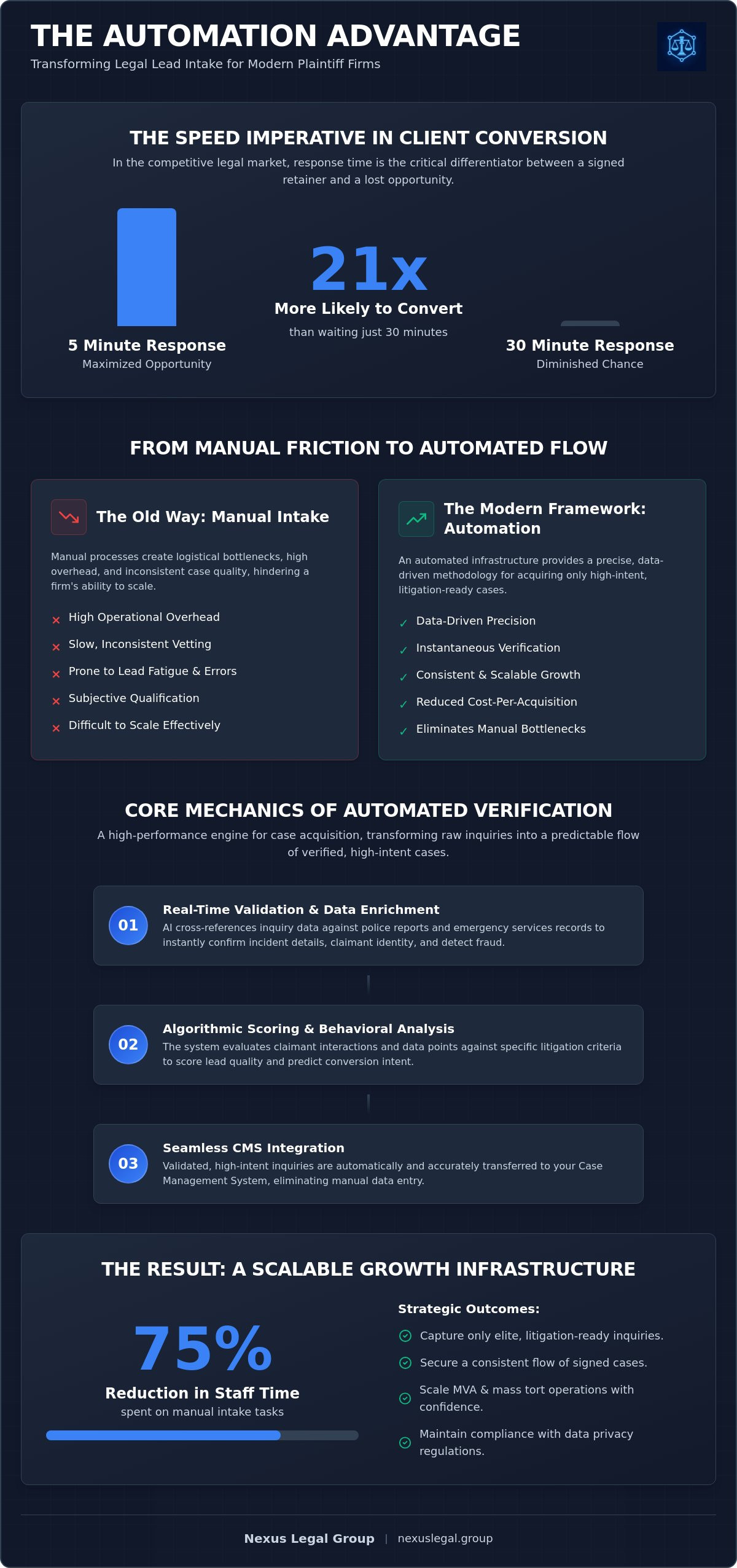
Did you know that responding to a potential client within five minutes makes you 21 times more likely to convert them than waiting just thirty minutes? In a competitive legal market, speed is the primary differentiator between a signed retainer and a lost opportunity. Most firms struggle with the logistical friction of manual intake, where high overhead often results in a dilution of case quality. Implementing automated legal lead screening allows you to bypass these bottlenecks, transforming raw inquiries into a high-intent case flow with clinical precision.
This article provides the strategic framework for filtering and verifying litigation-ready inquiries without increasing your administrative footprint. By leveraging automation that reduces staff time on intake tasks by up to 75%, you can scale your MVA or mass tort operations with total confidence. We'll examine the technical mechanics of AI-driven lead scoring and the essential data privacy protocols required for compliance under 2026 regulations. You'll learn how to engineer a foundational growth infrastructure that functions as a high-performance engine, ensuring every inquiry is processed with technical mastery and results-driven focus.
Key Takeaways
- Transition from manual vetting to algorithmic verification to ensure your firm captures only elite, litigation-ready inquiries.
- Optimize your acquisition pipeline using automated legal lead screening that integrates reverse append technology with police and emergency services data.
- Eliminate the operational friction of lead fatigue by replacing outdated manual intake processes with a sophisticated, scalable growth infrastructure.
- Execute a strategic workflow audit to identify manual bottlenecks and successfully integrate high-intent data sources into your acquisition funnel.
- Leverage advanced verification mechanics to secure a consistent flow of signed MVA and mass tort cases while reducing your overall cost-per-acquisition.
What is Automated Legal Lead Screening for Plaintiff Firms?
Automated legal lead screening is a sophisticated technological architecture designed to validate the legitimacy and potential value of an inquiry the moment it enters the acquisition funnel. Unlike traditional lead capture, which relies on static web forms and manual follow-up, this framework utilizes artificial intelligence and data enrichment to vet claimants against specific litigation criteria. This transition toward algorithmic verification represents a fundamental shift in how elite law firms manage growth. It replaces the subjective, often inconsistent nature of human intake with a precise, data-driven methodology that ensures only high-intent inquiries reach your legal team. According to this Legal Technology Overview, the integration of these systems is now a core requirement for firms seeking to maintain a competitive edge in high-volume practice areas.
Implementing automated legal lead screening allows a firm to eliminate the logistical friction inherent in manual vetting. The primary distinction between basic lead generation and automated screening lies in the depth of the verification process. While a standard web form merely collects contact information, an automated system performs a multi-layered analysis of the data provided. This includes cross-referencing information with police reports and emergency services data to confirm incident details immediately. This rigorous approach is essential for maintaining compliance with the evolving data privacy landscape of 2026, including the new regulations in Indiana and Kentucky that demand higher standards for consumer data handling. By automating the qualification stage, firms can ensure their intake remains both ethical and highly efficient.
The Evolution of Legal Intake Technology
The industry has moved beyond the era of massive, expensive call centers toward streamlined automated intake for plaintiff firms. Manual screening often fails to scale in high-volume MVA environments because human staff can't achieve the near-instantaneous response times required for modern conversion. Research indicates that firms responding within five minutes are 21 times more likely to convert a lead than those waiting thirty minutes. This level of speed is only achievable through automation. The goal of this evolution is to reach "litigation-ready" status, where an inquiry is fully verified and ready for immediate retainer signature without further administrative delay.
Key Components of an Automated Framework
A robust automated legal lead screening system functions as a high-performance engine for case acquisition. It involves several critical operational stages:
- Real-time validation: Instant fraud detection and data verification using external databases to confirm the claimant's identity and incident history.
- Behavioral analysis: Evaluating how a prospective claimant interacts with digital touchpoints to predict their intent and likelihood of conversion.
- CMS Integration: The seamless transfer of validated data into your Case Management System, eliminating manual entry and reducing the risk of data corruption.
The Mechanics of Automated Verification and Data Enrichment
Raw lead data is a liability without a robust verification layer. For a modern plaintiff firm, the goal isn't just to increase the volume of inquiries; it's to engineer a predictable flow of verified, high-intent cases. Sophisticated automated legal lead screening functions as a high-performance filter, using multi-point validation to ensure that every inquiry is cross-referenced against real-world incident data before it ever reaches an intake specialist. This process eliminates the friction of manual vetting and provides the clinical precision necessary for scaling mass tort or MVA operations.
Effective acquisition relies on the immediate synthesis of disparate data points. By integrating police reports and emergency services data directly into the screening workflow, firms can confirm the basic facts of an accident in real-time. This level of technical mastery ensures that your team isn't wasting resources on unverified claims or fraudulent submissions. If you're looking to refine your acquisition strategy, exploring precision case acquisition models can help you establish a more reliable pipeline.
Leveraging Incident Data for Precision
High-intent acquisition relies on police report generated MVA leads to provide a verifiable foundation for every case. Sourcing accident reports automatically allows the system to confirm participant details, vehicle involvement, and fault descriptors without manual intervention. The speed of this process is critical. When emergency services data is utilized, it enables a rapid response that captures the claimant's attention while the incident is still fresh, significantly increasing the likelihood of a signed retainer.
Reverse Append and Lead Enrichment
Reverse append technology is a foundational layer for law firm growth, allowing a system to move from a single phone number to a comprehensive accident profile in seconds. This technology queries expansive databases to "fill in the blanks" of a claimant's history, insurance status, and contact information. Industry data indicates that this type of comprehensive data enrichment reduces manual vetting time by over 60% by providing pre-verified context to the intake team. This efficiency allows firms to maintain a lean administrative staff even during aggressive expansion phases.
Beyond simple data matching, modern systems use AI to identify high-intent signals within claimant narratives. By analyzing the specific language and behavioral patterns of a prospective client, the system can prioritize cases that show the highest probability of a successful settlement. As discussed in research regarding Court Automation Technologies, the integration of these systemic integrity tools is essential for maintaining a clean, duplicate-free database. This focus on connectivity and automation ensures that your firm's infrastructure remains a powerful engine for growth rather than a source of administrative overhead.
Manual Intake vs. Automated Growth Infrastructure
Relying on manual intake staff to vet potential claimants creates an inherent ceiling on your firm's growth. While a human-centric approach feels personalized, it lacks the systemic integrity required to process high volumes of data with clinical precision. Manual screening introduces significant hidden costs, ranging from the direct expense of administrative overhead to the opportunity cost of lost cases. When a firm depends on manual vetting, the response time inevitably lags. This delay is catastrophic for conversion; research from 2026 confirms that responding within five minutes increases the likelihood of conversion by 21 times compared to a 30-minute delay. Automated legal lead screening eliminates this latency, ensuring that high-intent inquiries are captured and verified instantly.
The operational drain of "lead fatigue" is another critical factor that manual systems fail to address. When intake teams are forced to sift through a high volume of low-intent or fraudulent inquiries, their performance degrades. This fatigue leads to slower response times, missed details, and a general dilution of case quality. By implementing an automated framework, you remove the burden of initial vetting from your staff. The system acts as a high-performance engine, filtering out noise and presenting only litigation-ready inquiries to your team. This shift doesn't just improve efficiency; it protects your most valuable human resources from the friction of repetitive, low-value tasks.
Scalability remains the ultimate differentiator between manual processes and a robust technological foundation. Manual systems frequently break during mass tort surges or aggressive MVA expansion efforts because they cannot scale linearly without a massive, unsustainable increase in headcount. An automated infrastructure maintains its precision regardless of inquiry volume. It allows for a steady, direct progression from initial contact to a signed retainer, providing a level of reliability that manual teams simply cannot match. This technical mastery ensures your firm remains agile and capable of capturing market share during peak demand periods.
Efficiency Metrics for Modern Law Firms
Calculating the true ROI of your law firm growth infrastructure requires looking beyond simple acquisition costs. You must account for the 65 to 75 percent reduction in staff time spent on intake tasks when automation is deployed. This efficiency directly correlates with signed case volume. By reducing the friction between an initial inquiry and the start of litigation, you create a streamlined pipeline that maximizes the value of every marketing dollar spent. The result is a lower cost-per-acquisition and a significantly more scalable business model; for example, utilizing licenseiq.app allows firms to ensure this same efficiency extends to their Microsoft 365 licensing costs.
Staff Optimization and Resource Allocation
Freeing up high-level staff for case strategy rather than vetting is a hallmark of an elite practice. When your most experienced team members focus on the mechanics of litigation instead of basic data entry, the institutional value of the firm increases. A "no-nonsense" intake flow improves employee morale by ensuring that every case they handle is pre-verified and high-intent. This professional environment fosters a culture of excellence and competence, positioning your firm as a sophisticated leader in the legal marketplace.
This level of operational excellence often extends to personal investment strategies; for partners who value data-driven discovery, New Launch provides a clinical approach to identifying new condominium developments in Singapore.
Implementing Automated Screening: A Strategic Checklist
Engineering a high-performance intake engine requires a shift from reactive manual labor to proactive algorithmic precision. To begin, you must conduct a rigorous audit of your existing intake workflows to identify where manual bottlenecks occur. Most firms find that inquiries stall during the initial vetting phase, where staff struggle to verify incident details while simultaneously managing high call volumes. Replacing these friction points with automated legal lead screening allows your firm to process data with clinical precision, ensuring that no high-intent opportunity is lost to administrative delay.
The next phase involves the integration of high-intent data sources, specifically police reports and emergency services data. By establishing these connections, your system can automatically cross-reference claimant information against verifiable incident records. You must then configure automated verification rules based on your firm's specific case criteria. For MVA cases, this might involve instant insurance validation; for mass torts, it may require specific exposure benchmarks. Deploying real-time notification systems ensures that your team is alerted the instant a litigation-ready inquiry is secured, facilitating the rapid response times essential for 2026 conversion standards.
Defining Qualification Criteria for MVA and Mass Tort
Establishing clear "litigation-ready" benchmarks is the only way to maintain systemic integrity across diverse practice areas. Your screening logic should be customized to evaluate the specific nuances of each case type, ensuring that only the most viable inquiries reach your legal team. This level of technical mastery is fundamental to achieving compliant legal lead generation. By monitoring conversion metrics, you can refine your algorithmic accuracy over time, continuously improving the quality of your case flow.
Technical Integration and CMS Connectivity
A sophisticated screening framework is only effective if it integrates seamlessly with your existing Case Management System. Whether you utilize Salesforce, Litify, or Filevine, robust API connectivity is required to ensure a steady, direct flow of data without manual entry. Maintaining claimant privacy and data security remains a top priority, particularly as new state regulations in 2026 demand higher standards for automated decision-making technology. If you're looking to eliminate intake friction, you can evaluate our automated acquisition systems to see how we bridge the gap between inquiry and a signed case.
The Nexus Legal Group Advantage: Precision Case Acquisition
Nexus Legal Group functions as a strategic architect for elite plaintiff firms. We don't just generate inquiries; we engineer a high-performance engine for case acquisition that drives growth from behind the scenes. By combining AI-driven marketing with rigorous automated legal lead screening, we ensure that every inquiry is vetted for litigation-ready status with clinical precision before it reaches your team. This end-to-end growth infrastructure allows your firm to maintain a lean administrative staff while aggressively expanding your case portfolio.
The result of our methodology is a steady, direct pipeline of signed cases delivered through a system that values logic and systemic integrity. We understand that for a law firm, growth isn't just about volume; it's about the elimination of friction in the intake process. Our systems are designed to move quickly through data validation stages, grouping related accident details together to create the sensation of a well-oiled machine in motion. This technical mastery instills a sense of security, knowing that your acquisition funnel is grounded in practical, rigorous operational realities.
Exclusive MVA Case Acquisition Infrastructure
Our exclusive MVA acquisition infrastructure utilizes reverse append technology to transform a basic inquiry into a comprehensive accident profile. By sourcing accident report details and cross-referencing them with emergency services data, we confirm the validity of every claim. This means our inquiries are high-intent by design. You can scale your practice without increasing your administrative headcount because our system handles the complex vetting that typically burdens intake staff. We provide the foundational layer that allows you to focus on the mechanics of litigation rather than the logistics of lead verification.
Ethical and Compliant Mass Tort Solutions
Delivering qualified inquiries and signed cases for complex litigation requires a commitment to the highest ethical standards. Nexus Legal Group ensures that every mass tort inquiry is vetted against specific exposure benchmarks and remains fully compliant with 2026 data privacy regulations. We provide the sophisticated technological solutions necessary to secure high-value cases in a competitive market. If you're ready to move beyond manual intake, contact Nexus Legal Group to engineer your firm’s growth infrastructure and secure a more predictable future for your practice.
Engineering a Scalable Future for Your Practice
Transitioning to a high-performance intake engine requires more than just new software; it demands a fundamental shift in how your firm validates opportunity. By replacing manual bottlenecks with automated legal lead screening, you ensure that your staff focuses on high-level litigation strategy rather than repetitive vetting. The integration of real-time data enrichment and algorithmic verification allows for a steady, direct progression from initial inquiry to a signed retainer. This technical mastery instills a sense of security through high-level competence and operational excellence.
Nexus Legal Group provides the foundational layer for this expansion. We combine AI-driven marketing precision with rigorous automated verification to deliver exclusive, litigation-ready inquiries that meet the highest standards of systemic integrity. Our infrastructure eliminates the friction of lead fatigue and secures a predictable pipeline for MVA and mass tort growth. It's time to transform your intake into a powerful engine that drives your firm's expansion with clinical precision. You have the tools to scale; now it's time to implement them.
Request a Consultation for Nexus CaseFlow Infrastructure
Frequently Asked Questions
How does automated legal lead screening differ from traditional lead generation?
Automated legal lead screening differs from traditional methods by prioritizing algorithmic verification over raw inquiry volume. While standard lead generation often results in a high quantity of unvetted contact forms, automated screening uses real-time data enrichment to confirm incident details and claimant intent. This systemic approach ensures that your intake team only receives litigation-ready inquiries, significantly reducing administrative overhead and eliminating the friction of manual vetting.
Is automated screening compliant with legal ethics and attorney advertising rules?
Automated screening is fully compliant with legal ethics when integrated with rigorous data privacy protocols. Platforms must adhere to the TCPA and evolving state regulations, such as the 2026 Indiana and Kentucky Consumer Data Protection Acts. By using objective verification criteria rather than subjective legal advice, these systems maintain professional decorum while ensuring that all claimant communications are ethical and transparent throughout the acquisition process.
Can automated systems handle the complexity of mass tort case qualification?
These systems are engineered to manage the complex criteria inherent in mass tort litigation. By configuring practice-specific screening logic, the infrastructure can evaluate exposure history, medical benchmarks, and statute of limitations requirements in real-time. This technical mastery allows firms to scale their mass tort portfolios without the need for massive intake departments, ensuring that only high-intent claimants are prioritized for attorney review.
What is reverse append technology, and how does it help law firms?
Reverse append technology identifies and integrates missing claimant data from a single identifier, such as a phone number or email address. This process queries expansive databases to retrieve accident reports, insurance details, and residential history automatically. For a plaintiff firm, this results in a more complete accident profile, allowing your team to verify the potential value of a case before making the first outbound call.
Does automated screening replace my current intake team?
Automation doesn't replace your intake team; it optimizes their performance by removing repetitive, low-value tasks. By filtering out fraudulent or unqualified inquiries, automated legal lead screening allows your staff to focus on high-level case strategy and building relationships with pre-verified claimants. This shift improves employee morale by eliminating lead fatigue and ensuring that every interaction has a high probability of conversion.
How quickly can an automated case acquisition system be implemented?
Implementation typically occurs within two to four weeks, depending on the complexity of your existing Case Management System. The process involves auditing current workflows, establishing API connectivity with platforms like Salesforce or Filevine, and configuring the specific verification rules for your practice areas. Once integrated, the system functions as a high-performance engine, providing a steady and direct flow of litigation-ready cases with immediate effect.
What data sources are used to verify MVA leads automatically?
Automated verification relies on a combination of police report data, emergency services records, and comprehensive insurance databases. By cross-referencing claimant narratives with these authoritative sources, the system can confirm vehicle involvement, fault descriptors, and incident timestamps. This rigorous approach provides a foundational layer of security, ensuring that your firm's resources are allocated only to verifiable motor vehicle accident claims.
How does automation improve the conversion rate of legal inquiries?
Automation improves conversion rates by maximizing speed-to-lead and ensuring a near-instant response to inquiries. Research indicates that firms responding within five minutes are 21 times more likely to convert a lead than those responding later. By identifying high-intent signals instantly and automating the initial follow-up, the system captures the claimant's attention while their need is most urgent, leading to a more streamlined pipeline of signed cases.