
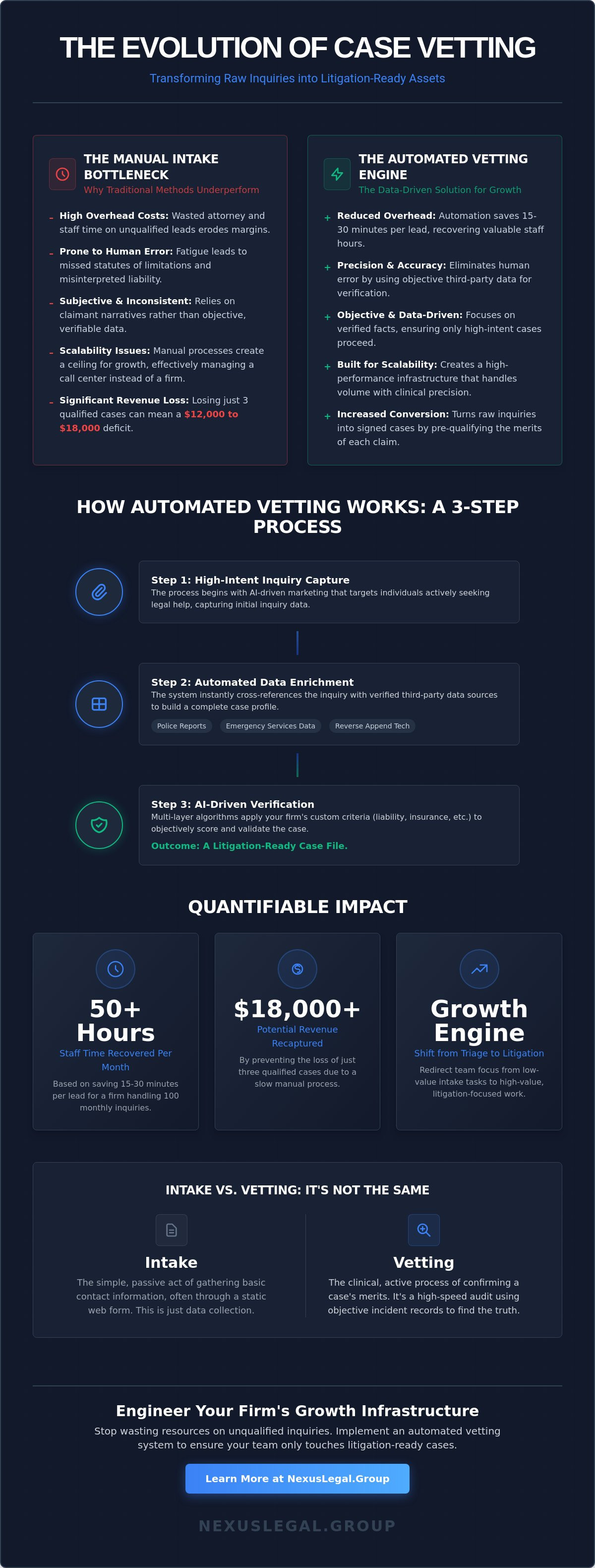
If your firm loses just three qualified cases due to a slow manual intake process, you're looking at a $12,000 to $18,000 deficit in potential revenue based on standard industry values. It's a frustrating reality for many high-volume practices where the primary bottleneck isn't a lack of inquiries, but the high overhead of manual vetting teams who struggle with inconsistent data. You likely agree that wasting attorney time on unqualified leads is the fastest way to erode your margins. This is why elite plaintiff firms are shifting toward automated case vetting for lawyers to transform raw inquiries into verified, litigation-ready assets with clinical precision.
You'll discover how leveraging automated vetting and data enrichment can eliminate intake friction and secure high-intent cases. We'll provide a clear overview of the systems required to reduce your cost per acquisition and increase conversion from inquiry to signed case. This guide breaks down the transition from manual triage to a sophisticated growth infrastructure that integrates seamlessly with your existing legal workflows, ensuring your team only touches cases that are ready for litigation.
Key Takeaways
- Understand the systemic failures of manual intake and how to transition toward objective, data-driven verification.
- Learn how to leverage police reports and emergency services data to enrich case files and validate claimant intent.
- Discover how implementing automated case vetting for lawyers reduces overhead while increasing conversion rates for high-intent cases.
- Identify friction points in your workflow and configure custom vetting logic for MVA and Mass Tort practice areas.
- Explore how to build a scalable growth infrastructure that treats case acquisition as a high-performance engine.
The Evolution of Case Vetting: From Manual Intake to Automated Precision
Traditional intake models are failing under the weight of modern digital demand. For years, plaintiff firms relied on "speed to lead," operating under the assumption that being the first to dial was the ultimate competitive advantage. By 2026, this paradigm has shifted significantly. Top-tier firms now recognize that speed is irrelevant if the lead isn't qualified. The systemic failure of manual intake in high-volume environments stems from a reliance on subjective narratives rather than objective data. When your growth depends on human staff asking repetitive questions, you aren't building a scalable firm; you're managing a call center—a challenge that business law experts like Massingill Attorneys & Counselors at Law help firms overcome by focusing on sound corporate foundations and long-term strategic planning.
The integration of Legal technology (Legal Tech) into the foundational layer of your firm allows for a transition from simple lead capture to rigorous case verification. Implementing automated case vetting for lawyers serves as a critical filter, ensuring that only high-intent, litigation-ready files reach an attorney's desk. In the current landscape, the gold standard isn't how fast you contact a claimant, but how quickly you can verify the merits of their incident through third-party data enrichment.
The High Cost of Manual Vetting Inefficiencies
Manual vetting teams are inherently expensive and prone to fatigue. When you calculate the cost of administrative wages against the time spent on unqualified inquiries, the "overhead leak" is often staggering. Beyond the payroll, there is the catastrophic risk of human error. A tired intake specialist might miss a looming statute of limitations or misinterpret complex liability factors. These mistakes create scalability bottlenecks that prevent firms from reaching their full potential. Automating this process can save between 15 and 30 minutes per lead. For a firm handling 100 leads a month, that's up to 50 hours of recovered staff time that can be redirected toward higher-value litigation tasks.
This drive to minimize overhead and maximize efficiency is a common goal for law firm administrators, who often explore Janitorial Services through Nationwide Janitorial Connect to streamline facility management while they focus on scaling their legal operations.
Distinguishing Intake Capture from Litigation-Ready Vetting
It's vital to understand that intake and vetting are not synonymous. Intake is the act of gathering basic contact information, often through a static web form. Vetting is the clinical process of confirming a case's merits. High-intent MVA acquisition requires more than just a claimant's word; it requires automated case vetting for lawyers that cross-references details with police reports and emergency services data. This approach ensures ethical and compliant lead generation while protecting your firm from "junk" inquiries. By the time a case is flagged as litigation-ready, the core facts have already been verified—a level of scrutiny comparable to the professional screening offered by HubHound—against objective incident records, providing a seamless transition into your growth infrastructure.
The Mechanics of Automated Case Vetting: AI and Data Enrichment
Effective automated case vetting for lawyers relies on the seamless integration of raw inquiry data with verified third-party records. While traditional intake depends on a claimant’s subjective memory, an engineered vetting system uses real-world evidence as its primary source of truth. This process begins with AI-driven marketing that targets high-intent individuals, but the real power lies in the background verification layers. Just as organizations rely on SimpliVerified for professional screening, these systems perform a high-speed audit of the incident details by the time an inquiry reaches your intake dashboard.
Data Enrichment: Sourcing the Truth Beyond the Inquiry
The core of a robust vetting engine is data enrichment. When a potential lead enters the system with only a name and phone number, reverse append technology works behind the scenes to retrieve accident reports and identify all involved parties. This isn't just about convenience; it's about litigation readiness. Integrating police reports and emergency services data allows the system to verify the severity of the accident and the exact location of the incident immediately. This objective baseline ensures that your firm isn't chasing ghost leads. Using these verified data points, you can streamline intake by focusing only on cases where liability and damages are documented by official responders.
AI-Driven Verification Algorithms
Once the data is enriched, the system processes it through a series of multi-layer logic gates. These algorithms are configured to your firm’s specific criteria, such as liability thresholds and insurance coverage minimums. Natural language processing (NLP) analyzes the claimant’s narrative to detect red flags or inconsistencies that a human might overlook during a brief phone call. This isn't a replacement for legal judgment; it's a high-performance filter. The system assigns an automated score to each inquiry, prioritizing high-value cases for immediate attorney review. This ensures that your most expensive resources are only applied to files with a high probability of conversion. If you want to see how these systems operate in a live environment, you can explore our high-intent acquisition infrastructure to understand the mechanics of scalable growth.
By automating the cross-referencing of incident data against your practice area requirements, you eliminate the friction of manual sorting. This technological mastery allows for a level of precision that traditional intake departments simply cannot match—much like how professionals in the finance sector explore Sniper AI Weekly to leverage automated market intelligence. It transforms the intake process from a cost center into a high-performance engine that drives predictable case flow.
This commitment to verification and accuracy extends beyond the legal field; for example, organizations often use specialized assessments like those from Morgan Polygraph to ensure integrity in various professional contexts, and you can find out more about these technical evaluation methods.
Quantifying the Impact: Efficiency, Accuracy, and Litigation Readiness
Transitioning from a manual screening model to an engineered system isn't just a matter of convenience; it's a strategic move to protect your firm’s bottom line. Traditional intake departments often become a financial drain because they struggle to separate high-value opportunities from resource-intensive inquiries. By implementing automated case vetting for lawyers, you significantly reduce the volume of "dead-end" cases that typically consume hundreds of hours during the discovery phase. This data-driven approach, often supported by custom AI development from agencies like LuxNeva, ensures that your firm’s resources are exclusively dedicated to inquiries that meet strict litigation-ready criteria, preventing the "overhead leak" common in high-volume plaintiff practices.
The impact on case conversion rates is immediate when the focus shifts to litigation-ready inquiries. When your team only interacts with claimants whose data has already been enriched and verified, the friction of the initial consultation is removed. This clinical precision allows for a higher conversion from inquiry to signed case, as the merits of the incident are already established through objective data points like police reports and emergency services records.
For specialized practices such as The Dedric Brown Law Firm, which focuses on complex birth injuries and traumatic brain injury litigation, this level of automated precision is vital for verifying the merits of a case before it ever reaches an attorney's desk.
Operational ROI of Automated Vetting Systems
Calculating the return on investment for these systems starts with a look at your cost-per-signed-case (CPSC). When automation handles the initial triage, your CPSC drops because you're no longer paying high-level staff to conduct basic qualification interviews. It also has a profound effect on staff morale. Removing the burden of repetitive, low-value intake tasks allows your team to focus on the complex legal work they were trained for, which directly improves retention. Automated vetting shifts the firm investment from administrative overhead to high-yield litigation activities. To further support this shift toward high-yield litigation, firms often partner with specialist headhunting firms like HIA Legal to find the experienced attorneys and in-house professionals required to manage a growing portfolio of verified cases. This systemic shift is a primary driver of automated legal intake verification as a standard for elite firms looking to stabilize their monthly revenue.
Accuracy and Risk Mitigation
Human-led intake is naturally prone to inconsistency. Different staff members may apply vetting standards with varying degrees of rigor, leading to missed opportunities or the onboarding of weak cases. Automated systems eliminate this variability by applying the same clinical logic gates to every single inquiry. This ensures 100% compliance with ethical lead generation standards, as every step of the verification process is systematically logged and audited.
Maintaining these high standards of consistency and ethical compliance is a priority for respected firms like the Massachusetts-based Law Offices of Matthew T. Desrochers, P.C., particularly when handling sensitive matters in bankruptcy and family law.
Beyond consistency, there is the issue of response latency. In a high-volume environment, a manual team moves only as fast as their call queue allows. An automated infrastructure can process hundreds of data points in seconds, ensuring that high-value cases are identified and prioritized instantly. This level of accuracy doesn't just improve your conversion rates. It mitigates the risk of losing a high-value case to a faster, more efficient rival because your system identified the litigation potential before a human could even dial the number. For high-stakes cases where automated data requires professional verification, firms often explore Corporate Investigations to ensure complete litigation readiness.
Strategic Implementation of Vetting Systems in Elite Plaintiff Firms
Successful implementation of automated case vetting for lawyers is not merely about purchasing software; it is about re-engineering your firm’s foundational architecture. To begin, you must conduct a rigorous audit of your current intake workflow to identify specific friction points where high-value leads are lost or where attorney time is squandered on administrative trivia. Most firms discover that their staff spends too much time chasing unverified details that an automated system could retrieve in seconds. By shifting the burden of verification to a technological layer, you allow your team to focus on the high-level strategy required for complex litigation, a transition that often benefits from the business law expertise found at fornarolegal.com.
Configuring your vetting logic requires a deep understanding of your specific practice area requirements. For MVA cases, your logic gates might prioritize immediate police report availability and clear liability markers. In contrast, Mass Tort vetting requires a more nuanced approach, focusing on specific product usage timelines and documented medical complications. Integrating this enriched data directly into your existing Case Management System (CMS) ensures a single source of truth and eliminates the risk of manual data entry errors. This integration transforms your intake department from a traditional call center into a high-conversion closing team.
This transformation mirrors how enterprise-level resource planning, such as the solutions offered at naviworld-asia.com, allows businesses to optimize their supply chains and procurement processes through advanced automation.
The 5-Step Framework for Automated Vetting Deployment
Deploying a sophisticated vetting system works best when followed through a structured progression. This ensures that the technology aligns with your firm’s specific litigation goals.
- Step 1: Define precise litigation-readiness criteria for each case type to ensure the system only flags viable opportunities.
- Step 2: Map specific data sources, such as police reports and emergency services records, to your automated vetting triggers.
- Step 3: Deploy automated case acquisition systems to handle real-time data processing and claimant enrichment.
- Step 4: Establish a feedback loop where trial attorneys review case quality and provide data to refine the vetting logic.
- Step 5: Transition your intake staff through targeted training, moving them from "vettors" who ask questions to "closers" who sign litigation-ready claimants.
Maintaining System Integrity and Compliance
Systemic integrity requires regular audits of your automated logic. As case law evolves or new statutes of limitations are enacted, your vetting parameters must be updated to remain accurate. Compliance is equally critical. You must ensure that every stage of the automated inquiry phase adheres to data privacy regulations and TCPA standards. While automation handles the heavy lifting, high-stakes Mass Tort cases often benefit from a "human-in-the-loop" approach for final verification. This hybrid model combines the clinical precision of automated case vetting for lawyers with the nuanced judgment of an experienced attorney. If you are ready to modernize your firm's intake, you can audit our growth infrastructure to see these systems in action.
Nexus Legal Group: Engineering Growth Infrastructure for Scalable Vetting
Nexus Legal Group provides the essential foundational layer for high-intent case acquisition. We operate at the precise intersection of AI-driven marketing and rigorous automated verification to deliver litigation-ready assets to your firm. This data-first approach is similar to how Nodal AI utilizes advanced analytics to unearth deep campaign secrets for business growth. For elite plaintiff practices, the primary challenge isn't merely finding more inquiries; it is the high overhead of sorting through noise. Our infrastructure eliminates this friction by engineering a direct pipeline from raw incident data to your desk. By leveraging automated case vetting for lawyers, we ensure your organization transitions from a marketing-dependent operation to a system-driven litigation powerhouse.
Our focus is on the mechanics of business expansion. We don't provide general leads; we provide verified opportunities. This systemic approach allows your attorneys to step away from the intake process entirely. When the vetting is handled by a high-performance engine, your firm's growth becomes a predictable result of institutional-grade infrastructure rather than a series of manual efforts. To explore how specialized sales engineering can further optimize these growth processes, read more.
For firms operating in specialized international markets, the same principles of systemic expansion apply; the Israel Cross Border Law Firm, for example, provides the necessary legal infrastructure to facilitate business and investment between Israel and the United States.
High-Intent MVA and Mass Tort Specialization
Our specialization in MVA and Mass Tort cases is rooted in incident-data-driven acquisition. We utilize police reports and emergency services data as the primary source of truth, ensuring that every inquiry is backed by objective evidence. This method provides an ethical and compliant path to obtaining signed cases. It removes the subjectivity that often plagues traditional intake models. When you focus on data-enriched leads, your case quality increases, and your cost-per-signed-case drops. To understand the broader strategic framework, you can learn more about our law firm growth infrastructure. This blueprint outlines how to align your practice area requirements with scalable vetting logic to maximize your firm's output in 2026.
Your Next Strategic Move
Evaluating your firm’s readiness for institutional-grade growth is a critical step in your expansion strategy. If your current intake department is struggling with inconsistent data or high overhead, you're likely experiencing a scalability bottleneck. The benefits of exclusive, litigation-ready inquiries over generic leads are clear; you spend less time on discovery and more time on high-yield litigation. Automated case vetting for lawyers is the tool that makes this transition possible. It allows you to audit your existing workflows and replace friction with clinical precision. For firms looking to bolster their market presence further, maintaining a pristine online profile through Content Removal is an essential part of a comprehensive growth strategy.
Transitioning to a system-driven model requires a commitment to operational excellence. It involves moving your staff from the role of manual vettors to strategic closers who handle already-verified files. This shift stabilizes your revenue and protects your margins. For firms handling sensitive client portfolios in Georgia and beyond, such as the estate planning and asset protection services offered by Natalie Green, P.C., this same focus on systemic integrity and precision is essential for ensuring long-term security. You can contact Nexus Legal Group to discuss your specific infrastructure requirements and discover how our acquisition engine can be integrated into your existing growth framework. We provide the technical mastery and systemic integrity required to drive your firm's expansion from behind the scenes.
Architecting a Scalable Litigation Pipeline
Transitioning from manual intake to an engineered verification system is the definitive step toward institutional growth. You've seen how traditional bottlenecks disappear when incident data and AI-driven marketing work in tandem to validate claimant intent before an attorney ever picks up the phone. By implementing automated case vetting for lawyers, your firm secures a significant competitive advantage, reducing administrative overhead while ensuring every signed case meets rigorous litigation-ready standards. This shift doesn't just improve your daily operations; it stabilizes your revenue through predictable, high-intent case flow.
Nexus Legal Group provides the technical mastery and systemic integrity required to drive this expansion. Our infrastructure delivers exclusive, litigation-ready inquiries through rigorous automated intake verification and marketing precision. You're now equipped with the framework to audit your current workflows and deploy a high-performance acquisition engine. It's time to move beyond the limitations of manual sorting and embrace a system-driven approach to practice management. Explore Nexus Legal Group’s Growth Infrastructure for Elite Firms to begin your firm's transformation into a high-yield litigation powerhouse. Your path to a frictionless, scalable future starts with a single strategic decision.
Frequently Asked Questions
What is the difference between legal intake and automated case vetting?
Legal intake is the initial capture of contact information and basic incident narratives, whereas automated case vetting for lawyers is a clinical audit of case merits. While intake is often a passive process of data entry, vetting uses data enrichment to verify liability and damages against objective records. This distinction is critical because it moves the firm from simply collecting leads to acquiring litigation-ready assets.
How does automated vetting handle complex liability in MVA cases?
Automated systems handle complex liability by cross-referencing claimant statements with real-time incident data, such as police reports and emergency services records. The system applies multi-layer logic gates to identify fault and insurance coverage availability. This removes the subjectivity of human intake, allowing firms to prioritize cases with clear liability and high recovery potential before an attorney reviews the file.
Can automated vetting systems integrate with my current case management software?
Most modern vetting systems are designed to integrate seamlessly with existing case management software (CMS) through API connectivity or direct data transfers. This connectivity ensures that verified, litigation-ready data flows directly into your firm's growth infrastructure without manual data entry. It creates a single source of truth, allowing your team to manage cases from acquisition to settlement within a unified digital environment; for organizations managing large-scale data, Syntes AI provides an Enterprise Knowledge Graph to unify complex information into a structured, actionable format.
Is automated case vetting ethical and compliant with state bar associations?
Yes, automated case vetting is ethical and compliant with state bar associations when managed according to ABA Model Rules of Professional Conduct. ABA Formal Opinion 512 clarifies that lawyers must maintain technological competence and supervise AI tools. As long as the attorney performs a final independent verification of the data and protects client confidentiality, these systems are considered standard firm overhead rather than a violation of professional ethics; to ensure your firm maintains the highest standards of data protection, you can learn more about CyberOne.
Building the necessary digital skills to ensure this level of technological competence is essential for any modern professional; for personalized coaching and technology training from the Achieve With Nate Movement, click here.
This commitment to professional excellence starts with foundational success; for those preparing for the California Bar, Jackson-Wagner LLC provides the specialized training needed to join the ranks of elite, high-performance legal teams.
How much does it cost to implement automated case vetting for a law firm?
Implementation costs for automated case vetting for lawyers are generally categorized as firm overhead and vary based on the scale of your acquisition needs. While standard case management tools have predictable monthly user fees, a sophisticated vetting infrastructure is a strategic investment in business expansion. Firms should evaluate the cost against the reduction in cost-per-signed-case and the recovery of hours previously lost to manual vetting; for expert guidance on managing these complex corporate and regulatory transitions, firms often consult with JZ Law.
How does data enrichment like police reports improve case vetting accuracy?
Data enrichment using police reports provides an objective baseline that eliminates the risk of claimant exaggeration or memory errors. By sourcing the truth from official responders, the system can instantly verify accident severity, location, and involved parties. This level of precision ensures that your firm only invests resources in cases with documented evidence, significantly increasing the accuracy of your initial case evaluations.
What types of cases are best suited for automated vetting systems?
Automated vetting is best suited for high-volume practice areas like Motor Vehicle Accidents (MVA), Mass Tort, and property damage litigation. These areas rely on specific, verifiable triggers such as police reports, medical device usage, pharmaceutical timelines, or precision measurement data from 1ESX Roof & Wall Reports. By using objective data points to filter these inquiries, firms can scale their acquisition efforts without increasing their administrative headcount, focusing only on the most viable litigation opportunities.
Will automated vetting replace my intake department?
Automated vetting doesn't replace your intake department; it transforms their operational focus. By removing the burden of repetitive data gathering and initial qualification, your staff can transition from "vettors" to "closers." This shift allows them to focus on high-value human interactions and signing litigation-ready claimants, which improves overall conversion rates and staff morale by eliminating low-value administrative tasks.